
The Terapixel Panorama
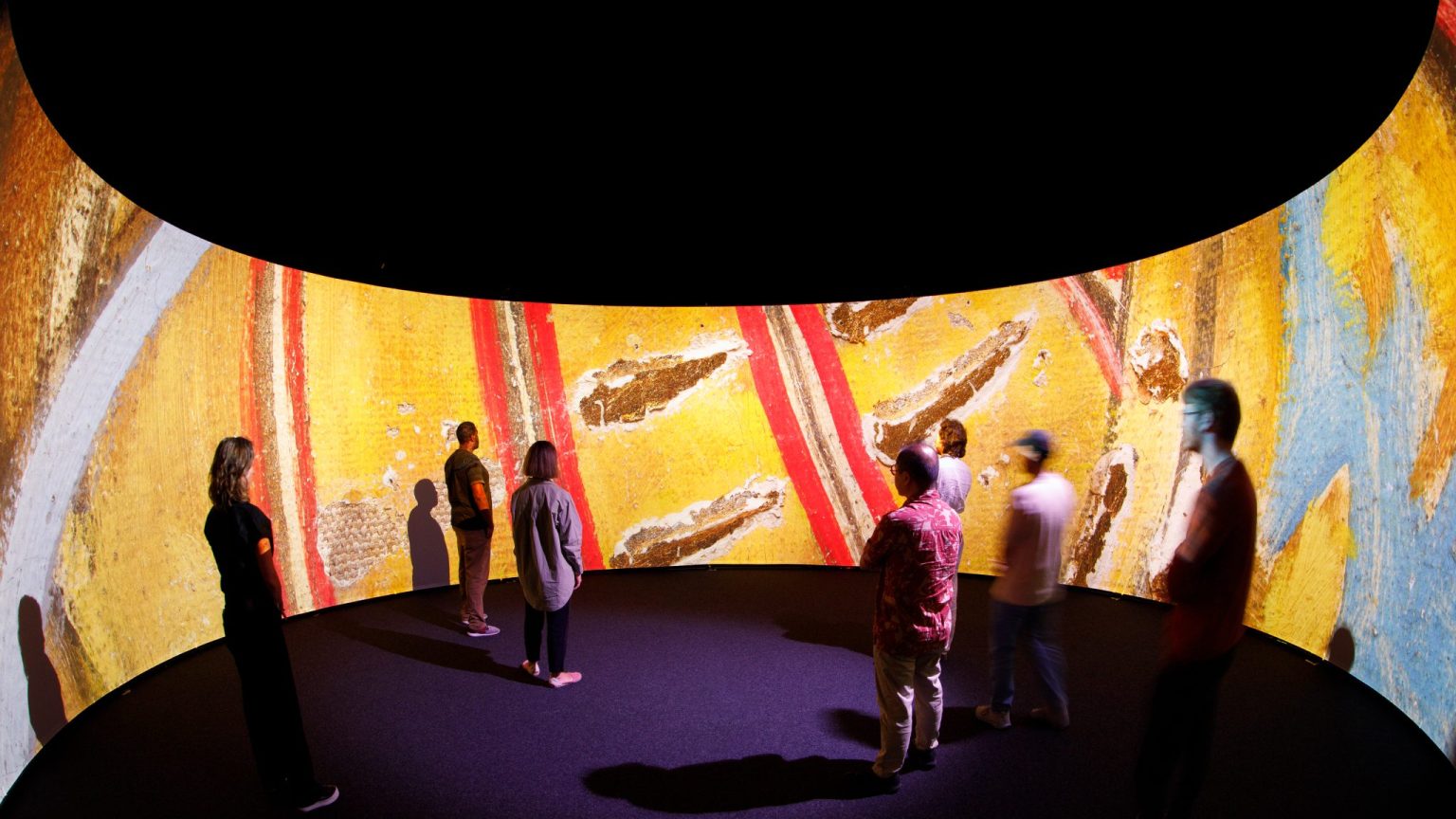
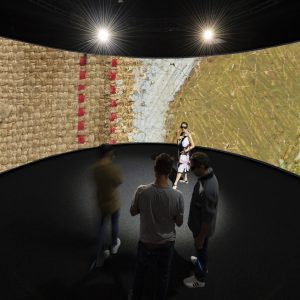
Representation of the Terapixel Panorama in the interactive and augmented 360-degree environment (2025) © Laboratory for Experimental Museology, EPFL
The panorama of the battle of Murten, created by Louis Braun in 1893-94, celebrates a victory that irrevocably altered Swiss and European history. This event has been continuously commemorated, but only once in panoramic display. The panorama represents a late-19th century vision of a Medieval battle instrumental in political discourse. Today, its societal and cultural meaning has changed. The Terapixel Panorama project intends to offer a critical analysis of the 19th-century image and new approaches for cultural interpretation.
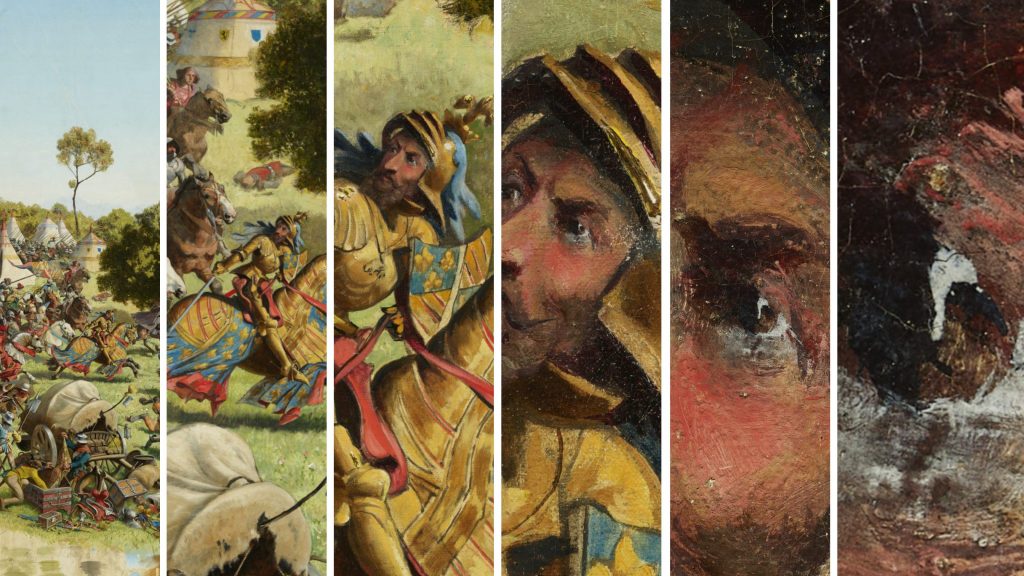
The imaging of this national treasure, a panorama painting spanning 1,000 m2, has produced a 1.6-trillion-pixel digital twin: the largest digital image of a single object ever produced. From this state-of-the-art image, a series of innovative, interactive museum installations will be designed in the context of the 550th anniversary of the Burgundian wars (2026).

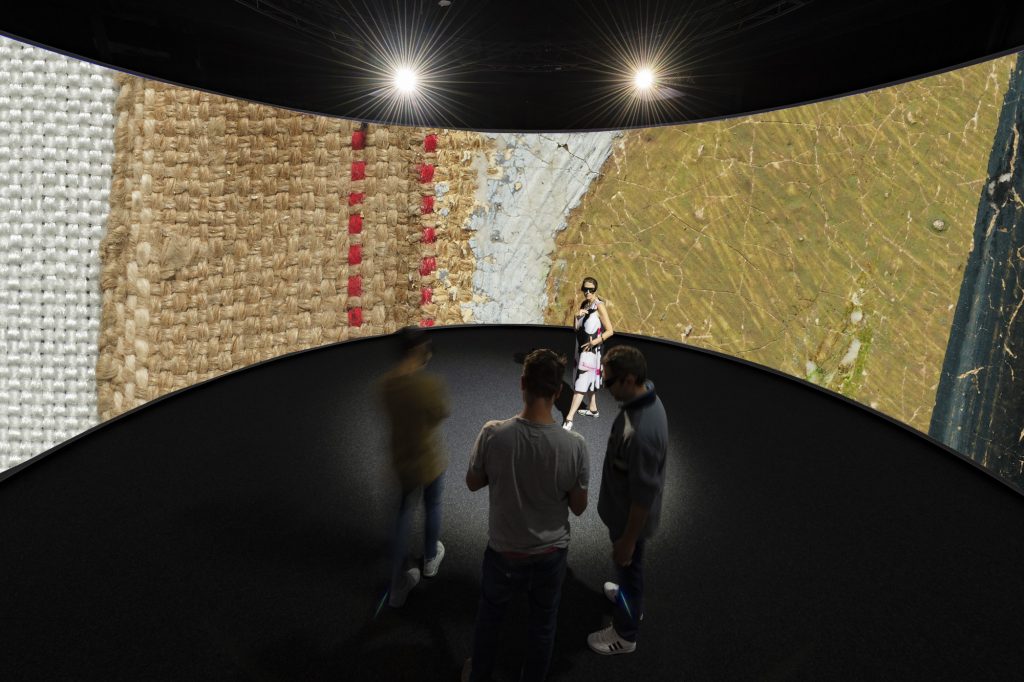
Representation of the digital twin of the Murten Panorama on the system Panorama+. Image credits: eM+
Presentation of the research project by Prof. Sarah Kenderdine and Dr. Daniel Jaquet
The object
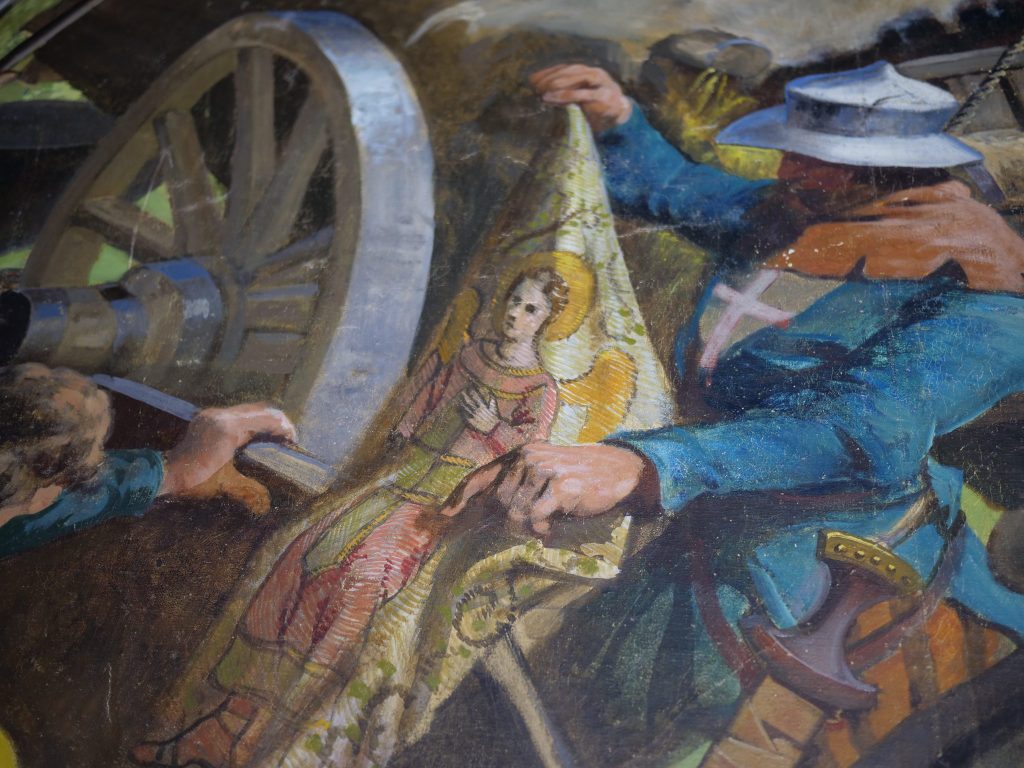
The painting depicts the moment Swiss Confederates gained the upper hand against the Duchy of Burgundy during its 1476 invasion, a turning point in European history. Commissioned by a Swiss society specialized in public entertainment, the panorama was the main media of the end of the 19th c. The artist, Louis Braun, was a famous painter of German military history. Braun and his team produced this work measuring 10 x 100 m in 1893. It was on display in Zurich, then Geneva (1894-1907), before falling in oblivion behind the new media of the cinema. Rediscovered in 1996, it was restored and put on a brief display for 4 months during Expo.02 (2002) in a monolith built by Jean Nouvel on the Murten lac. Since then, it remained rolled up in a Swiss Army deposit.

The imaging process
For a full description see the making of the digital twin
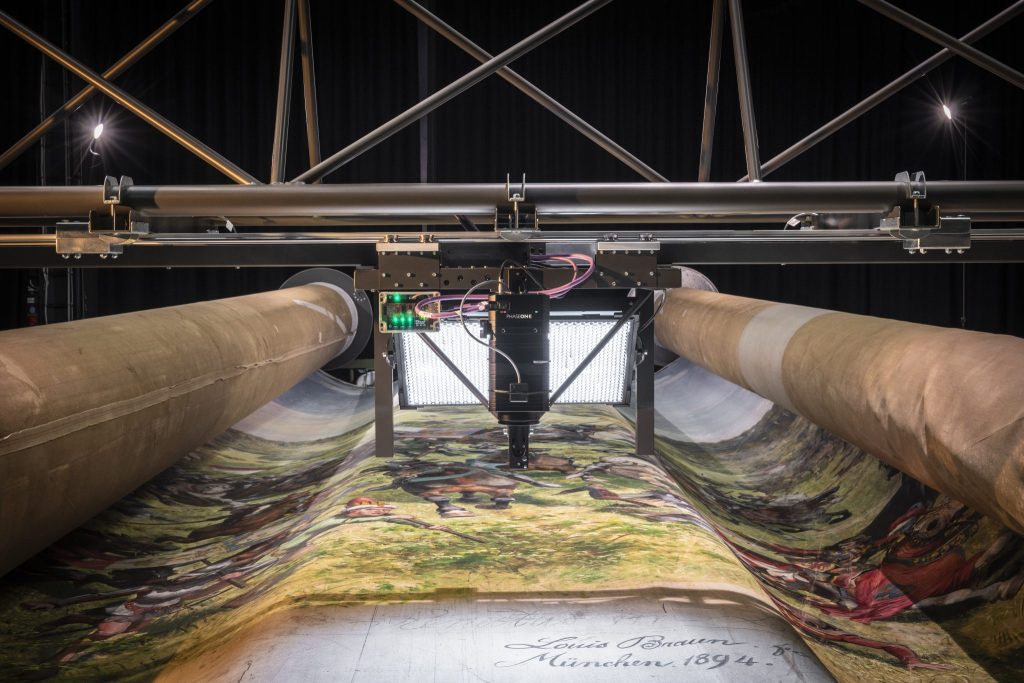
In June, 2022, the panorama of the battle of Murten was transported to the EPFL Laboratory for Experimental Museology. The design of the custom-built inspection platform ran parallel to the first inspections and tests (August-December 2022). The conservation of the 3 rolls was performed parallel to the design and production of the scanning rig (January-June 2023). The scanning process took place between August and October 2023, after which the panorama was returned to its storage location. The post-processing of the image data and first tests took place in November – January 2024.
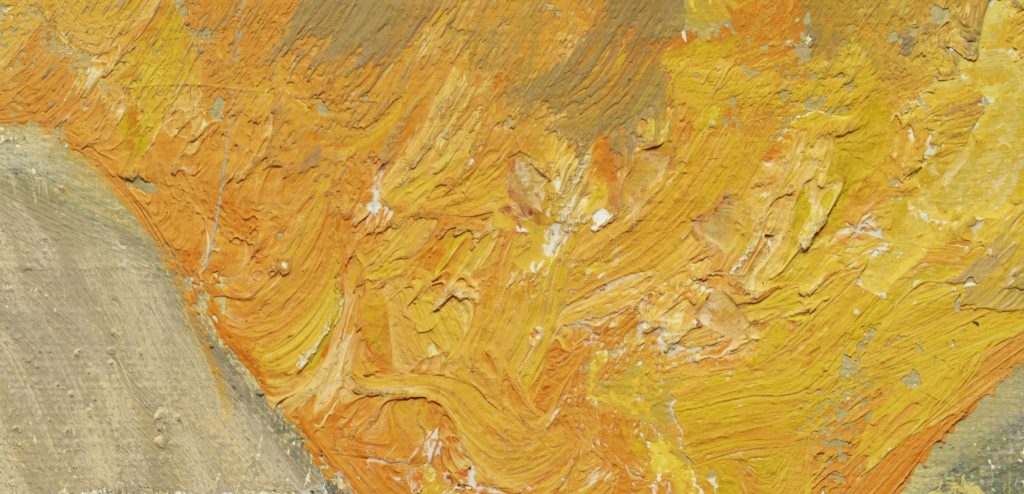
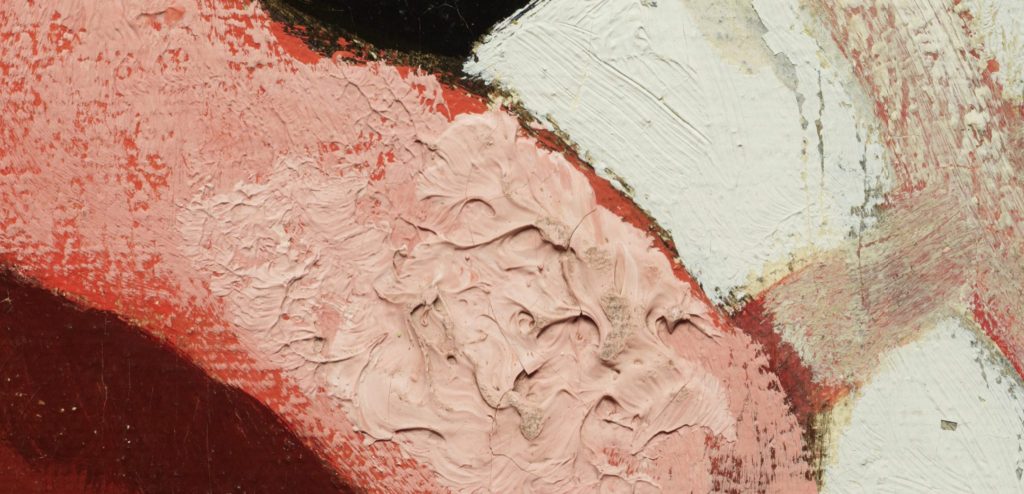
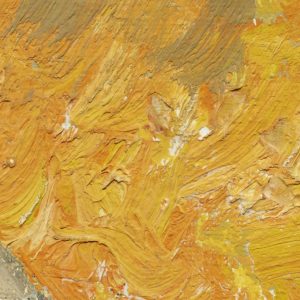
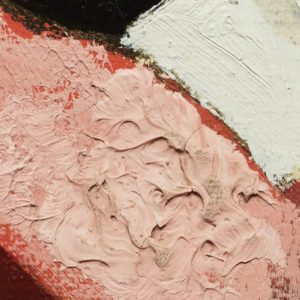
The imaging, provided by camera systems manufacturer, Phase One, took advantage of an iXH 150-megapixel camera with a 72mm lens specifically built for high-resolution digitization projects. The process took four months, capturing 27,000 images within and beyond the RGB (red, green, and blue) color spectrum. The challenges of producing an image of 1.6 terapixel with high color fidelity at a resolution of 1000 dots per inch are both physical and technical.
Physical challenges include capturing a flawless 2D picture despite irregularities on the canvas’s surface. The original canvas is also hyperboloid in shape, as it was intended to be installed vertically for display in a rotunda (spherical building/room). The painting has therefore been carefully ‘spooled’ across a substrate to ensure smooth image capture.
The challenges posed by the size, quality and high technological aspects of the digital twin are the subject of scientific research and experimentation during the imaging phase. They allow for scientific contributions in the fields of data science, conservation, and historic panoramas. It includes the use of block chain technologies, the post-processing of stitched images, and digital conservation. More information can be found on the publications related to the project.

Augmentation of the panorama (2024-2026)
The scanning of the Battle of Murten Panorama canvas gives rise to a range of interpretation projects from ultra-high resolution streaming online, to highly significant situated experiences of the panorama akin to what the original experience would have been like but with the aid of spectacular software initiated interactive audio visual effects. From August 2025 to May 2027, a series of exhibitions at the Museum für Gestaltung Zürich, Museum Murten, Bernisches Historisches Museum, Château de Grandson, and other international venues, invite the visitors to a multisensory immersive experience of the 19th-century panoramic painting.
Additional datasets
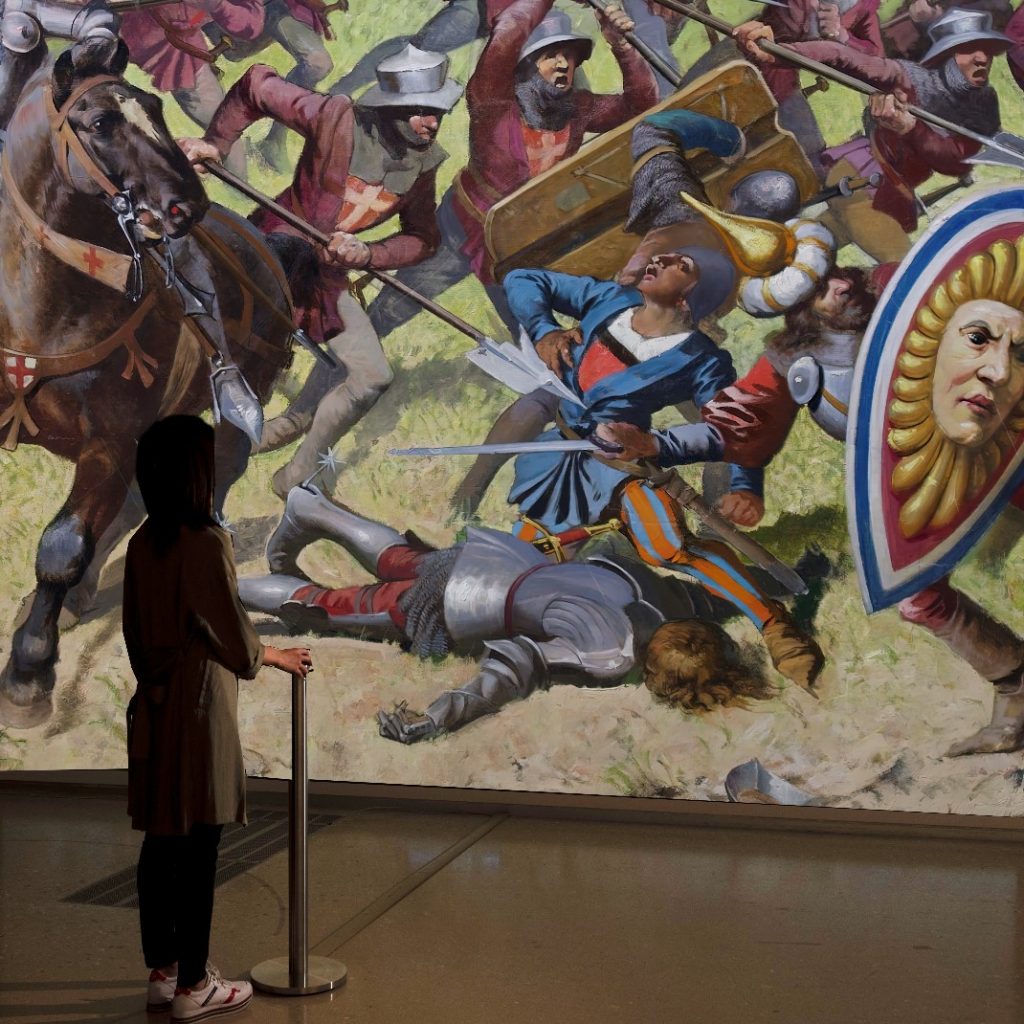
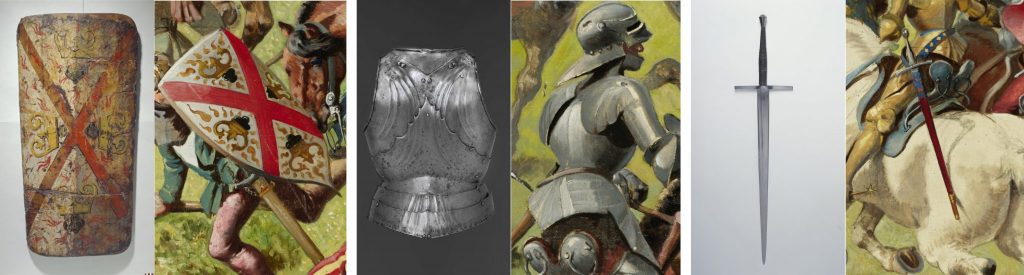
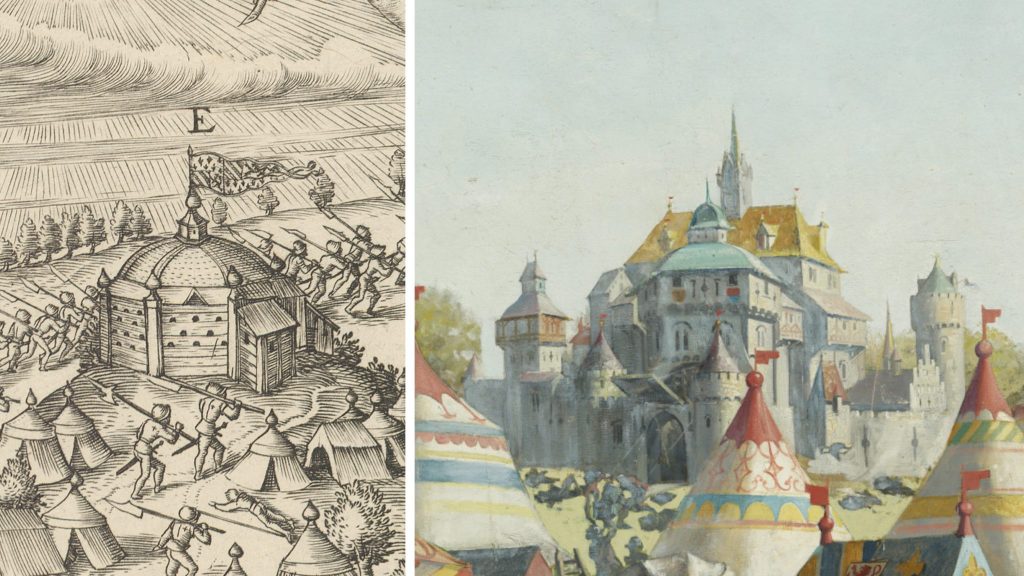
Next to the zooming and panning options available at an unprecedented resolution, additional content will be produced to enrich the digital twin. It will guide public access to and understanding of the artwork. These augmentations are superimposed on the original image. Additional datasets will include 3D models of objects, volumetric videos, and motion capture of scenes in the painting, situated within a historically informed soundscape based on research into Medieval chronicles, letters, narrative literature, and other archival documents that mention sound in battles. Research into the material culture evidenced in the panorama has identified dozens of related artifacts held in Swiss museums, such as costumes, weapons, or accessories. Synthetic smells diffused on experimental devices will allow the exploration of the fragrant environment of the battlefield.
The Terapixel Panorama website
Launched on June 22, 2025 — marking the anniversary of the Battle of Murten — the website is key to transmit and deepen engagement with both the exhibitions and the 2026 Burgundian wars commemorations. The digital twin is displayed at the highest resolution supported by web browsers. The website features other content from the exhibition system version such as 3D models, volumetric videos of reenactors, and a 2D video of the installation being experienced live by visitors. The project database is made available through Linked Open Data related to the digital twin (links and metadata to images and text). It includes a selection of primary sources connected to both the history of the panorama and the context of the battle of Murten. This includes all the recently digitized preparatory drawings by Louis Braun and archives related to the production of the panorama, as well as an augmented edition using Text Encoding Initiative (TEI) standards of the collection of primary sources by Ochsenbein (1876). Enabled by semantic web technologies and IIIF manifest, data can now be curated down to the image region level.

Exhibitions
- Geneva International Film Festival (GIFF)
Dates: 1–10 November 2024
Venue: GIFF, Geneva
System: 5-metre wide back-projected screen
Context: group exhibition
- Swiss Month, Hong Kong (Swiss Consulate in Hong Kong)
Dates: 9–11 November 2024
Venue: Hong Kong Baptist University, Visualization Research Centre
System: 9-metre diameter, 360-degree interactive LED system
Context: standalone installation
- Museum für Gestaltung Zürich
Dates: 29 August 2025 – 1 February 2026
Opening reception: Thursday, 28 August, 19:00–22:00
Venue: Museum für Gestaltung Zürich (Ausstellungsstrasse 60)
System: 9-metre-wide, 120-degree interactive projection system
Context: group exhibition Museum of the Future — 17 Digital Experiments
- Festival international du film d’archéologie de Nyon (FIFAN)
Dates: 2–7 September 2026
Venue: Nyon
System: 5-metre wide back-projected screen
Context: group exhibition
- Swissnex San Francisco
Dates: 3 November – 12 December 2025
Venue: Swissnex, Pier 17, San Francisco, USA
System: 6-metre diameter, 360-degree interactive Panoramic Navigator
- Museum Murten
Dates: 14 February – 19 April 2026
Venue: Museum Murten, Murten
System: interactive projection mapping
Context: projection installation integrated into the Museum architecture
- Bernisches Historisches Museum
Dates: 25 February 2026 – 9 May 2027
Venue: Bernisches Historisches Museum, Bern
System: 360-degree interactive projection system
Context: main installation in the exhibition The Battle of Murten. Staging a Victory
- Castle of Grandson
Dates: September – November 2026
Venue: Castle of Grandson, Grandson
System: 6-metre diameter, 360-degree interactive Panoramic Navigator
Context: standalone installation in the exhibition Grandson – Morat 1476-2026


Project Team
Lead: Prof. Sarah Kenderdine
Computational photography expert: Dr. Paul Bourke
Project manager & military historian: Dr. Daniel Jaquet
Senior project manager: Jean-Pierre Chabrol
Software engineers: Samy Mannane, Loïc Serafin, Nikolaus Völzow and Adriano Viegas Milani
Conservation and scanning platform engineers: Nelissen Decorbouw (Huib Nelissen, Jaap Leutscher)
Scan rig drive system integration and control software: Nikolaus Völzow
Sound: Composition Prof. Paul Doornbush, Integration Eric Larrieux
Hardware Technician: Taras Debera and Ryan Jones
PhD researcher: Raphael Tsz-Kin Chau
Researcher: Tonia Ramogida
Science communicator: Dr. Marinella Sofia Gkinko
Administrative Coordinator: Stéphanie Romon
Conservation: Olivier Guyot (lead), Béatrice Claveland, Maïlys Chopard
Integration of display platform at Bern Historisches Museum: Immersive Realisation (Damian Leonard)
Contributors
Preparatory drawings of the Panorama: Hällisch-Fränkischen Museum, Panorama Einsiedeln, and Murten Museum
Objects: Bernisches Historisches Museum, Bern and Landes Museum, Zurich
3D Model Post-Production: ArchonVR
3D scan technician: Benjamin Padernoz
3D Historic Costume Research & Realisation: Prof. emerita Kathi Martin, fashion and textile designer and costume historian, Drexel University, and Momo Jawwad, digital artist and digital fashion specialist
Volumetric capture of reenactors: 4D Views , Grenoble
Smells: dsm-firmenich
Smell necklaces: ScentRealm
Platform engineering Panoramic Navigator: Countdown Company
Reenactors: Adrian Jain, Etienne von Günten, Bob Davet, Sonja Blatter, Stefan Kern, Aaron Himmler, Samuel Monbaron, Daniel Jaquet
Terapixelpanorama.ch Project:
Storytelling & Content: Dr. Marinella Sofia Gkinko, Tonia Ramogida, and Dr. Daniel Jaquet
UX & Web Development: Boojum
Visual Design website: Shapeless
IIIF Image API: Raphael Tsz-Kin Chau
Hosting: EPFL XaaS
Voice Recordings – Guided Tours: EPFL Audiovisual Service
Audio Descriptions: Audio Description Network
Translations: textocreativ and eM+
Acknowledgements
A research project of the EPFL Laboratory for Experimental Museology, in partnership with the Foundation for the Panorama of the Battle of Murten, custodian of the original painting.
Supported by Phase One.
Funded by the Swiss National Science Foundation, Loterie Romande (Fribourg), Loterie Romande (Conférence des Présidents des Organes de Répartition), Loterie Romande (Vaud), Municipality of Murten, Canton of Fribourg, Federal Office for Culture, Association of the Friends of the Panorama, Foundation Etrillard, Ernst Göhner Stiftung, Stiftung für Kunst, Kultur und Geschichte, UBS Culture Foundation, Association Suisse d’Histoire et de Sciences Militaires, Hong Kong Baptist University ITC, and HK Innovation Technology Fund.
The Terapixel Panorama Project was awarded an Optimus Agora Prize in 2024.
EPFL Press releases
EPFL lab to digitize 1,000m2 ‘Swiss national treasure’ (July 2022)
The Digitisation of the Panorama of Murten is about to start (April 2023)
The Panorama of the Battle of Murten becomes an immersive experience (June 2025)
Media coverage
Press review (last updated November 2023)
Gobbo, S. (2024, November 6). ‘La bataille de Morat, comme si vous y étiez; «On passe du tumulte de la bataille au son du pinceau»‘. Le Temps.
‘Le GIFF expose à Genève la version numérique du fameux panorama de la bataille de Morat‘. (2024, November 7). Radio Télévision Suisse.
Rhône FM : Le Panorama de la Bataille de Morat comme expérience immersive (22 June 2025)
La Liberté : La bataille de Morat, comme si vous y étiez! (22 June 2025)
Freiburger Nachrichten : Schlachtpanorama lässt sich online sinnlich erleben (22 June 2025)
Zürichsee-Zeitung : Virtuelles Schlachtpanorama (23 June 2025)
Tages-Anzeiger : Virtuelles Schlachtpanorama (23 June 2025)
RTS La 1ère / La Matinale / Journal 6h / Journal 6h30 : Le panorama de la bataille de Morat numérisé par l’EPFL (8:00-8:44) (23 June 2025)
Der Landbote : Virtuelles Schlachtpanorama (23 June 2025)
Der Bund : Virtuelles Schlachtpanorama (23 June 2025)
Basler Zeitung : Virtuelles Schlachtpanorama (23 June 2025)
RTS La 1ère / Journal 10h / CQFD – Une expérience immersive de la Bataille de Morat (24 June 2025)
Solothurner Zeitung – Das Panorama der Murtenschlacht ist digitalisiert (24 June 2025)
swissinfo.ch – EPFL launches digitised version of Battle of Murten panorama (24 June 2025)
Talks
Ramogida, T. (Forthcoming, 2025). ‘Olfactory Research Notes: Terapixel Panorama and Olfactory Art.’ Institute for Art and Olfaction, Los Angeles, United States of America. Invited talk.
Ramogida, T. (2025). ‘Immersive Research Sessions: No. 2.’ Velaslavasay Panorama. Los Angeles, United States of America. Invited talk.
Publications about the project
Ramogida, T., & Kenderdine, S. (Forthcoming, 2025). ‘Scenting Heritage: Real-Time Olfactory Augmentation.’ 2025 Digital Heritage, Siena, Italy.
Chau, TK., Kenderdine, S. (2025). ‘Historicizing Controlled Vocabularies in Digital Humanities: A Lightweight Context-Indexed Extension for Vocabulary Systems.‘ ADHO Digital Humanities Conference 2025 (DH2025), Lisbon.
Ramogida, T. (2025). ‘Panorama: IPC 2024 Post-Conference Tour.’ Panoramic and Immersive Media Studies Yearbook 2. DOI: 10.1515/9783111695754-021
Ramogida, T., Jaquet, D., & Kenderdine, S. (2025). ‘Panoramas as Memory of the World: Perspectives from the 33rd IPC Conference Hosts.’ Panoramic and Immersive Media Studies Yearbook 2. DOI: 10.1515/9783111695754-022
Chau, TK., Kenderdine, S. (2025). ‘Embodying Scholarly Annotations in the Network of Digitized Archives.‘ Proceedings for IS&T Archiving conference 2025. DOI: https://doi.org/10.2352/issn.2168-3204.2025.22.1.23
Chau, T. K., Jaquet, D., & Kenderdine, S. (2024). ‘Towards an Annotation Data Model for a Scholarly Semantic Annotation Platform in Visual Heritage: A Case Study Using the Murten Panorama.‘ In CEUR Workshop Proc (Vol. 3809).
Chau, T. K., Jaquet, D., & Kenderdine, S. (2024). ‘Unveiling Historical Depth: Semantic annotation of the Panorama of the Battle of Murten.’ 33rd International Panorama Council Conference, Lausanne, Switzerland. Book of Abstracts: https://panoramacouncil.org/pics/files/IPC2024_digital_package.pdf.
Chau, T. K., Jaquet, D., & Kenderdine, S. (2024). ‘Developing an Ontology for Intricate Visual Content Annotation: Experience from the Panorama of the Battle of Murten.’Digital Humanities 2024: Reinvention & Responsibility, Arlington, Virginia, United States of America.
Chau, T. K., Jaquet, D., & Kenderdine, S. (2024). ‘Augmentation of the Panorama of the Battle of Murten (1893) – Experimental Annotation System for the World Largest Digital Image of a Single Object.’ Open Up Digital Editions Conference, Zurich, Switzerland.
Deicher, P., Koller, G., & Jaquet, D. (trsl) (2024). ‘Historic Panoramas of the World: The Fascination of a Visual Mass Medium of the 19th and Early 20th Centuries.’ Lucerne: Bourbaki Panorama Museum.
Jaquet, D., & Kenderdine, S. (2024). ‘The Digitization of the Murten Panorama: Notes on the Creation of the World’s Largest Image’. Panoramic and Immersive Media Studies Yearbook 1. DOI: 10.1515/9783111335575-022
Chau, T. K., Bourke, P., Hibberd, L., Jaquet, D., & Kenderdine, S. (2024). ‘Cultural Big Data: Nineteenth to Twenty-first Century Panoramic Visualization’. Frontiers in Big Data: Data Mining and Management 7. DOI 10.3389/fdata.2024.1309887
Serenko, I. (2024). ‘Augmenting the Panorama of the Battle of Murten with 3D Models of Cultural Artifacts.’ MA Thesis: EPFL, Lausanne, Switzerland.
Jaquet, D. (2021). ‘Le Panorama de la bataille de Morat version 2.0‘. Annales Fribourgeoises 83(2): 49‑53.
Jaquet, D., & Kenderdine, S. (2020). ‘The Murten Panorama, from 2D to 4D’. International Panorama Council Journal 3: 102–9.
Panoramic media and theory
Books
Kenderdine, S. (2013). Place-Hampi: Inhabiting the panoramic imaginary of Vijayanagara, Heidelberg: Kehrer Verlag.
Frank, I., Feneley, M., Kenderdine, S. & J. Shaw (2021), The Atlas of Maritime Buddhism. Hong Kong: City University Press.
Chapters
Kenderdine, S. (2021). ‘Experimental museology: Immersive visualization and cultural (big) data’, in (eds) M. Achiam, M. Haldrup and K. Drotner, Experimental Museology Institutions, Representations, Users. Abingdon: Routledge: 15-34.
Kenderdine, S. (2020). ‘Omnidirectional Strategies for Exploring Ancient Cities and Territories’, in M. Forte & H. Murteira (eds.), Digital Cities: Between History and Archaeology. Oxford: Oxford University Press, 185-206.
Kenderdine, S. (2016). ‘Embodiment, entanglement and immersion in digital cultural heritage’ in S. Schreibman, R. Siemens & J. Unsworth (eds.), A New Companion to Digital Humanities. John Wiley & Sons Ltd, 22–41.
Kenderdine, S. & J. Shaw. (2014) ‘A Cultural Heritage Panorama: Trajectories in Embodied Museography’, in H. Din and S. Wu (eds), Digital Heritage and Culture – Strategy and Implementation, Singapore: World Scientic Publishing Co: 197-218.
Kenderdine, S., Shaw, J. & T. Gremmler, T. (2012) ‘Cultural Data Sculpting: Omnidirectional Visualization for Cultural Datasets’, in F.T. Marchese and E/ Banissi (eds), Knowledge Visualization Currents: From Text to Art to Culture. London: Springer-Verlag: 199-221.
Kenderdine, S. (2007) ‘Speaking in Rama: Panoramic Vision in Cultural Heritage Visualisation’, in F. Cameron and S. Kenderdine (eds), Theorizing Digital Cultural Heritage: A Critical Discourse. Cambridge: MIT Press: 301-332.
Kenderdine, S., J. Shaw, D. del Favero & N. Brown. (2007). ‘Place-Hampi: Co-Evolutionary Narrative and Augmented Stereographic Panoramas, Vijayanagara, India’, in (eds) Y. Kalay, T. Kvan and J. Affleck, New Heritage: New Media and Cultural Heritage. Abingdon & Oxford: Routledge: 336-352.
Journals
Kenderdine, S. (2021). ‘Prosthetic architectures of the senses: museums and immersion’, in (eds) M. Beugnet & L. Hibberd, dossier: ‘Absorbed in Experience: new perspectives on immersive media’, Screen 61(4): 635-645.
Kenderdine, S. & T. Hart. (2014). ‘mARChive: Sculpting Museum Victoria’s Collections’, Museums and the Web: Proceedings, 2-5 April 2014, Baltimore.
Kenderdine, S. & Lancaster, L. (2014). ‘Cultural Data Sculpting: The Tripitaka Koreana’, in Nhat Tur, Đuc Thien and Lancaster, L (eds), Proceedings of Buddhist Culture and Technology: New Strategies for Study, Ninh Binh: Vietnam Buddhist University.
Kenderdine, S. (2013). ‘Pure Land: Inhabiting the Mogao Caves at Dunhuang’, Curator: The Museum Journal 56(2): 199-118.
Kenderdine, S. & Hart, T. (2011) ‘Cultural Data Sculpting: Omni-Spatial Visualization for Large Scale Heterogeneous Datasets’, in Museums and the Web 2011: Proceedings, Philadelphia, 6-9 April.
Kenderdine, S., Lancaster, L., Lan, H. & Gremmler, T. (2011). ‘Omnidirectional 3D Visualization for the Analysis of Large-Scale Textural Corpus: Tripitaka Koreana’, in Proceedings of The Second International Conference on Culture and Computing, Kyoto: IEEE, pp. 27-32.
Kenderdine, S. (2010). ‘PLACE-Hampi, Ancient Hampi and Hampi-LIVE: An Entanglement of People- Things’, in M. Forte (ed.), Cyber-Archaeology, British Archaeological Reports, Oxford: Bar Publishing, pp. 47-62.
Kenderdine, S., Shaw, J. & Kocsis, A. (2009). ‘Dramaturgies of PLACE: Evaluation, Embodiment and Performance in PLACE-Hampi’, in Proceedings of the International Conference on Advances in Computer Entertainment Technology, Athens: ACM, pp. 249-56.
Kenderdine, S. (2008). ‘An entanglement of people-things: Place-Hampi’, International Journal of Digital Cultural Heritage and E-Tourism (IJDCE): .139-156.
Kenderdine, S. (2007). ‘The Irreducible Ensemble: Place-Hampi’, in Proceedings of Virtual Systems and Multimedia (VSMM) 13th International Conference, Brisbane, in Revised Selected Papers Series: Lecture Notes in Computer Science, 4820, Berlin: Springer, pp. 58-72.
Kenderdine, S. (2007). ‘Somatic Solidarity, Magical Realism and Animating Popular Gods: Place-Hampi “Where Intensities Are Felt”’, in Proceedings of the 11th European Information Visualisation Conference, Zürich: IEEE, pp. 402-408.
Kenderdine, S. (2004). ‘Stereographic Panoramas of Angkor, Cambodia’, in Proceedings: Virtual Systems and Multimedia (VSMM) 10th International Conference, Gifu: IOS Press, pp. 612-621.
Doornbusch, P. & Kenderdine, S. (2004). ‘Presence and Sound: Identifying Sonic Means to “Be There”’, in Proceedings of Consciousness Reframed, Beijing, pp. 67-70.