
The following student projects are currently available at EESD. If you are interested in any of the projects, please contact the person indicated in the project description. The scope and duration of each project can be tailored to your study program and research interests.
Project types:
- Bachelor projects
- Semester projects
- Master projects
Bachelor projects
Brief description:
This project involves selecting a building in Switzerland scheduled for renovation or demolition. The goal is to perform a survey to document its structural system, materials, and key structural details and to discuss qualitatively weak points of the structure to various types of loads. In addition, some quantitative assessments will be performed.
Tasks:
- Selection of case-study building.
- Gather available background information (e.g., architectural plans, construction period, materials, renovation history).
- On-site survey and documentation.
- Identification of the structural system.
- Qualitative discussion of weak points of the structure to various types of loads; possibly some quantitative assessments.
- Reporting and presentation.
Contact:
Savvas Saloustros ([email protected])

Brief description:
Reinforced concrete is the predominant construction material in Switzerland and worldwide. Working in groups of two, you will design the structural system of a regular multi-storey building that ensures load transfer from the superstructure to the foundation system.
Contact:
Katrin Beyer ([email protected])

Brief description:
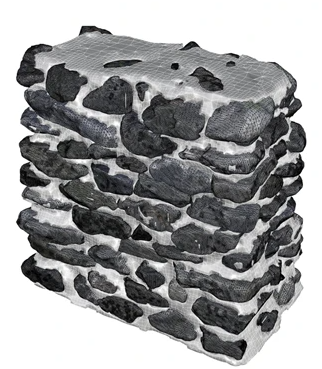
This project focuses on generating geometrical digital twins of rubble stone masonry walls using an existing image-based processing pipeline. The student will use already available datasets to reconstruct wall geometry, extract individual stones, and refine digital models for subsequent numerical analyses. In addition, the project will explore automating the detection and correction of stone collisions currently handled manually.
Tasks:
- Generate geometrical digital twins of stone masonry walls using the existing image-based pipeline.
- Detect and correct stone collisions, exploring options to automate this process.
- Document the workflow and suggest improvements for accuracy and efficiency.
- Compute and analyze masonry quality indices to evaluate wall geometry and construction quality.
Contact:
Mati Ullah Shah ([email protected])
Savvas Saloustros ([email protected])
Katrin Beyer ([email protected])

Semester projects
Brief description:
We are developing a practical modeling framework for a wall constructed with demolition pieces. This is achieved using an efficient remeshing to represent the irregular microstructure obtained from point clouds as well as a new point cloud compression scheme. In this scheme, the point cloud data is saved as a set of expansion coefficients from the (hemi-) spherical (cap) and/or disk harmonics. There is no need for storing the surface data (vertices, lines, and faces) explicitly as we can retain such information from the reconstruction stage of the spectral method for any required resolution. Each individual demolition unit is stored as a coefficient corresponding to the most appropriate harmonic bases, which depends on the overall element topology.
Supervisors:
Hnat Lesiv, Katrin Beyer

Brief description:
Geometrical digital twinning of structures such as stone masonry walls demands robust and accurate 3D registration. The quality of the digital twin depends on how well key features can be extracted and matched from images. Traditional methods like SIFT, SURF, and ORB have been used for years, but they often struggle in difficult conditions such as low texture, extreme viewpoint changes, or varying lighting. Deep learning approaches like SuperPoint and D2-Net offer a more advanced solution by learning key point detection and description end-to-end, making them more reliable and precise.
In this project, we will implement and compare these methods for 3D reconstruction, evaluating their accuracy, robustness, and efficiency. The goal is to improve the fidelity of geometrical digital twins for applications in structural analysis, heritage conservation, and automated construction.
Tasks:
- Implement and compare traditional (SIFT, ORB) and deep learning (SuperPoint, D2-Net) feature matching methods.
- Integrate both methods into a 3D reconstruction and geometrical digital twinning pipeline.
- Evaluate performance based on accuracy, robustness, and computational efficiency.
Contact:
Mati Ullah Shah ([email protected])
Savvas Saloustros ([email protected])
Katrin Beyer ([email protected])
Brief description:
Experimental investigation of the erosion properties of earthen materials (Freeze-thaw cycles, wind, rain).
Tasks:
- Perform erosion simulation tests on earthen construction materials (rammed-earth, compressed earth blocks)
- Estimate influence of soil composition on erosion properties.
Contact:
Savvas Saloustros ([email protected])
Yuhan Zhu ([email protected])
Katrin Beyer ([email protected])

Brief description:
Numerical modeling and uncertainty assessment of a building that has been experimentally tested on a shake table. Through this exercise, students will gain practical experience in model calibration, uncertainty interpretation, and validation of simulation results against experimental evidence.
Tasks:
- Develop a structural model (equivalent framer model) of the selected building.
- Simulate its seismic response, and compare the results with available experimental measurements and observations.
- Identify and interpret the main sources of discrepancy between simulated and observed behavior.
- Understand how these uncertainties affect the reliability of predictions.
Contact:
Mathias Haindl ([email protected])
Katrin Beyer ([email protected])
Brief description:
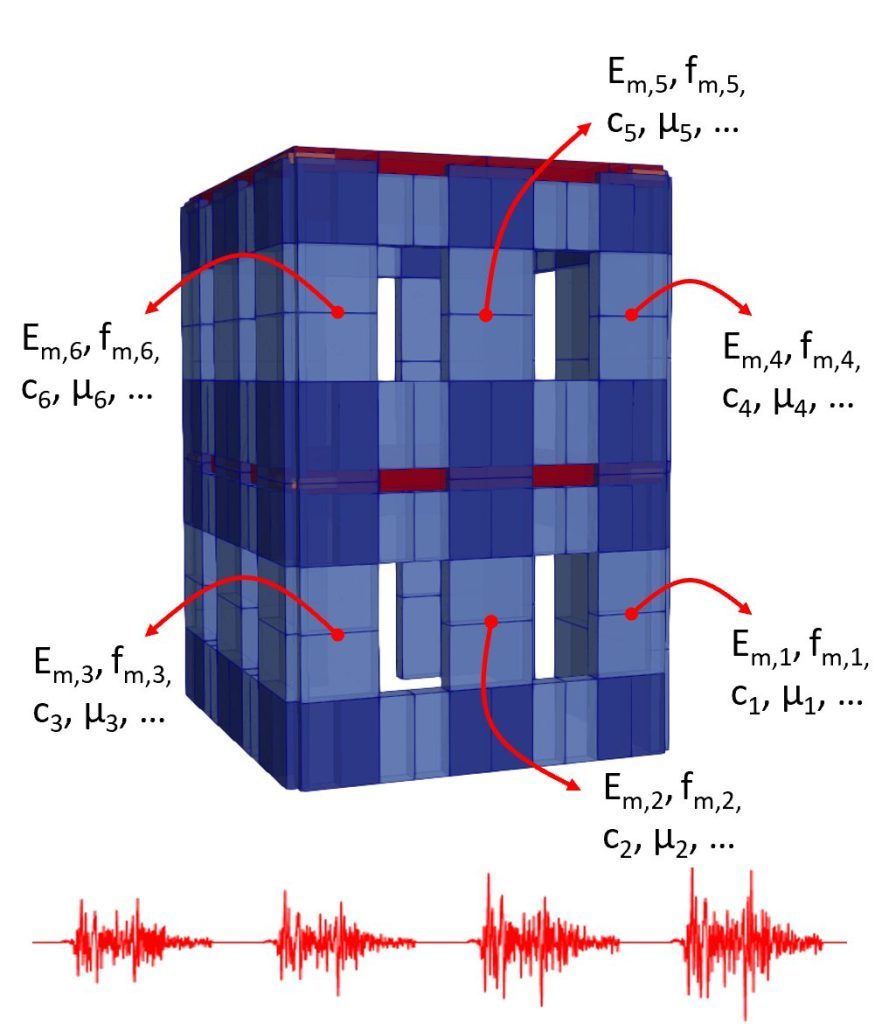
Apply an optimization-based rigid block model to building-level analysis
Tasks:
- Understand the optimization-based rigid block modeling method and learn how to use it from the Python interface.
- Limit analysis and pushover analysis of the case study.
Contact:
Qianqing Wang ([email protected])
Katrin Beyer ([email protected])
Brief description:
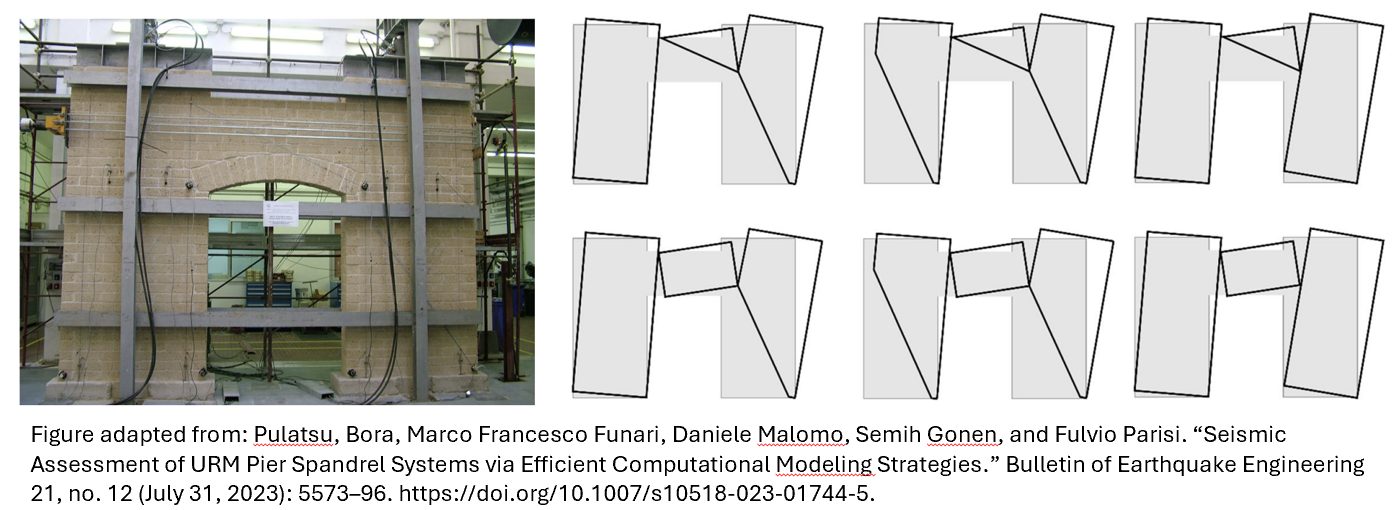
Apply an optimization-based rigid block modeling method to simulate pier spandrel systems* with macro elements.
(*Other case studies are also available)
Tasks:
- Identify possible failure mechanisms and discretize the structure with macro elements.
- Understand the optimization-based rigid block modeling method and learn how to use it from a Python interface.
- Limit analysis and pushover analysis of the case study.
Contact:
Qianqing Wang ([email protected])
Katrin Beyer ([email protected])
Master projects
Brief description:
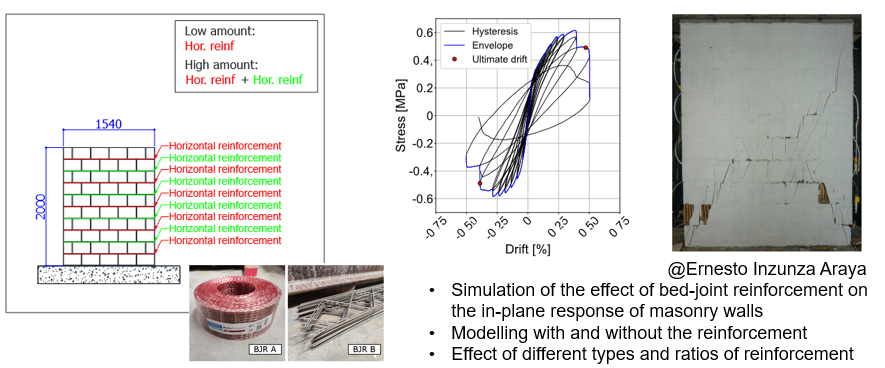
This project aims to investigate the effect of bed joint reinforcement on the in-plane response of modern brick masonry under in-plane loading. The numerical model will follow a micro-modelling approach, where bricks are represented as continuum elements and mortar joints as discrete elements.
After calibrating the numerical model using available experimental data from tests conducted at EESD, the project will explore the impact of different bed-joint reinforcement typologies and ratios on the in-plane seismic response of brick masonry walls.
Through this project, you will deepen your knowledge in:
- Nonlinear analysis of structural elements
- Masonry mechanics
- Seismic design of masonry structures
Tasks:
- Generation of numerical models (micro-modeling).
- Calibration of numerical models using experimental data.
- Assess the impact of different bed-joint reinforcement typologies and ratios on the in-plane seismic response of brick masonry walls.
Contact:
Ernesto Inzunza Araya ([email protected])
Savvas Saloustros ([email protected])
Katrin Beyer ([email protected])
Brief description:
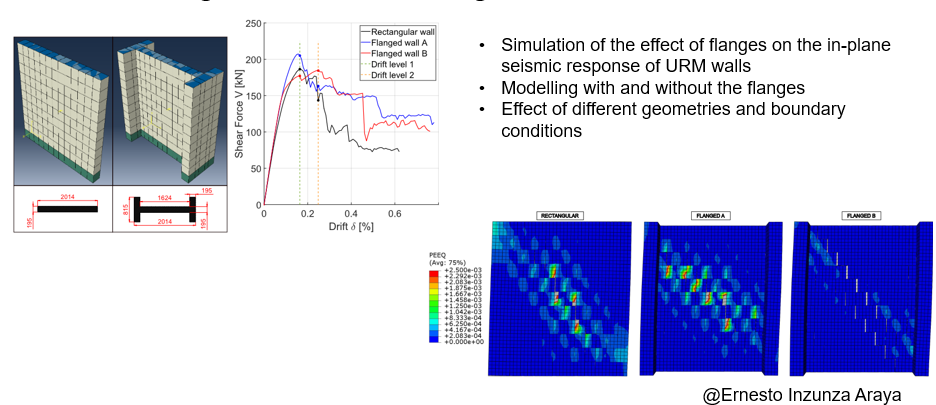
This project aims to investigate the effect of flanges on the in-plane response of modern brick masonry under in-plane loading. The numerical model will follow a micro-modelling approach, where bricks are represented as continuum elements and mortar joints as discrete elements.
After calibrating the numerical model using available experimental data from tests conducted at EESD, the project will explore the impact of different geometries and configurations of flanges on the in-plane seismic response of brick masonry walls.
Through this project, you will deepen your knowledge in:
- Nonlinear analysis of structural elements
- Masonry mechanics
- Seismic design of masonry structures
Tasks:
- Generation of numerical models (micro-modeling).
- Calibration of numerical models using experimental data.
- Explore the impact of different geometries and configurations of flanges on the in-plane seismic response of brick masonry walls.
Contact:
Ernesto Inzunza Araya ([email protected])
Savvas Saloustros ([email protected])
Katrin Beyer ([email protected])
Brief description:
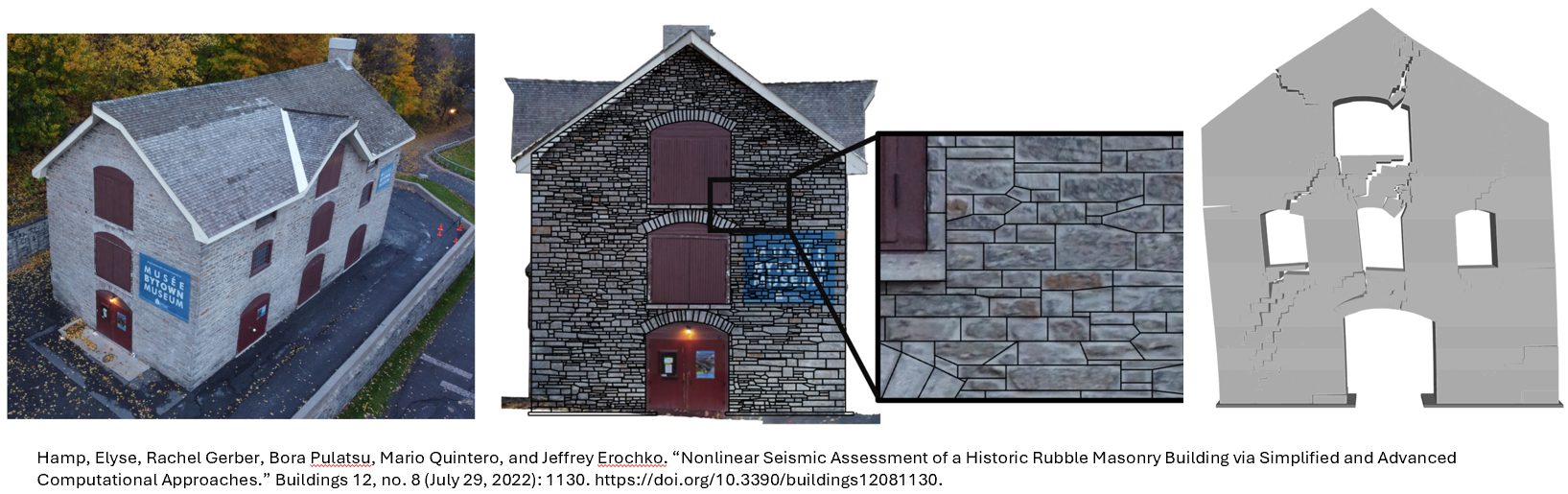
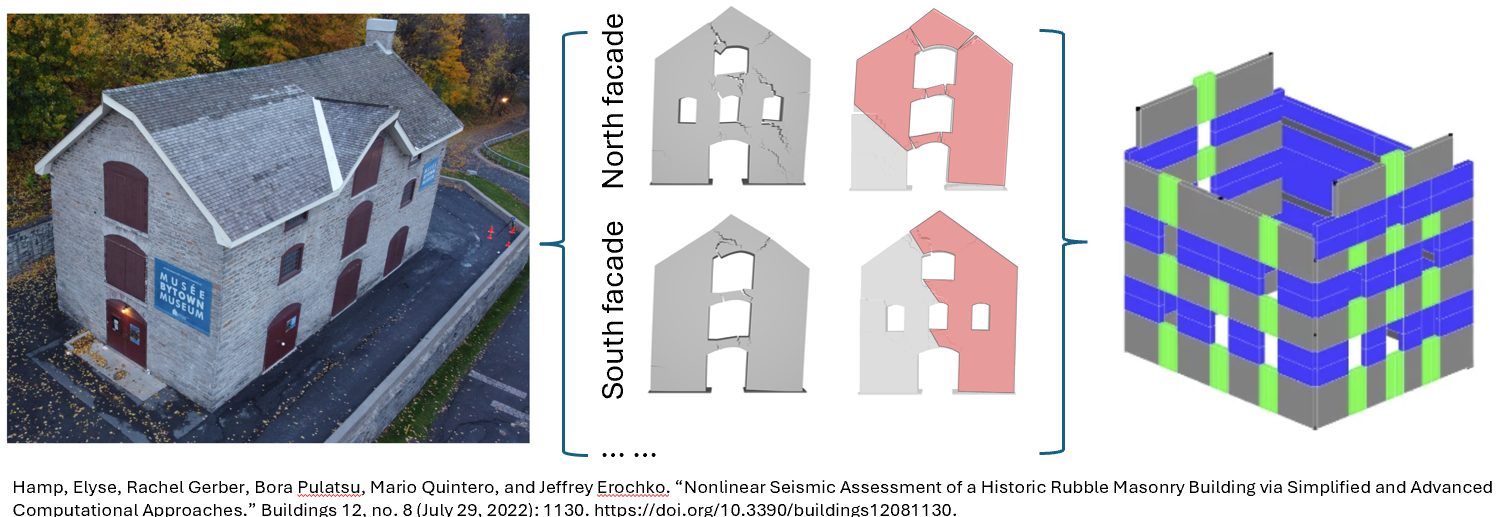
Analyze a rubble masonry building by combining microscale modeling and macroscale modeling methods.
Tasks:
- Understand optimization-based rigid block modeling method and learn how to use it from the Python interface.
- Identify different structural elements and their boundary conditions and loads.
- Create a micro model for each element and carry out the limit analysis.
- Create a macro model for each element based on results from the previous step.
- Assemble macro models of the full building and carry out pushover analysis of the building.
Contact:
Qianqing Wang ([email protected])
Katrin Beyer ([email protected])
Brief description:
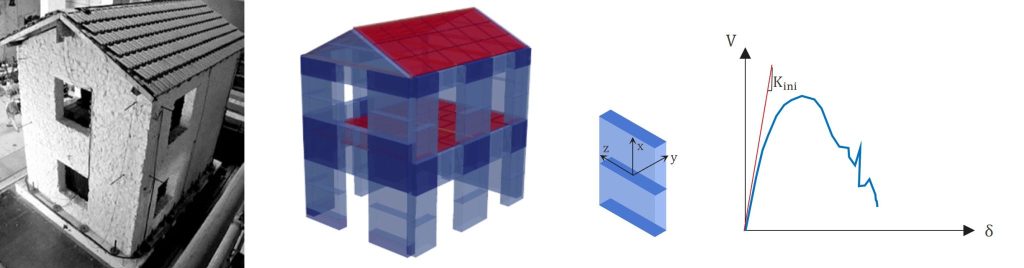
Experimental campaigns have demonstrated an increase in effective stiffness with the applied axial load (Vanin et al., 2017; Vasconcelos, 2005; Bosiljkov et al., 2005). This study aims to evaluate the impact of the axial load ratio (ALR) levels on the structural response using the Equivalent Frame Model proposed by Vanin et al. (2020) in OpenSees.
Tasks:
- The analysis will be conducted through non-linear static analysis (Pushover) considering a modulus of elasticity (E) that varies with the ALR, on walls of literature that already have experimental results.
- The student will compare and analyze the results of the Pushover curves with the experimental curves, using the current constitutive law and a new one where E is a function of ALR.
Contact:
Johnatan Orjuela Mejia ([email protected])
Katrin Beyer ([email protected])
Brief description:
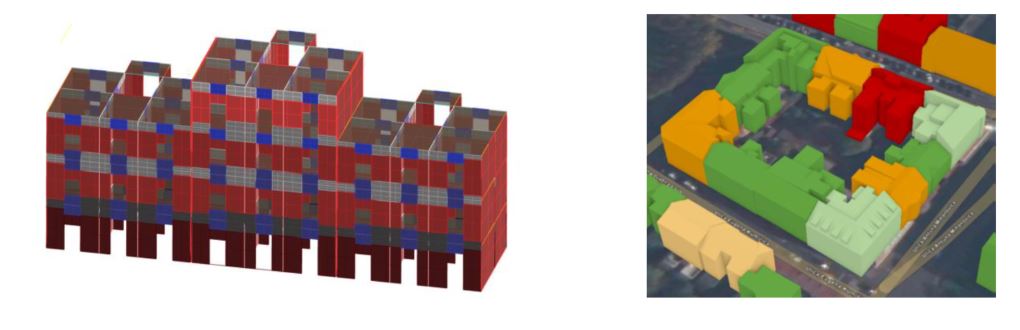
This project aims to help answering the question on how does a different height of the units influence behaviour, damage mechanisms, and fragility of units? For that, several case studies of buildings that were affected by the 2020 Croatia Earthquakes in Zagreb, Croatia, are available.
Tasks:
- Numerical modelling using open-source software „OpenSEES”
- Case studies in Zagreb, Croatia, affected by the 2020 Croatia Earthquakes
- Research question: How does a different height of the units influence behaviour, damage mechanisms, and fragility of units?
- Skills acquired:
- Dynamic analysis of nonlinear building models;
- Code-based hand calculations;
Contact:
Igor Tomić ([email protected])
Katrin Beyer ([email protected])
Brief description:
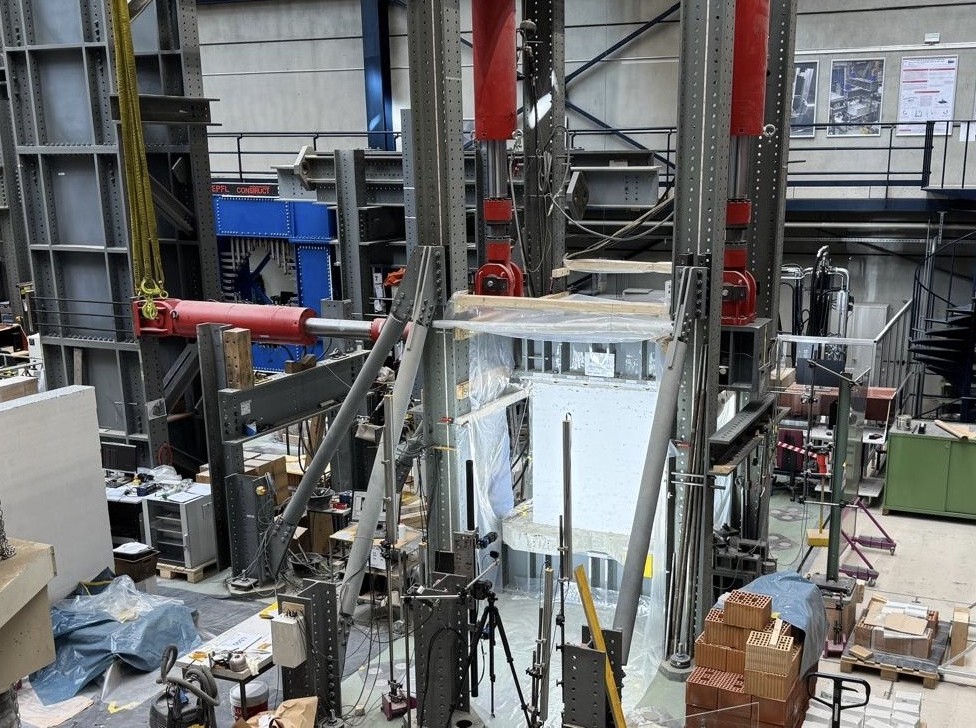
This project aims to help answering the question on how do various sustainable mortar types and classes impact the structural response of concrete demolition waste masonry walls? For doing that, the project considers an evaluation and analysis of the mechanical properties and life cycle assessment (LCA) of masonry walls incorporating concrete demolition waste, based on experimental campaign at the interface level.
Tasks:
- Testing of the updated setup for interface experiments.
- Life Cycle Analysis (LCA) of different masonry solutions.
- Experimental campaign on the mortar-concrete interface, considering various mortar types (M5–M15, OPC, and LC3) and different levels of precompression load.
- Post-processing and analysis of experimental results.
- Numerical modelling and simulation at the wall level, integrating findings from the experimental campaign.
Contact:
Jakov Oreb ([email protected])
Igor Tomić ([email protected])
Katrin Beyer ([email protected])

Brief description:
Investigate the capacity of different constitutive models for the simulation of the in-plane response of rammed earth walls under diverse boundary conditions.
Tasks:
-
Review of modelling approaches for rammed earth.
-
Choice and validation of constitutive models using experimental data.
-
Use the model to investigate the response under diverse boundary conditions.
Contact:
Yuhan Zhu ([email protected])
Savvas Saloustros ([email protected])
Katrin Beyer ([email protected])
Brief description:
This project aims to numerically investigate how variations in masonry microstructure influence the in-plane seismic response of multi-leaf rubble stone walls. It focuses on correlating geometric characteristics with strength, stiffness, and drift capacity using virtual and real microstructures of rubble stone masonry walls.
Tasks:
-
Develop and calibrate a micro-continuum model for rubble stone masonry walls in ABQUS.
-
Perform parametric numerical simulations using various virtual and real microstructures to study the effect of geometric variation on strength, stiffness, and drift capacity.
-
Analyze and correlate geometric indices with mechanical response and failure mechanisms.
Contact:
Mati Ullah Shah ([email protected])
Savvas Saloustros ([email protected])
Katrin Beyer ([email protected])

Previous projects
- Alexis Caloz, Effect of spatial variability of masonry properties in the seismic response of unreinforced masonry buildings, June 2025.
-
Andrea Cabriada Ascencio, Seismic behaviour of historical timber-framed brick masonry buildings in North Pakistan, September 2024.
-
Adrien Neyroumande Shahreza, “Reproducible q-factor derivations for modern URM buildings,” September 2024. SGEB Prix for the best Master thesis in Seismic Engineering
-
Lara Ashenden, in Enterprise Résonance Ingénieurs-Conseils, Carouge GE.
-
Jordan Dessibourg, “Design of Social Housing in South America with Textile Reinforced Concrete“, 2024, Co-supervisor Dr David Fernández-Ordoñez
-
Halime Wawa Dahab, “Influence of higher vibration modes on the seismic performance of seismically isolated structures: Chilean Hospital as a case study”. Co-supervisor: Prof. Juan Carlos De la Llera, Pontifica Universidad Católica de Chile, 2023.
-
Aline Bönzli, “Evaluation and retrofit of a historical masonry building that was damaged during the 2020 earthquakes in Croatia”, 2023.
-
Caroline Heitmann, “Evaluation and retrofit of a historical masonry building that was damaged during the 2020 earthquakes in Croatia”, 2023. SGEB Prix for the best Master thesis in Seismic Engineering
-
Melchior Frick, “Analysis of a building or a church that was damaged during the recent earthquakes in Croatia”, 2023.
-
Yoann Antille, “Seismic evaluation of a stone masonry building”, 2023.
-
Ziad Nabil Sahlab, “Performing and analyzing rock-mortar shearing experiments with x-ray tomography”, 2023.
-
Camille-Marie Hochar, “Vulnérabilité sismique de bâtiment existant”, 2023.
-
Romain Colella “Nonlinear models for RC wall response and simplified structural models to estimate nonlinear dynamic response”, 2022.
-
Thibaud Maillard, “Analysis of a building or a church that was damaged during the recent earthquakes in Croatia” 2022.
-
Joachim Droz, “Seismic assessment of a historical masonry structure”, 2021.
-
Blaise Gasser, “Seismic assessment of a historical masonry structure”, 2021.
-
Samuel Corado Cosme, Master student Universidade Nova de Lisboa, Lisbon, Portugal, 02-06/2021
-
Thomas Drouin, “Behavior of precast reinforced spun concrete piles under seismic loading”, 2019. Exchange student at the Tokyo Institute of Technology, Japan. Co-supervisor: Prof. Sam Kono.
-
Samuel Reyes, “Seismic analysis of reinforced concrete walls typical for Colombian construction” 2019. Co-supervisor: Prof. Carlos Blandon, School of Engineering of Antioquia, Colombia.
-
Lisa Imperatori, “Modelling reinforced concrete coupling beams designed for low-to-moderate seismic regions”, 2019. Exchange student at the University of Melbourne. Co-supervisor: Dr. Ryan Hoult.
-
Paolo Mininni, “Modelling of three shake table tests on a stone masonry building through an advanced macroelement model” visiting Master student from the University of Milano, Italy. Supervisor at alma mater: Prof. Marco V. Valente, 2019.
-
Giuseppe Sardano, “Equivalent frame models for stone masonry buildings and development of an automatic mesher in Rhino to be used in conjuction with OpenSees model” visiting Master student from the University of Milano, Italy. Supervisor at alma mater: Prof. Marco V. Valente, 2019.
-
Ayoub El Malagui, “Planning of a shake table test on a typical Iranian school building,” EPFL, 2018.
-
Céline Rossignon, “Seismic assessment of a reinforced concrete bridge,” EPFL, 2018. Co-advisor: Dr. J. Almeida.
-
Suvakar Arumugam, “Mechanical and environmental assessment of biobrick material,” EPFL, 2018. Co-advisor: Dr. J. Almeida.
-
Enio Zanchetta, “Mechanical and environmental assessment of biobrick material,” EPF, 2018.
-
Antoine Mauron, “Predicting the change in natural period of building due to damage,” EPFL, 2018.
-
Daniel Grüter, “Effect of induced seismicity on masonry buildings: Stone masonry shear compression tests and numerical simulations,” EPFL, 2017.
-
Nathan Richard, “Effect of induced- and normal seismicity on masonry buildings,” EPFL, 2017.
-
Olivier Pasquier, “Analysis of the microstructure of a new construction material,” EPFL, 2017.
-
Matteo Realini, “Evaluation parasismique d’un bâtiment existant en prévision de sa surélévation,” EPFL, 2017.
-
Benoît Girod, “Assessment of Colombian reinforced concrete buildings with thin structural walls,” EPFL, 2017.
- Manuel Jordan, “Modelling reinforced concrete frame structures subjected to ground motions with large vertical-to-horizontal peak acceleration ratios,” EPFL, 2016.
- David Grisot, “Out-of-plane failure of reinforced concrete walls with a single reinforcement layer,” EPFL, 2016.
- Marlène Vouillamoz, “Evaluation parasismique d’un bâtiment en bois,” EPFL, 2016.
- Tharchagini Kandiah, “Evaluation parasismique d’un bâtiment en maçonnerie de pierre,” EPFL, 2016.
- Cristiano Garbellini, “Efficient analysis methods of RC sections under cyclic biaxial bending and axial load,” EPFL, 2016.
- Claudia Gardeta, “Vulnerability of RC wall buildings in New Zealand,” EPFL, exchange student at the University of Canterbury (Prof. S. Pampanin, Prof. R. Dhakal), 2016.
- Dario Zaganelli, “Performance-based seismic assessment of stone masonry buildings: numerical and experimental studies,” visiting Master student from the University of Bologna, Italy. Supervisor at alma mater: Dr. L. Landi, October 2015-March 2016.
- Filippo Lucca, “Analysis of out-of-plane response of brick masonry walls by means of discrete element models,” visiting student from the Università degli Studi di Padova, Italy. Supervisor at alma mater: Prof. C. Modena, 2015.
- Emanuele Paolo Ghera, “Seismic assessment of the Ganter bridge,” EPFL, 2015.
- Alexandre Aubry, “Seismic assessment of a highway bridge over the Dranse (Valais),” EPFL, 2015.
- Alexandru Moraru, “Potential of damping devices in regions of moderate seismicity,” EPFL, in collaboration with the company VSL, 2014.
- Matteo Campiche, “Seismic behaviour of thin walls subjected to large axial forces,” EPFL, in collaboration with Prof. Carlos Blandon, School of Engineering of Antioquia, Colombia, 2014.
- Mohamed Eddamanhoury, “Comportement sismique de bâtiments en maçonnerie non armée avec dalles en béton armé, (Seismic behaviour of unreinforced masonry buildings with reinforced concrete slabs)” EPFL, 2014.
- Danilo Tarquini, “Seismic performance of reinforced concrete walls with substandard details,” visiting Master student from Roseschool, Istituto Universitario di Studi Superiori (IUSS) Pavia, Italy, 2014.
- Benaboud Haroun, “Effective slab width in URM buildings with RC slabs,” EPFL, 2013. SGEB-award for outstanding Master project in the field of earthquake engineering (www.sgeb.ch)
- Efthymios Papoutsis, “Seismic behaviour of planar and non-planar reinforced concrete walls,” visiting Master student from the Aristotele University of Thessaloniki, Greece. Supervisor at alma mater: Prof. Anastasios Sextos. 2013.
- Salvatore Marino, “Force-deformation characteristics for composite spandrels,” visiting Master student from the University of Bologna, Italy. Supervisor at alma mater: Prof. D. Diotallevi, Dr. L. Landi, October 2012-August 2013.
- Raphaël Bonvin, “Seismic assessment of an existing URM building in the canton Valais,” EPFL, 2012.
- Sujith Mangalathu, “Analysis of masonry spandrels with shallow arches,” visiting Master student from Roseschool, Istituto Universitario di Studi Superiori (IUSS) Pavia, Italy, 2012.
- Sabrina Simonini, “Seismic analysis of RC walls with unequal length,” visiting Master student from the University of Bologna, Italy, Co-Supervisor: Prof. Rutenberg (Technion, Israel), 2011.
- Suleidy Perez, “Seismic design and analysis of mixed reinforced concrete – unreinforced masonry wall Structures,” EPFL, 2011. SGEB-award for outstanding Master project in the field of earthquake engineering (www.sgeb.ch)