
Welcome to Blaze
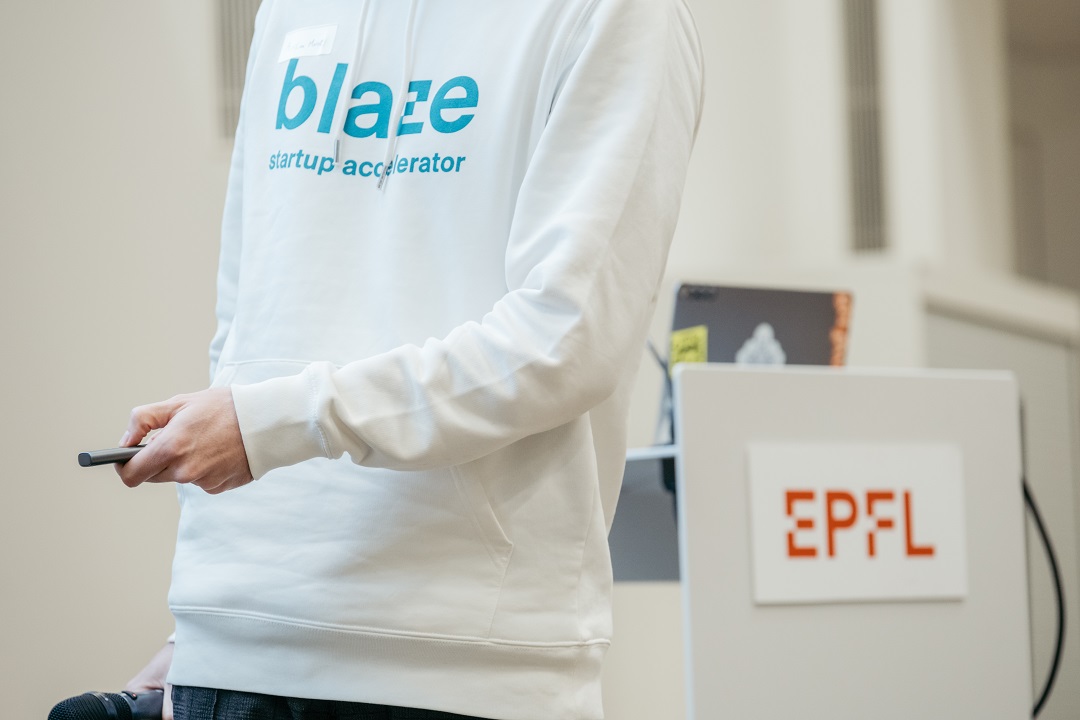
Blaze is the execution-focused accelerator platform for EPFL founders ready to launch and scale. We provide the professional support, resources, and environment required to bridge the gap between a functional prototype and a venture-ready startup.
Applications are read as they arrive and answered within 10 days. Blaze supports 16 to 18 projects a year and takes around one application in three.
Is your project a fit?
- Fast-to-deploy technological solutions. You work on a digital, SaaS, or hardware solution with rapid market entry and you already have a functional prototype or MVP.
- Validation. You can show early market interest: user sign-ups, pilot data, letters of intent.
- Momentum. You can see yourselves working full time on this company within the next twelve months. If you cannot picture that, the timing is wrong.
- Model. Fast and scalable, with the potential to become a leading international startup.
- EPFL DNA. You work as a team, with at least one leading co-founder who is a current EPFL student, or an EPFL graduate from the last two years. The two-year window is measured at admission, and the team has to keep at least one such co-founder for the whole support period. Once nobody on the team qualifies, support ends.
- Independence. The project cannot already be housed inside an existing business, and nobody on the team can be a founder, owner or employee of a company that competes with it or could lay claim to its results. If you are unsure, ask before applying.
Blaze admits unincorporated projects only. Reaching the point where incorporation makes sense is what the program is for.
There are no academic credits. Blaze runs independently from your curriculum. The hours you put in are hours taken from something else.
If that describes your project, the rest of this page is what you would be taking on.
Why this exists
At the stage you are at, the market will not back you. Investors, corporate partners, banks and competitive funding bodies all price risk, and they engage once the uncertainty has come down. Your uncertainty is highest exactly when you most need someone to commit. Covering that gap is the only thing Blaze is for.
So the program measures itself on one thing: bringing you to the point where you can connect to the next step, whether that is a first paying customer, an investor conversation worth having, or a pilot that needs a legal entity behind it. Blaze is a bridge to that point, not a destination. Its aim is to make you no longer need it.
A milestone-driven framework
Your support period runs between two dates set at intake, up to six months apart, and it always starts on the first day of a month. What happens in between is built around your own milestones. Two teams admitted the same week can end up with very different support.
- Validation Sprint, 6 weeks. An intensive phase to stress-test your core market assumptions, sharpen the value proposition and confirm early traction before the full acceleration phase.
- Acceleration Phase, up to 6 months. Support toward the milestones that matter at this stage: first customers, Swiss incorporation, preparation for follow-on funding.
Applicants who already meet the full eligibility criteria go directly into the Acceleration Phase. Those who still need to stress-test their market assumptions start with the Validation Sprint and can progress from there.
The same for every accelerated team: a trajectory agreed at intake, a monthly progress discussion with the program staff, a mid-term review against that trajectory, a closing discussion and report at the end date.
What varies: whether you are matched with a coach (most teams are, some work with the program staff and the workshops instead), which workshops fall inside your window, what you request a grant for, which introductions get opened.
Targeted resources for execution
The core of Blaze is people: the program staff running the process, practitioners leading the workshops, and for most teams a coach. Around that sits a set of resources. They are not handed over as a package at the start. Each one gets placed where a venture is testing something, so you have to ask.
- Goal-driven grants. Funding toward technical development, cloud credits, go-to-market testing, or bought expertise such as legal and IP advice, prototyping or a market study. You request a grant against a named blocker. The request says what is being bought, which assumption it unblocks, and what happens to your plan if it does not come. Up to CHF 10,000 per startup across the program, usually in tranches of CHF 1,500 to 3,500, so each one stays tied to a concrete piece of work. Payment lands about 30 days after a grant is accepted, so a grant you need next week is already too late to request.
- 1:1 founder sparring. Sessions with experienced operators, sector specialists and repeat founders. Most come from outside EPFL, some from within. Whoever you are matched with is bound to confidentiality: external coaches by a non-disclosure agreement and a non-solicitation clause, EPFL staff by official secrecy. Nothing from a session circulates further.
- Workshops on startup fundamentals. Legal foundations, IP strategy, revenue modeling, led by practitioners.
- Community. Founder breakfasts, afterworks, and Open Mic pitching in front of an audience that will tell you what did not land.
- Access to the business network. Introductions opened where they unblock a specific step.
- The EPFL association. Your project becomes publicly identified as supported by EPFL, and you join the community of founders around the school. That association can matter to a customer weighing up a pilot, or to an investor deciding whether to take a first call.
- Microsoft for Startups. Acceleration Phase teams are referred into the program and get its benefits: cloud credits, technical support, and Microsoft’s developer and hiring tools.
- A free desk at The Station. Co-working space on campus alongside other startups, with meeting rooms and the events that happen there. No rent, no desk fee.
How much of the ecosystem side happens in a given month depends on the cohort and the calendar. What you get out of it is largely proportional to what you ask for.
Discover the story and passions of Gustave Lapierre, a student entrepreneur who founded a BoundaryAI, a startup focused on AI-driven text data analysis. Thank you to EPFL’s Student Support Program for the video and support they offer to our students.
What we ask in return
Blaze places a finite resource behind your venture. What it asks back is short, and every item on the list is something observable. Nobody is assessed on enthusiasm, or on how well they get on with the staff. The list is identical for every team, so there is nothing to guess at.
- Do the de-risking work. Test the assumptions you named, and come back with what the answers were. Everything else multiplies this.
- Hold the checkpoints, prepared. A monthly progress discussion with the program staff, and a mid-term review against the trajectory you agreed at intake. The mid-term carries a decision about continued support.
- Take part in the collective activities on offer, and ask for the connections you need.
- Account for the money. Grants are spent against the budget agreed when they were requested, and reported at the end of the support period.
- Be transparent. Everyone supporting you is bound to confidentiality. Hold back the numbers and the doubts and you waste the sessions.
- Pass it on. The coaches, operators and founders who make your six months useful were mostly helped at this same stage themselves, and came back. Nothing obliges you to do the same. The program asks anyway: stay reachable after you leave, tell us what happened to the venture, and say yes when a team stuck where you once were would learn more from an hour with you than from anyone on staff.
Support is finite and goes where founders are testing. If the de-risking work stops, you will hear it early and directly, and support can be reduced. The conversation always happens before anything is withdrawn.
One thing that does not count as failure. Using the whole six months is no achievement in itself. If the evidence says the venture does not work, stopping in month two beats stopping in month six: every extra month on a project that will not survive contact with the market is a month taken from a job or a thesis. Teams that stop for that reason leave in good standing, and we put it in writing.
Apply now
There are no deadlines. Applications are read as they arrive, and the process runs to fixed intervals from there.
- Send the application. Use your EPFL email address to reach the form.
- An answer within 10 days. Selected teams are invited to a 30-minute call, where the trajectory and the dates get agreed. Teams we decline receive an email with a short reason.
- Support starts on the first of a month. Apply by the 15th to start on the 1st of the following month. Applications arriving after the 15th are reviewed on the same clock, with the next available start a month later.
Not sure you are at the right stage? Ask for a short call on your project before applying: [email protected]. Half an hour, and you will know where you stand before spending time on the form.
The Entrepreneurship Track
The Sylvie Rusconi Foundation’s mission is to support young people in their business creation projects. By offering them personalised guidance, a strong network and financial support, we enable them to develop innovative, creative and meaningful projects.
Within this framework, in collaboration with the Blaze platform, we offer the Entrepreneurship Track specifically for Swiss projects. Our support and methodology are individualised: the frequency and content of our meetings vary from one person to the next, because the individual, their personality, their ideas and their pace dictate our approach.
If your project is Swiss, ask the programme manager whether it applies to you.