
EDAM – Advanced Manufacturing

About the program
Advanced manufacturing is key to maintaining and strengthening the ability of our society to produce high-quality, high-precision products and services. New technologies enable complex manufacturing processes, intricate designs, and customization capabilities. They also allow to optimize production, reduce waste, and minimize resource consumption. Education at the highest possible level is a crucial element for proper training of engineers.
Advanced manufacturing is diverse, multiscale and multidisciplinary. It requires fundamental knowledge in materials, solid and fluid mechanics, surface and interface science, multiscale modeling, process and system engineering. More specialized topics include control system theory, production flow optimization, micro- and nano-fabrication, laser processing, metrology, additive and subtractive 3D manufacturing, assembly and joining processes, sustainability and cost analysis.
Applying to EDAM
Applications can be submitted several times a year.
Deadlines: Submission prior to April 15 or December 15.
- Check out How to apply to EDAM for specific information.
- Read the FAQs for applications
- If you already applied to the EDAM program in the past, and wish to re-apply, you must write a letter (in addition to and other than the requested statement of objectives) to give the commission convincing reasons why they should reconsider your application.
- Be aware that only complete applications are reviewed.
- Candidates with a 4-or 5-year Bachelor’s degree in material science, electrical-, micro- or mechanical engineering as well as micro-and nanotechnology or similar disciplines and an excellent track record may apply, explaining the specifics of their education in the statement of objectives letter. Admission is not guaranteed and prerequisites and additional courses during the first year may be required.
Further information on the EDOC admission criteria and application procedures visit the webpage.


Example of recent research
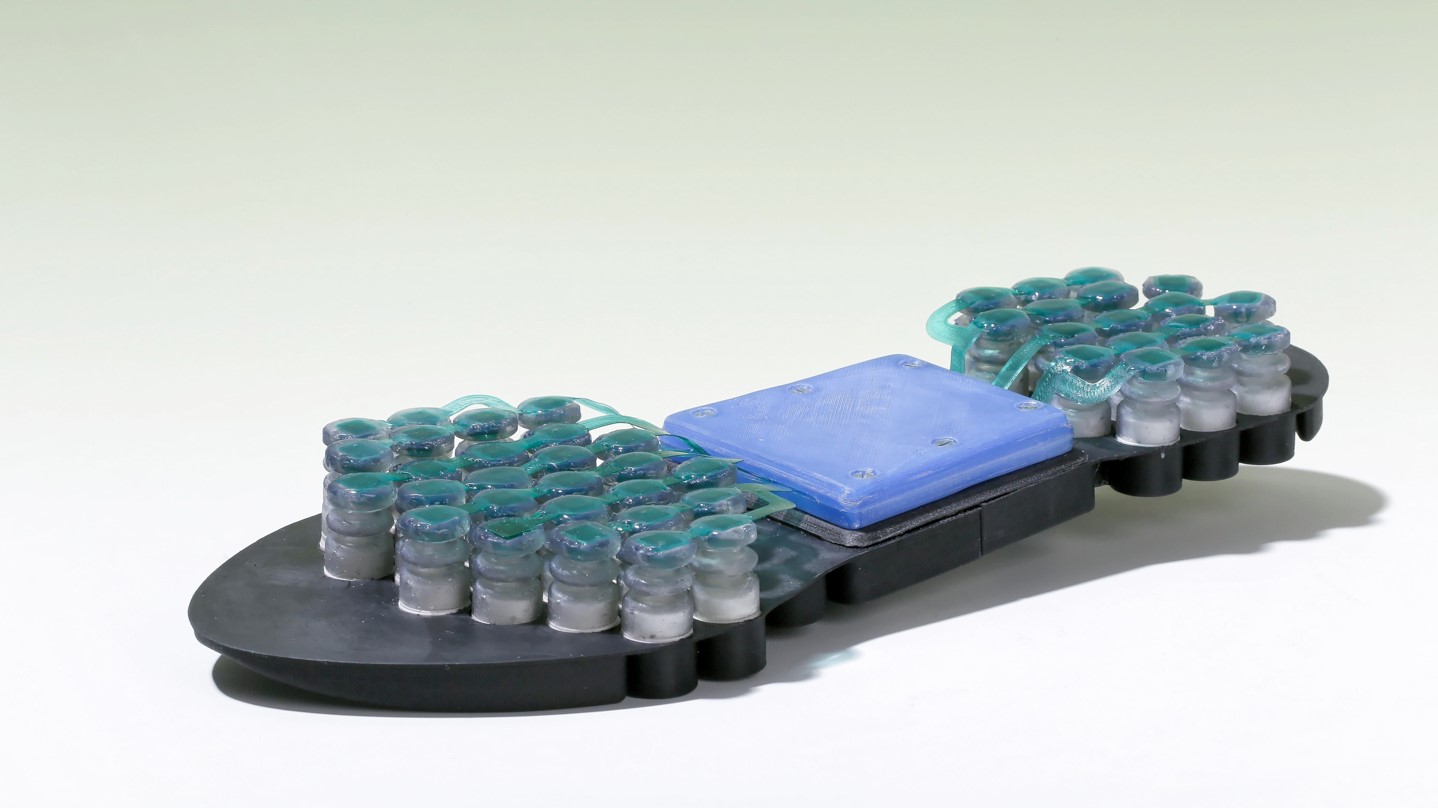
Researchers at ETH Zurich, Empa, and EPFL are developing a 3D-printed insole with integrated sensors that allows the pressure of the sole to be measured in the shoe during activity. This helps athletes or patients to determine performance and therapy progress.

Our program covers a wide range of multi-disciplinary topics, mixing materials science with mechanics, physics and chemistry, and tackling new approaches such as additive, 3D, data-driven and sustainable manufacturing. Over the last years, our students have been placed both in industry (including start-ups) and academic institutions, at the highest level.


The program supports an interdisciplinary approach, enabling me to step outside traditional research boundaries to meet the concrete needs of industry. It provides the ideal setting for my growth as an engineering researcher.
After completing my studies in mechanical engineering at EPFL and ISAE-Supaéro and gaining industry experience, I sought to work at the intersection of theoretical research and industrial application. I chose EDAM because it is one of the few doctoral programs that bridges this gap explicitly to address real-world engineering challenges.
My research is conducted in the context of an industrial Innosuisse project aiming to develop the next generation of hydrogen compressors. Currently, we face a “computational cost” bottleneck in numerical modelling for high-performance carbon fibre composites. Existing failure models are often computationally prohibitive for the complex geometries required in these industrial parts.
To solve this, I bridge three fields: material science, computational mechanics, and artificial intelligence. My research focuses on:
- Experimental Innovation: Using Digital Image Correlation, Acoustic Emissions, and a modified Arcan fixture with novel coupon designs to capture material response under realistic, heterogeneous 3D stress states.
- Machine Learning: Combining this experimental data with synthetic data from calibrated numerical twins to train an ML model that predicts the failure envelope of the material.
- Industrial Impact: Integrating this model into Finite Element software to allow for scalable, fast, and accurate failure prediction.
Working under the joint supervision of Prof. Michaud (EPFL) and Prof. Cugnoni (HEIG-VD), I benefit from a rewarding collaboration that blends academic rigour with applied engineering. The program supports this interdisciplinary approach, enabling me to step outside traditional research boundaries to meet the concrete needs of industry. It provides the ideal setting for my growth as an engineering researcher.

The high-quality research environment at EPFL, supported by advanced facilities, encourages discussion and collaboration with researchers. This framework grants the freedom to explore unconventional pathways and reinvent traditional methods, providing as many directions to tackle fabrication as there are students involved in this program.
With their ability to manipulate light at the nanoscale, metasurfaces are set to reshape the field of refractive optics. While their efficiency and performances continue to improve, a remaining challenge lies in their fabrication. Meeting both the high-resolution requirements for nanostructure generation and the high-throughput demands of industrial production requires novel, scalable manufacturing methods.
A compelling aspect of my research, which aims at developing alternative fabrication approaches for large-scale nanostructured surfaces, is the strategic use of what is usually considered a defect: dewetting. By understanding the fundamental physics behind this phenomenon, it becomes possible to describe and predict its behaviour. In particular, controlling it through the use of templated substrates has proven to be a reliable method for producing large arrays of uniform nanostructures. By designing specific patterns and tuning the dewetting conditions, it is thus possible to create metasurfaces for sensing or photonics applications, enabling their scalable and cost-effective production.
My background in microengineering and a strong interest in materials science led me to the EDAM program. Its multidisciplinary perspective provides a perfect balance between fundamental knowledge and practical skills while addressing modern challenges such as sustainability or resource efficiency. The high-quality research environment at EPFL, supported by advanced facilities, encourages discussion and collaboration with researchers. This framework grants the freedom to explore unconventional pathways and reinvent traditional methods, providing as many directions to tackle fabrication as there are students involved in this program.
Career prospects
Advanced Manufacturing is key to maintaining and strengthening the Swiss (and European) industry’s reputation for the production of high-quality, high-precision products and services. New technologies enable complex manufacturing processes, intricate designs, and customization capabilities. They contribute to tackling the high expectation to facilitate the integration of sustainability principles and practices into the manufacturing industry through optimizing production processes, reducing waste, and minimizing resource consumption. On the academic side, the alignment with current research trends is excellent and timely, with the explosion in new methods such as additive, 3D, data-driven manufacturing, etc.

For applicants
Further information: how to apply, program details, testimonials

For PhD candidates
Practical information: what you need to know as an EDAM PhD student

People
Who is who: all you need to know about the EDAM community

Upcoming public defense
News highlights
Contact
Program Director
Prof. Roland Logé
Administration
Tatiana Dubi [email protected]
EPFL EDAM program
SV 2515
CH-1015 Lausanne
021 693 07 82