
EDMA – Mathematics
About the program
Mathematics is a domain where we can study and express beautiful ideas. It is also a domain that is essential to science, technology, engineering, medicine, and other fields such as finance and insurance. From theory to real-world applications, mathematics is a pilar in quantitative thinking.
It helps tackle complex problems through abstraction, and it keeps evolving, driven by its own ideas and by challenges from other disciplines.
Applying to EDMA
Applications can be submitted three times a year.
Deadlines: prior to April 15, September 15 or December 15.
- Check out the eligibility criteria and how to apply
- To apply to this doctoral program, you have to complete and submit an online application form
- Visit our website to get an idea of ongoing research in Mathematics at EPFL and see the PhD advisors linked to our doctoral program
Further information on the admission criteria and application procedures visit the webpage.


Research projects
It includes pure mathematics, such as geometry, algebra, and probability, as well as applied fields like numerical analysis, statistics, and operations research, often driven by real scientific and engineering challenges. The EPFL Doctoral Program in Mathematics (EDMA) reflects this breadth, offering a strong academic home, advanced courses, and training for doctoral candidates.
As a doctoral student in EDMA, you will be part of an environment where world-class faculty, including recipients of prestigious awards such as the Fields Medal, work with talented researchers and students. Our research spans many areas, both pure and applied. You will benefit from close mentorship from our renowned professors, advanced courses, and opportunities to collaborate across disciplines, while being expected to develop and pursue your own original research.
Career prospects
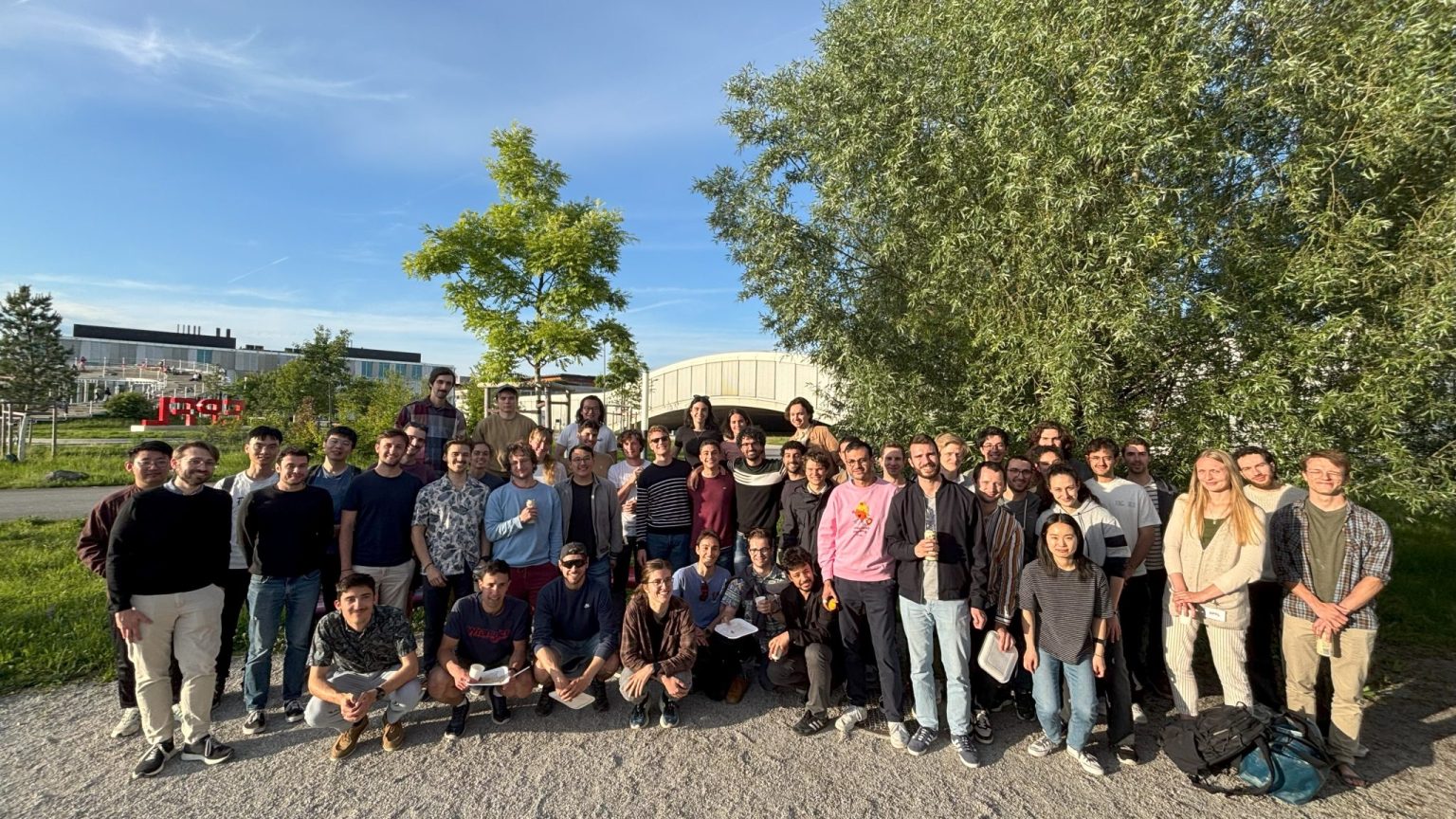
(c) EPFL, EDMA 2025
Former students: testimonials

For me, the doctoral program at EPFL was the ideal introduction to life in academia. I was fortunate to have an excellent advisor, with whom I met regularly and from whom I learned a great deal.
For me, the doctoral program in mathematics at EPFL was the ideal introduction to life in academia which lead to my exciting post-doc at UCLA as Assistant Adjunct Professor at UCLA. During my PhD I was fortunate to have an excellent advisor, with whom I met regularly and from whom I learned a great deal. It gave me the freedom to develop my technical skills without being overwhelmed by deadlines and commitments, while still providing structure through advanced courses and teaching opportunities. I’m especially grateful for the opportunities to connect with researchers around the world through conferences and research visits, often supported by the department, which deepened my understanding of the field and ultimately helped me secure a postdoc after graduation. Lastly, any discussion of life at EPFL would be incomplete without mentioning weekends spent hiking, climbing, or relaxing by the lake with friends. It was a privilege to spend four years studying mathematics in such a spectacular environment, surrounded by supportive colleagues.
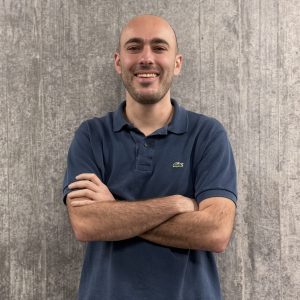
I worked on challenging problems in fluid dynamics, focusing on the analysis of the Navier-Stokes equations, the transport equation, and the transport-diffusion equation.
I am a Chapman Fellow in Mathematics at Imperial College London. During my PhD at EPFL under the supervision of Prof. Maria Colombo, I worked on challenging problems in fluid dynamics, focusing on the analysis of the Navier-Stokes equations, the transport equation, and the transport-diffusion equation. My research explored how small scales form in both smooth and irregular fluids. For instance, I contributed to the understanding of enhanced dissipation in smooth flows, and of anomalous dissipation and the lack of selection in the vanishing viscosity limit for irregular ones. I used advanced tools from PDE theory such as convex integration, mixing techniques, and pseudo-spectral bounds to study the fine structure that arises in fluid behavior. Outside of research, I really enjoyed the PhD experience: meeting many great people, making close friends, and travelling often for conferences and collaborations.
For applicants
Further information: how to apply, program details, testimonials
For PhD candidates
Practical information: what you need to know as an EDMA PhD student
People
Who is who: all you need to know about the EDMA community


Upcoming public defenses

Mathematics – Seminars and events


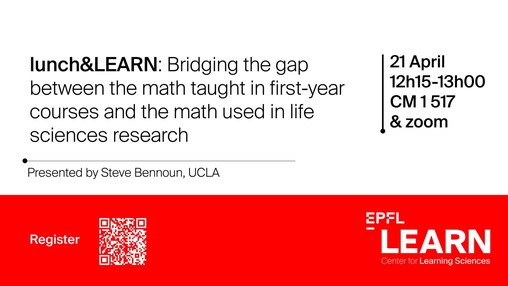
lunch&LEARN: Bridging the gap between the math taught in first-year courses and the math used in life sciences research
Speaker: Steve Bennoun
Location: CM 1 517 & Online
Category: Conferences – Seminars
Target audience: Informed public


News highlights from EDMA
Contact
Program Director
Prof. Mats Stensrud
Administration
Anne Kolly
EPFL EDMA program
MA A2 393
CH-1015 Lausanne
[email protected]