
Passive diagnostics are measurement techniques that do not introduce any external perturbation or energy into the plasma. Instead, they rely on detecting and analysing naturally occurring emissions or signals produced by the plasma. While less prone to plasma perturbation, they require knowledge of the position or symmetries from where the signal is emitted.
No tokamak diagnostic suite would be complete without magnetic field sensing. TCV’s 200+ flux loops and probes form a nervous system for plasma control. Their micro second resolution measurements of field fluctuations enable both real-time shape stabilisation and MHD instability tracking. Together, these systems don’t just observe; they feed into adaptive controllers that tweak heating, fueling, and magnetic fields mid-pulse— enabling TCV to test scenarios no other tokamak can attempt.
The magnetics diagnostics are high bandwidth measurement devices which all leverage the same working principle : the induction law. Each of these devices consist of a metalic wire forming a closed loop in which a voltage is induced when the magnetic field inside the loop varies with time. Depending on the orientation of the surface described by the wire loop, the diagnostic will measure different components of the magnetic field. TCV is equipped with many magnetic sensors, allowing for high spatial resolution, control and characterisation of the various plasma shapes.
There are 4 main devices installed on TCV: poloidal field probes, flux loops diamagnetic loops (DML) and saddle loops.
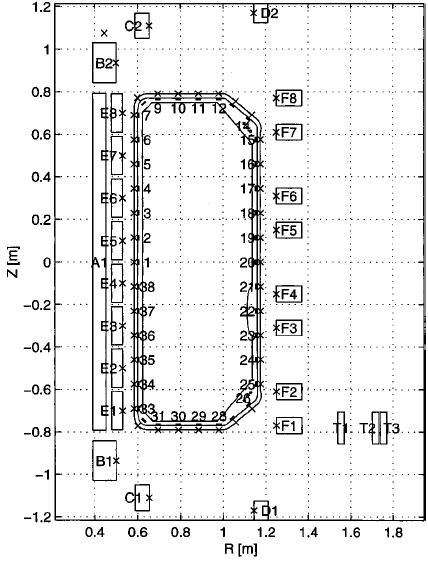
These are small copper windings installed within the vacuum vessel behind the tiles that are oriented such that they measure the time variation of the poloidal magnetic field. TCV is equipped with 4 poloidal arrays consisting of 38 probes, and 6 toroidal arrays, 3 arrays of 8 probes on the HFS and 3 arrays of 16 probes on the LFS, spanning 3 different heights, giving a total of over 200 equidistant poloidal field probes. These probes are used for the real time reconstruction of the plasma, but also for MHD activity analysis. The poloidal array can be used as a discretised Rogowski coil allowing for the measurement and control of the plasma current. They have a very high sampling frequency of 500kHz, enabling measurement of changes to the magnetic field down to 5 micro-second.
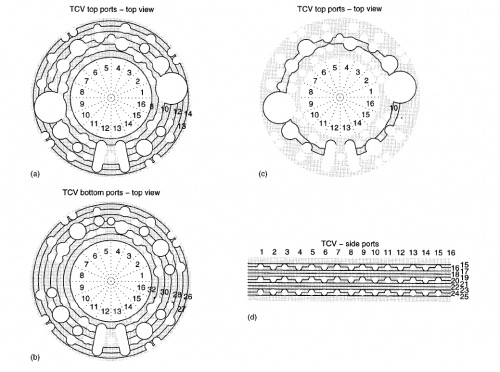
These are long copper wires, toroidally wound on the outer side of the vacuum vessel. There are 38 flux loops, spaced equidistant to the poloidal magnetic probe arrays and one loop for each poloidal field coil. They measure the change of the poloidal magnetic flux which is also used in the real time reconstruction of the plasma with a sampling frequency of 10kHz.
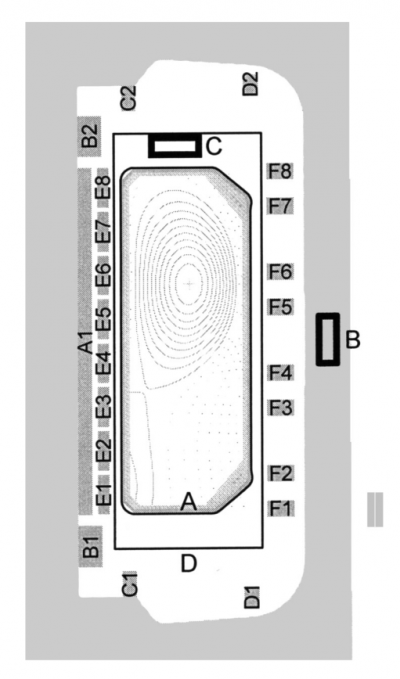
The DiaMagnetic Loop (DML) is another flux loop, but one which is oriented poloidally on the outer surface of the vacuum vessel. It measures the toroidal magnetic field flux coming from the plasma, known as the diamagnetic flux. Since the loop is outside of the vacuum vessel, this single loop cannot directly measure the diamagnetic flux as the magnetic fields of the toroidal field coils are much bigger than the fluctuations of the diamagnetic flux. Hence, the DML is actually composed of 4 loops A,B,C and D, as shown in the figure where loops A, B and C are compensation loops used to correct the induced voltage in loop D. The DML diagnostic is used to estimate the thermal energy stored by the plasma also with a sampling frequency of 10kHz.
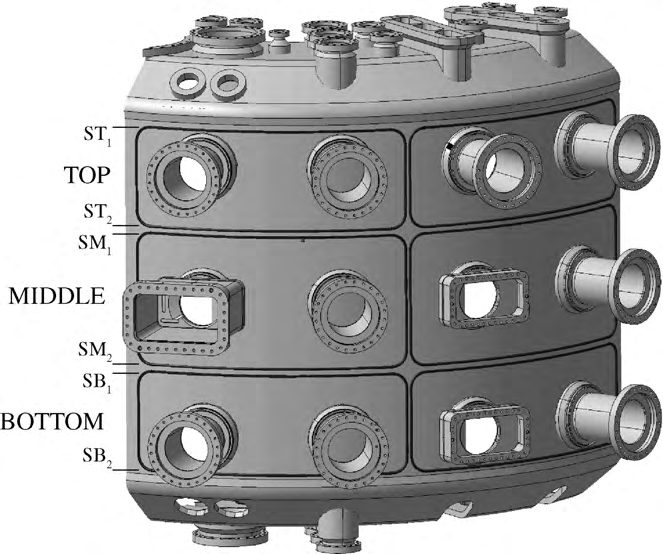
These are copper wire loops installed on the inner surface of the vacuum vessel behind the tiles forming a loop facing the plasma. It is used to measure the radial component of the magnetic field B_r. The variations of B_r are usually very small, so these loops span a large area. They also have a sampling frequency of 10kHz and are useful to detect the locking of rotating MHD modes.
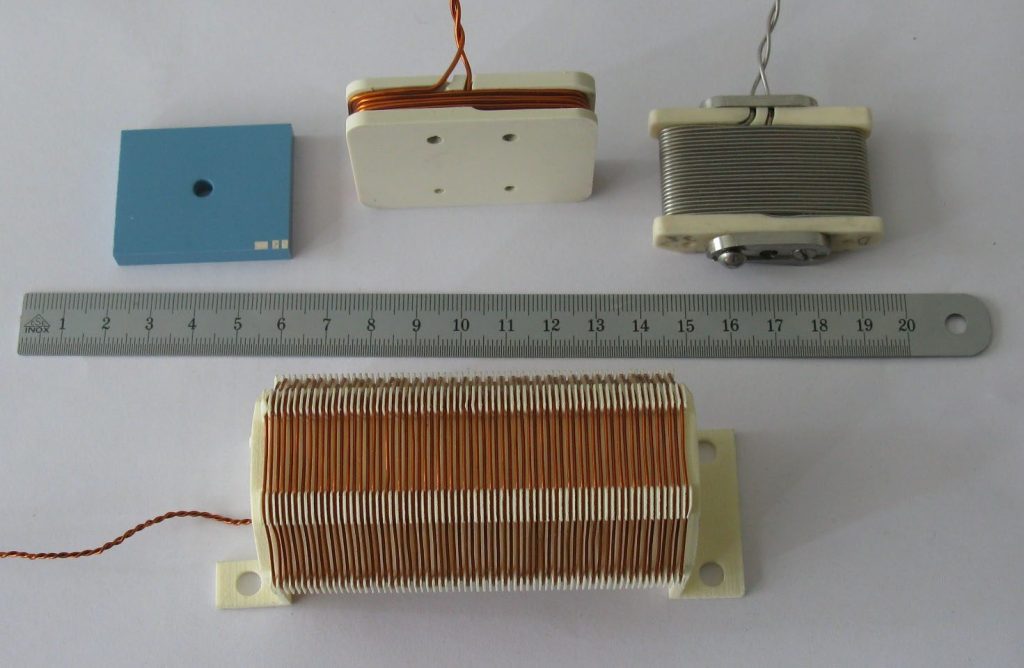
An advanced type of magnetic sensor using Low-Temperature Co-Fired Ceramic (LTCC) was developed at the Swiss Plasma Center (SPC) to measure fast changes in the magnetic field. These sensors measure rapid changes in magnetic fields which are useful in order to better understand and control plasma.
Unlike traditional “Mirnov” coil sensors, which use wound wires, LTCC sensors are built by stacking thin ceramic layers printed with metallic tracks. This innovative approach makes the sensors much smaller and more robust, while offering improved sensitivity and bandwidth — capable of detecting extremely small magnetic field changes (as low as 10⁻8 Tesla) at frequencies above 300 kHz and up to several MHz.
The compact LTCC design greatly simplifies installation inside the tokamak and allows for three-dimensional measurements of the magnetic field (poloidal, radial, and toroidal components). Each sensor is entirely sealed within its ceramic body, making it resistant to heat, radiation, and mechanical stress. The SPC’s LTCC sensors have been deployed on TCV and are now being used in major international fusion experiments, including ITER, where around 500 sensors based on this design are being installed.
The figure below shows an LTCC sensor developed at the SPC compared with conventional Mirnov sensors — illustrating its much smaller size yet five-times larger effective area and significantly higher frequency response.
This diagnostic technology showcases the SPC’s contribution to creating the precise tools needed to make fusion energy a reality.
In tokamak plasmas, most of the light originates from bremsstrahlung radiation or line radiation from impurities. Their energy spectrum ranges from visible to soft X-rays and includes ultraviolet (UV) radiation. Since radiation represents a significant fraction of the energy dissipated by the plasma, an accurate estimate of this quantity is essential for understanding the power balance.
Radiation measurements therefore form the backbone of plasma monitoring, with systems like RADCAM, the Divertor Spectroscopy System and ECE capturing emissions from the visible to X-rays—each frequency band reveals distinct facets of the plasma behavior, including, for example, the locations and types of impurities. At the soft x-ray end of the spectrum, DMPX and Pilatus dissect Bremsstrahlung and core impurity radiation, turning photons into precise electron temperature and impurity transport data. Meanwhile, hard X-ray detectors like the Hard X-ray Spectroscopy System (HXRS), LaBrDoRE and BGO act as sentinels for relativistic electrons, their energy-resolved counts warning of potentially damaging runaway beams.
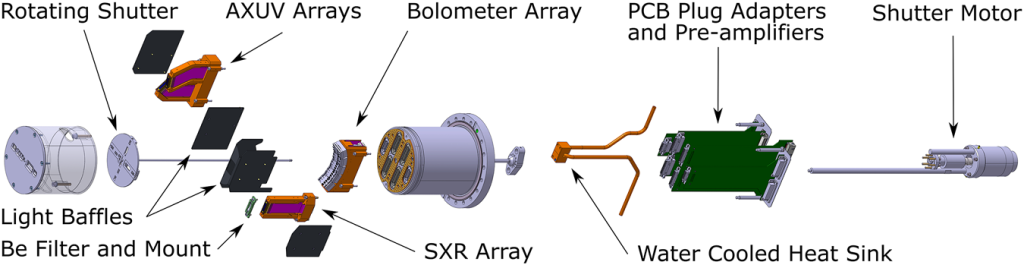
The RADCAM system integrates three types of radiation cameras: bolometers, Absolute eXtreme UltraViolet (AXUV) photodiodes, and Soft X-Ray (SXR) filtered photodiodes. Together, these are able to reconstruct the spatial distribution of the radiated power.
Foil bolometers provide slow but calibrated measurements of the radiated energy by detecting the temperature changes of a thermistor that is in thermal equilibrium with a material exposed to tokamak radiation. To enhance sensitivity, these detectors incorporate gold and platinum layers, along with a 50 nm carbon coating to enhance light absorption.
The AXUV photodiodes are uncalibrated and have a variable spectral response but enable much faster measurements.
SXR filtered diodes specialise in fast measurements of high-energy photons originating from the plasma core. They rely on the same detector technology as AXUV diodes but include a 47 µm beryllium filter to attenuate nitrogen and carbon lines, as well as bremsstrahlung photons emitted from outside the core. Together, this system provides a detailed view of the radiation emitted by the plasma.
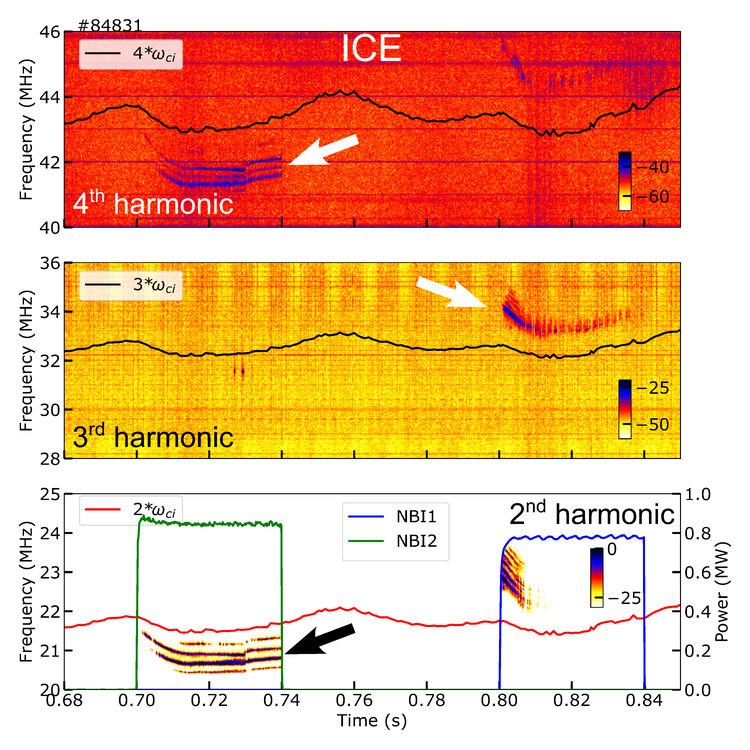
Ion Cyclotron Emission (ICE) is the spontaneous radiation of electromagnetic waves at the ion cyclotron frequency and its harmonics, driven by energetic ions, such as fusion-born alpha particles, via the Magneto-acoustic Cyclotron Instability. When these ions have significant perpendicular velocity to the magnetic field, they resonate with background plasma waves, amplifying emissions. ICE serves as a passive, non-invasive diagnostic for monitoring energetic ion behavior, crucial for assessing alpha-particle confinement and fast-ion transport.
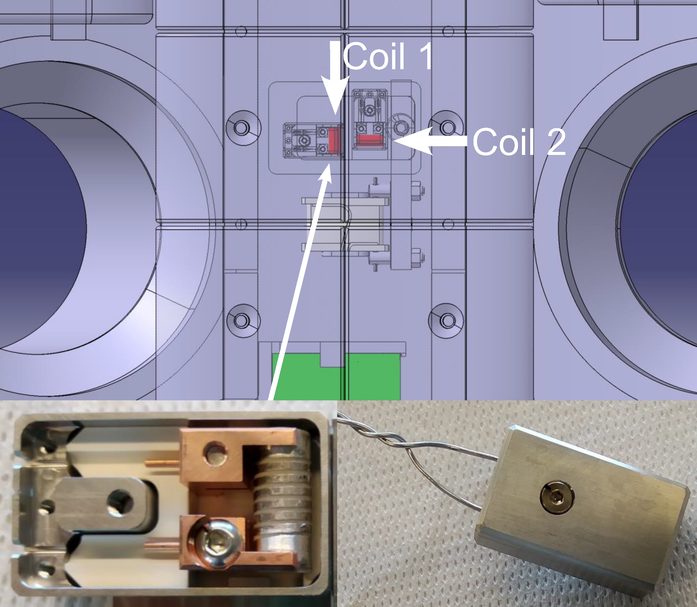
On TCV, an ICE diagnostic system was installed during the 2024 campaign, featuring two orthogonally positioned B-dot probes to measure toroidal and vertical magnetic fluctuations. A 1 GS/s data acquisition system enables clear detection of ICE at the second harmonic (~20 MHz) and other plasma phenomena such at higher harmonics, as well as possible Whistler waves (~200 MHz), particularly during runaway electron events—enhancing TCV’s ability to study fast-ion-driven instabilities.

In tokamak plasmas, electrons gyrate around magnetic field lines, generating Electron Cyclotron Emission (ECE) at a frequency proportional to the local magnetic field, which depends on the radial position. For a (Maxwellian) plasma in thermal equilibrium, the ECE intensity follows a blackbody radiation (in the Rayleigh-Jeans limit) distribution, enabling electron temperature measurements at positions where the emission frequencies match the receiver bandwidth.
At TCV, ECE radiometers measure radial electron temperature profiles using 24-channels (78–114 GHz for the high-field side, 65–100 GHz for the low-field side) with approximately 1 cm radial resolution. Two horizontal lines of sight (Z = 0, 21 cm) and a steerable receiver allow for various viewing angles. This diagnostic helps to diagnose the energies of fast electron populations.
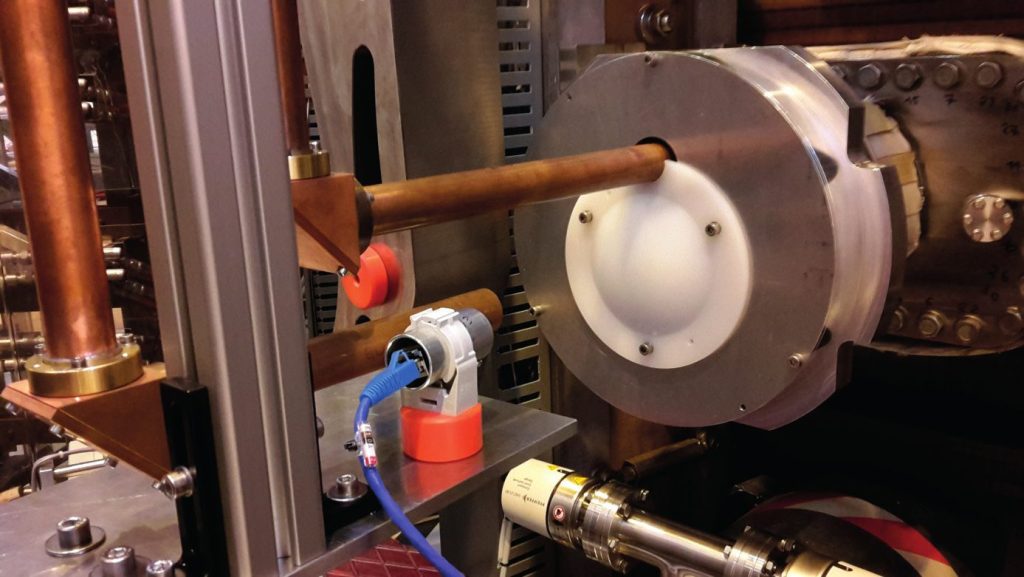
To gain a more complete picture of turbulence, we want to measure temperature fluctuations as well as density fluctuations. This is accomplished with a Correlation Electron Cyclotron Emission (CECE) diagnostic which looks at microwave radiation spontaneously emitted from the plasma. Free electrons in the tokamak rotate rapidly in response to the applied magnetic field, and these orbits give rise to electromagnetic waves: the larger the temperature, the more powerful the wave. And since the frequency depends on the magnetic field, which varies in space, by measuring emission over a range of frequencies we can reconstruct the spatial dependence of the temperature. Furthermore, we can study the statistical correlations of these different measurements, which give us access to the structure of the turbulent component of the temperature.
These analysis techniques are continuously being developed. For example, we are already planning to study the correlations between density and temperature fluctuations, as well as to probe faster, smaller-scale turbulence than we have done so far.
Soft X-ray emission (from few keV to 50 keV) arises from Bremsstrahlung and electron-ion recombination, forming a continuous spectrum which depends on electron density, temperature, and effective charge. These photons are detected by a series of high voltage wires spaced inside a gas chamber. When the Soft X-rays ionize gas atoms, they trigger an electron-ion avalanche measured through changes in the wire’s voltage.
At TCV, the DMPX is a 64-wire channel detector, designed to measure soft X-ray emissions between 3 and 30 keV with a high sampling rate of 200 kHz. It uses two superimposed wire chambers, with adjustable absorbers for varying energy limits. The signal measured is proportional to the incident soft X-ray flux along the lines-of-sight. This information can be used to try to estimate the spatial profile of the electron temperature.
Hard X-ray radiation is primarily generated by fast energetic electrons through inverse Compton scattering or bremsstrahlung radiation. The HXRS system measures X-rays in the 20-200 keV range with multiple angular views. Solid-state CdTe photodiodes detect the photons via the photoelectric effect, enabling photon counting and energy sorting via pulse height analysis. The spatial distribution of the emitted radiation gives information about the characteristics of the fast part of the electron distribution.
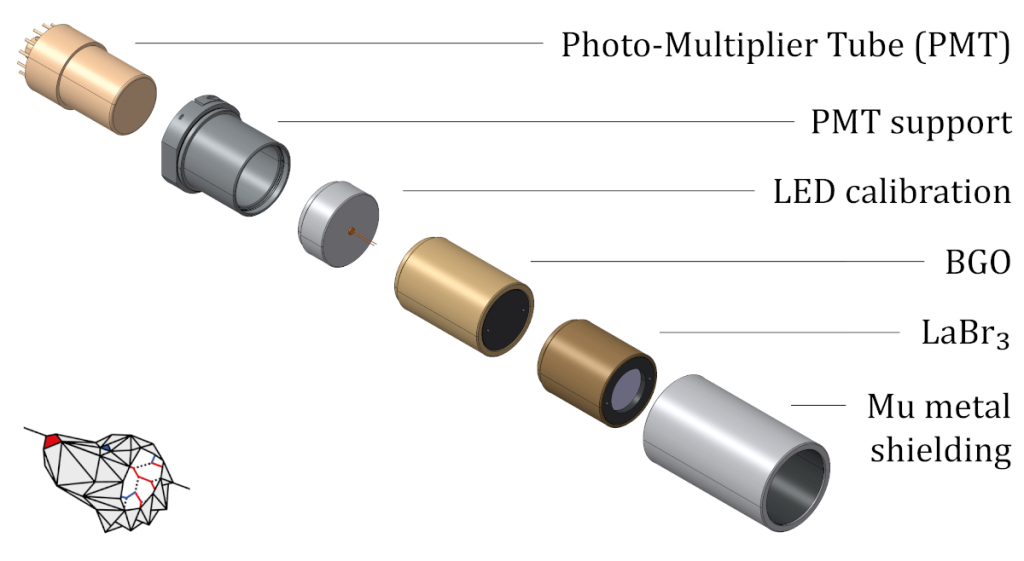
A critical issue for operating a tokamak fusion reactor safely is preventing the generation of fast electrons. Detecting the presence of these relativistic electrons, is challenging because of their extremely high energies. When runaway electrons collide with the wall or other particles in the plasma, they emit Hard X-Ray (HXR) radiation. This radiation can penetrate outside the vacuum vessel, carrying with it information about the runaway electrons.
The Lanthanum Bromide Detector of Runaway Electrons (LaBrDoRE) was designed to measure the energies of these Hard X-Rays. This diagnostic leverages the recently commercialized Lanthanum Bromide (LaBr3) scintillators which have an extremely fast scintillation decay time of 20ns. This enables much greater temporal resolution and creates the possibility to measure the detector response to individual HXR photons. By measuring tens of thousands of these photons, the evolving Hard X-Ray energy spectrum can be computed every millisecond.
LaBrDoRE has revealed in greater detail the influence of the loop voltage on the runaway electron energies in TCV. The acceleration of REs during low density experiments with constant current can be observed through the increasing energy of the HXR emission. This and other related phenomena are being explored as part of ongoing modelling and experiments.
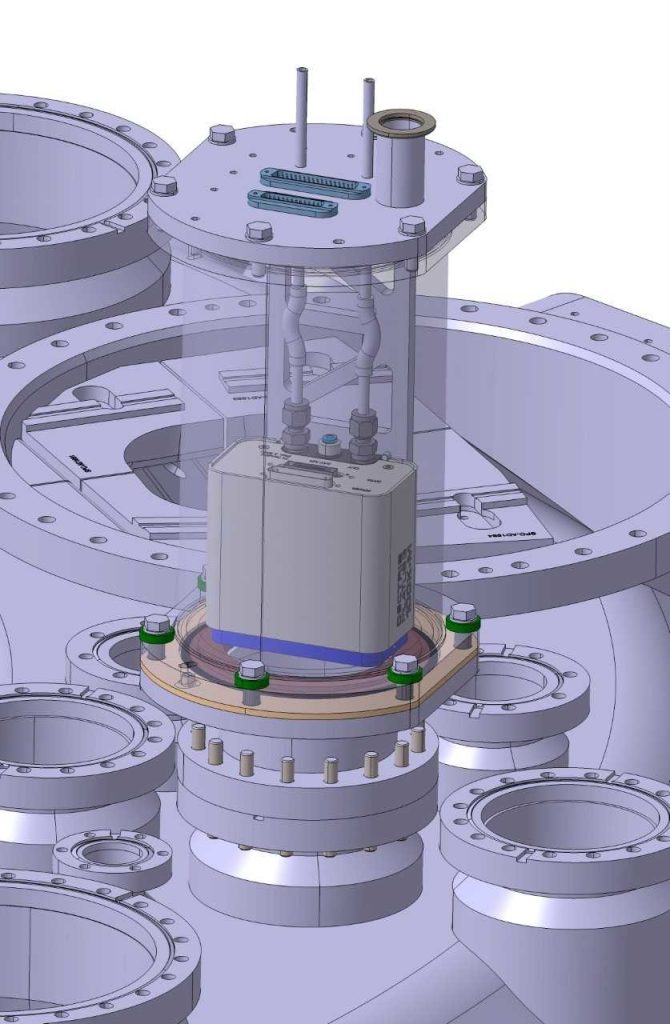
The Pilatus diagnostic is a state-of-the-art x-ray detector used for studying electron temperature profiles and the transport of high atomic number impurities in TCV. This system provides energy-resolved x-ray measurements that are essential for optimizing plasma performance in future fusion reactors.
The Pilatus system operates on the principle of energy-resolved soft X-ray detection. The detector, a Pilatus 3 X 100K-M Si pixelated array, is used in a pinhole camera configuration to capture soft X-ray emissions in the 1.6–30 keV range. Each of its ~100k pixels can be individually adjusted to set energy thresholds, allowing for flexible spectral analysis. The diagnostic distinguishes between characteristic line emission from impurities and bremsstrahlung radiation, providing crucial insights into plasma composition and temperature.
The system is calibrated using known X-ray sources and fluorescence targets to establish the precise relationship between detector settings and energy thresholds.
Deployed on an upper port, the Pilatus diagnostic provides high-resolution, time-resolved measurements of impurity radiation, bremsstrahlung emission which can be used to infer impurity concentration and electron temperature profiles. Its measure will contribute to impurity control strategies essential for sustaining high-performance plasma regimes, supporting advancements in tokamak operation and future fusion reactor designs.
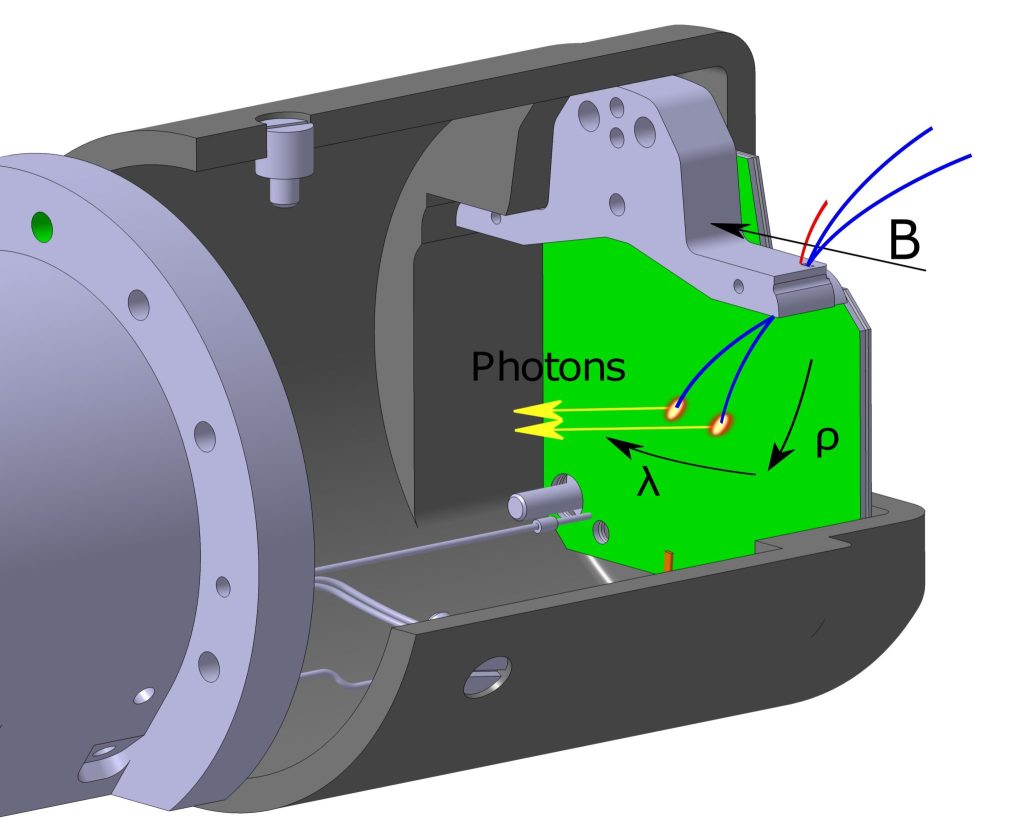
Fast Ion Loss Detectors (FILDs) are used on many fusion devices to measure light from charged particles striking a scintillator plate after passing through a collimator and slit. The strike location reveals the particle’s energy and pitch, defined as the ratio of parallel to total velocity (vparallel / v), with the sign indicating direction relative to the magnetic field. Though this is designed for fast-ion loss detection, FILDs can also detect runaway electrons (REs) with similar gyroradii—for example, a 4 MeV RE with pitch -0.8 behaves like a 6 keV fast ion.
TCV’s FILD features four collimator apertures, enabling simultaneous detection of co- and counter-current losses across magnetic field configurations. Scintillator light is recorded by a high-resolution CMOS camera (~3.6 kHz) and a fast 128-channel Avalanche Photo Diode (APD) camera (>1 MHz bandwidth). The CMOS provides spatial data on lost particle distributions, while the APD tracks fluctuations in loss signals, revealing their frequency spectra.
