
Active diagnostics are a category of measurement techniques on which an external action is required to generate the signal interest. While it can affect the plasma in adverse ways, it has the advantage of providing more constrained spatial information albeit at a repetition rate limited by the external actuator.
The propagation of an electromagnetic wave through a plasma varies depending on its wavelength. In the optical wavelengths, the magnitude of this variation depends solely on the plasma density. The FIR interferometer exploits this principle . By using a reference beam that does not cross the plasma, the phase difference between the probing and reference beams can be used to retrieve the line-integrated density along the path of the electromagnetic wave through the plasma.
Since the other main density diagnostic (Thomson Scattering) typically have a relatively low sampling rate and rely on computationally intensive analysis methods, FIR interferometers are an essential complementary diagnostic for tokamak devices. They are often used to obtain fast estimates of plasma density for real-time density feedback control.
|
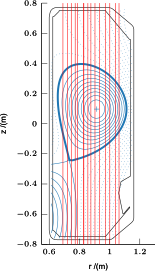
At TCV, the FIR interferometer uses a Mach–Zehnder optical configuration. The light source is a CH₂F₂ laser pumped by a CO₂ laser, generating probing radiation with a wavelength of around 200 µm. The probing beam is split into fourteen chords (see figure of FIR at TCV) that cross the plasma vertically before being recombined with the reference beam and detected using an hot-electron bolometer. |
 |
|
Incoherent Thomson Scattering uses the scattering of laser light by free charged particles to measure the plasma density and temperature. A laser beam of a fixed wavelength is injected vertically into the plasma. By analysing the spectrum of the scattered light, information about the thermal properties of charged particles are extracted. In the incoherent regime, the probing laser light has a wavelength smaller than the plasma charge screening length (Debye length). Because the laser light scatters most often off electrons, Incoherent Thomson Scattering (ITS) is an ideal diagnostic for measuring the spatial profiles of electron density and temperature. |
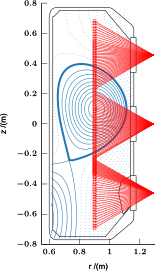 |
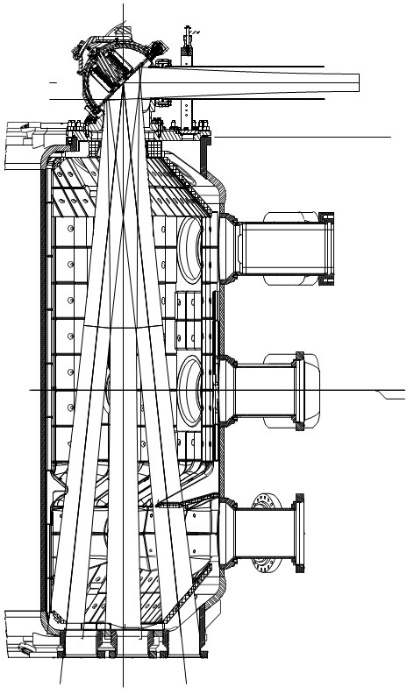
At TCV, the ITS diagnostic uses nanosecond-scale laser pulses from Nd:YAG Q-switched lasers operating at 1064 nm with repetition rates of several tens of hertz. The lasers pass vertically through the vessel. Three camera lenses on a horizontal port collect the scattered light over the entire height of the vacuum chamber (see the figure ITS at TCV) into a fiber bundle. More than a hundred polychromators are used to analyze the scattered light and retrieve the plasma’s thermal properties. Real-time analysis of the signals, with latency below 0.5 ms, enables advanced control of the plasma discharge.
Collective Thomson Scattering (CTS) involves the scattering of light by free charged particles. The coherent regime depends on the probing length associated with the scattering wave vector. This characteristic length scale is determined by the scattering geometry: it is determined by both the magnitude and direction of the incident and scattered light wave-vector. When this probed length scale exceeds the Debye screening length, light scattered from electron populations—experiencing fluctuations at length scales larger than the Debye length—can exhibit coherent interference between individually scattered waves. This leads to more complex scattering spectra, with features characteristic of collective modes that form coherent electron density fluctuation structures. From these features, additional information beyond electron properties (such as the ion temperature) can be extracted.
|
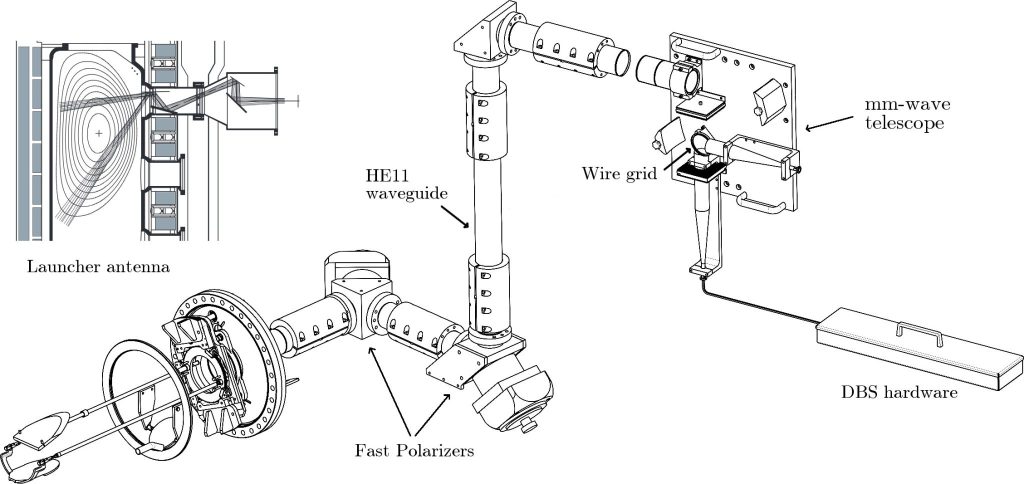
Understanding ion confinement and the influence of fast ions on ion temperature is critical for fusion plasma. CTS is therefore considered a key diagnostic for studying fast ions and turbulence physics. At TCV, a CTS diagnostic is currently under development. Due to port limitations for the probe beam, the CTS system will use a top launcher and the existing 1 MW, 126 GHz gyrotron (installed for ECR plasma heating) as an incident light source, with power modulation applied to enable signal to background discrimination. |
 |
For the scattered light measurement, CTS will share an equatorial launcher used by other diagnostics such as Doppler Backscattering and Electron Cyclotron Emission. Both launcher angles can be scanned to probe different plasma regions or move the electron cyclotron resonance outside the CTS scattering volume. The receiver will use heterodyne detection with a 124 GHz local oscillator and 14-bit, 5 GHz digitization. This acquisition scheme is expected to be sufficient to resolve thermal ion fluctuations.
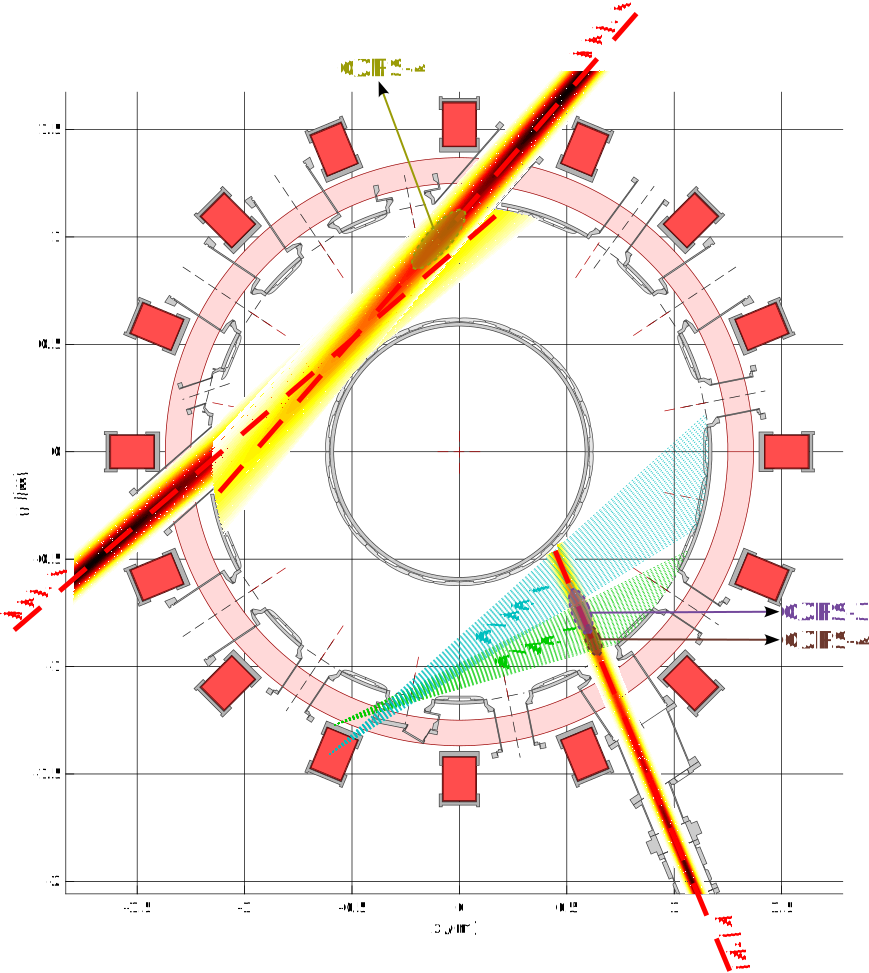
While impurities are usually undesirable inside tokamak plasmas, CXRS diagnostics utilize naturally present or intentionally injected impurity species to probe the ions . CXRS benefits from the larger charge exchange recombination cross section of fully stripped impurity ions. From the spectral analysis of well-characterized transitions, impurity density, temperature, and drift velocities of ion impurities can be determined from the line intensity, spectral broadening, and spectral shift, respectively.
In practice, an external diagnostic neutral beam injector is used to better define the origin of the emitted light.
Unlike many devices, TCV features a low-power (~80 kW) Diagnostic Neutral Beam Injector (DNBI) oriented almost perpendicularly to the torus. The DNBI enables low-perturbation ion velocity profile studies without applying external torque to the plasma. Four dedicate CXRS systems detect the radiation from this beam: two toroidal systems, one poloidal system near the plasma axis and one with higher resolution on the low field side edge. Together, these provide a comprehensive measure of the ion impurities in TCV.
Fast-Ion D-alpha (FIDA) diagnostics are an adaptation of charge exchange recombination spectroscopy (CXRS) used to study confined fast-ion distributions. They detect Doppler-shifted Balmer-alpha light emitted during charge exchange interactions between fast hydrogen ions and neutral atoms. The large Doppler shift of energetic ions separates their emission from other Balmer-alpha sources, enabling detection of the typically weak fast-ion signals.
The spectral shape reveals energy distributions and directional information, while intensity relates to the fast-ion and neutral densities. Quantitative interpretation of FIDA spectra requires forward modeling or tomographic reconstruction. Active FIDA uses neutral beam injection (NBI) to provide localised measurements, while passive FIDA arises from interactions with background neutrals, especially near the plasma edge where the neutral density is higher.

The core of fusion plasmas is a highly turbulent environment, as one might expect in a medium that is heated to extremely high temperatures and that acts as a “furnace” releasing energy through fusion reactions, much like the core of the sun. Turbulence is often described as a sea of eddies, such as can be observed in a turbulent body of water. These eddies act as channels for particles and energy to be transported efficiently, and as such, counteract the organized, well-confined structure that fusion scientists strive to engineer using magnetic fields. In short, turbulence is a nuisance that reduces the performance of fusion plasmas. It is important then to study its properties and devise ways to minimize it, whenever possible.
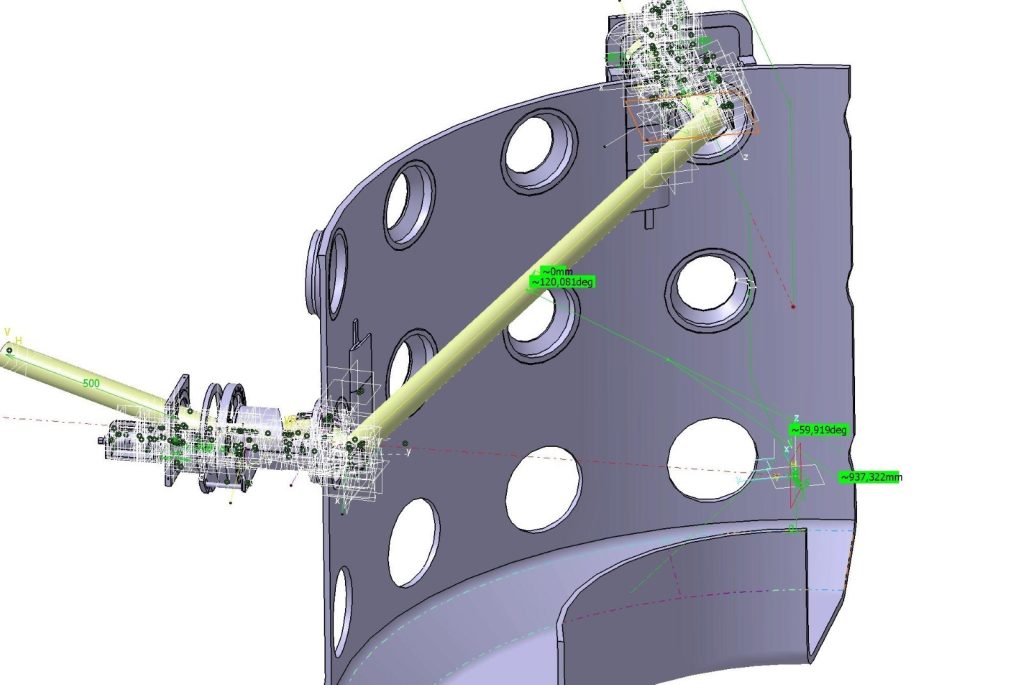
The Tangential Phase-Contrast Imaging (TPCI) diagnostic measures fluctuations in density. Infrared light (at a wavelength of 10.6 mm) is injected into the device as a narrow beam created by a CO2 laser. As it propagates through the plasma, the beam is not absorbed, but its phase is altered by the fluctuating density – it develops invisible “wiggles” that can be detected by an apparatus that uses a phase-contrast filter: this is equivalent to the so-called phase-contrast microscope used in biology, which permits the observation of diaphanous objects that do not absorb or reflect light. The tangential geometry – the beam direction has a large toroidal component – combined with optical manipulations results in a highly localised measurement, giving us a “map” of turbulent density throughout the plasma.
TPCI is complemented by a Short-Pulse Reflectometer (SPR). This is, in short, a radar. Electromagnetic pulses in the microwave range (50-80 GHz) are launched into the plasma. At these frequencies, electromagnetic waves encounter so-called “cutoff” locations, defined by the plasma properties (primarily its density). At these locations, the waves are reflected back. As the waves are in the form of short pulses (less than 1 nanosecond), one can simply measure their time of flight back to the point of departure, which allows one to locate the cutoff layer in space. By constantly scanning the pulse frequencies, a large fraction of the plasma is scanned, and the spatial variation of density can be reconstructed. Furthermore, as the pulses are so short, the scans can be very rapid and fast density fluctuations can also be estimated.