
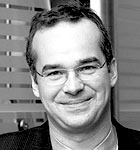
Full Professor of Finance
Swiss Finance Institute Senior Chair
Director, College of Management
Email: [email protected]
Phone: ++41 (0)21 693 0098 / Fax: ++41 (0)21 693 0110
Postal: Swiss Finance Institute @ EPFL
Quartier UNIL-Chamberonne, Extranef 211
CH – 1015 Lausanne, Switzerland
Profile
RUEDIGER FAHLENBRACH is Full Professor at Ecole Polytechnique Fédérale de Lausanne (EPFL), Switzerland. He holds a senior chair from the Swiss Finance Institute. Formerly on the faculty of the Fisher College of Business of the Ohio State University (USA), he received a Ph.D. in Finance from the University of Pennsylvania (Wharton). Since August 2022, he is director of the College of Management at EPFL.
He has research interests in empirical corporate finance, in particular corporate governance and entrepreneurship. Ruediger Fahlenbrach has published in the leading academic journals in finance, including the Journal of Finance, the Journal of Financial Economics, the Review of Financial Studies, the Review of Finance, and the Journal of Financial and Quantitative Analysis.
Ruediger has been elected director of the European Finance Association (2018-2020). He is former Associate Editor of the Review of Finance (2014-2021) and former Associate Editor of the Review of Financial Studies (2013-2016) and Financial Management (2012-2016).
Ruediger is a research member of the European Corporate Governance Institute. He is the chairman of the scientific advisory board of IWH – Leibniz-Institut fuer Wirtschaftsforschung Halle. He is member of the Unigestion academic advisory board.
His research has been reported in many large-circulation newspapers such as The New York Times, The Wall Street Journal, The Economist, Le Temps, NZZ, Handelsblatt, Forbes Magazine, USA Today, and Fortune Magazine.
He regularly teaches executive education modules at EPFL, IMD, and SFI.
Publications
Fahlenbrach, Rüdiger, Alexei Ovtchinnikov, and Philip Valta, 2026, Direct democracy, corporate political strategy, and firm value, forthcoming Management Science.
Fahlenbrach, Rüdiger, and Eric Jondeau, 2023, Greening the Swiss National Bank’s Portfolio, Review of Corporate Finance Studies 12, 792-833.
Efing, Matthias, Rüdiger Fahlenbrach, Christoph Herpfer, and Philipp Krueger, 2023, How do investors and firms react to an unexpected currency appreciation shock?, Review of Corporate Finance Studies 12, 488-538.
Kim, Hyemin, Fahlenbrach, Rüdiger, and Angie Low, 2023, CEO networks and the labor market for directors, Journal of Empirical Finance 70, 1-21.
Fahlenbrach, Rüdiger, and Marc Frattaroli, 2021, ICO investors, Financial Markets and Portfolio Management 35, 1-59.
Fahlenbrach, Rüdiger, Kevin Rageth, and René M. Stulz, 2021, How valuable is financial flexibility when revenue stops? Evidence from the COVID-19 crisis, Review of Financial Studies 34, 5474-5521.
Fabisik, Kornelia, Rüdiger Fahlenbrach, René M. Stulz, and Jerome Taillard, 2020, Why are firms with more managerial ownership worth less?, Journal of Financial Economics 140, 699-725.
Fahlenbrach, Rüdiger, Robert Prilmeier, and René M. Stulz, 2018, Why does fast loan growth predict poor performance for banks?, Review of Financial Studies 31, 1014-1063.
Fahlenbrach, Rüdiger, Angie Low, and René M. Stulz, 2017, Do independent director departures predict future bad events?, Review of Financial Studies 30, 2313-2358.
Schmidt, Cornelius, and Rüdiger Fahlenbrach, 2017, Do exogeneous changes in passive institutional ownership affect corporate governance and firm value?, Journal of Financial Economics 124, 285-306.
Boyson, Nicole, Fahlenbrach, Rüdiger, and René M. Stulz, 2016, Why Don’t all Banks Practice Regulatory Arbitrage? Evidence from Usage of Trust-preferred Securities, Review of Financial Studies 29, 1821-1859.
Cronqvist, Henrik, and Rüdiger Fahlenbrach, 2013, CEO Contract Design: How Do Strong Principals Do It?, Journal of Financial Economics 108, 659-674.
Evans, Richard B., and Rüdiger Fahlenbrach, 2012, Institutional Investors and Mutual Fund Governance: Evidence from Retail – Institutional Fund Twins, Review of Financial Studies 25, 3530-3571.
Fahlenbrach, Rüdiger, Robert Prilmeier, and René M. Stulz, 2012, This Time is the Same: Using Bank Performance in 1998 to Explain Bank Performance During the Recent Financial Crisis, Journal of Finance 67, 2139-2185.
Fahlenbrach, Rüdiger, and René M. Stulz, 2011, Bank CEO Incentives and the Credit Crisis, Journal of Financial Economics 99, 11-26.
Becker, Bo, Henrik Cronqvist, and Rüdiger Fahlenbrach, 2011, Estimating the Effects of Large Shareholders Using a Geographic Instrument, Journal of Financial and Quantitative Analysis 46, 907-942.
Fahlenbrach, Rüdiger, Bernadette Minton, and Carrie Pan, 2011, Former CEO Directors: Lingering CEOs or Valuable Resources?, Review of Financial Studies 24, 3486-3518.
Fahlenbrach, Rüdiger, Angie Low, and René M. Stulz, 2010, Why Do Firms Appoint CEOs as Outside Directors?, Journal of Financial Economics 97, 12-32.
Fahlenbrach, Rüdiger, and Patrik V. Sandås, 2010, Does information drive trading in option strategies?, Journal of Banking and Finance 34, 2370-2385.
Cronqvist, Henrik, and Rüdiger Fahlenbrach, 2009, Large Shareholders and Corporate Policies, Review of Financial Studies 22, 3941-3976.
Fahlenbrach, Rüdiger, and René M. Stulz, 2009, Managerial Ownership Dynamics and Firm Value, Journal of Financial Economics 92, 342-361.
Fahlenbrach, Rüdiger, 2009, Founder-CEOs, Investment Decisions, and Stock Market Performance, Journal of Financial and Quantitative Analysis 44, 439-466.
Fahlenbrach, Rüdiger, 2009, Shareholder Rights, Boards, and Executive Compensation, Review of Finance 13, 81-113.
Fahlenbrach, Rüdiger, and Patrik V. Sandås, 2009, Co-movements of Index Options and Futures Quotes, Journal of Empirical Finance 16, 151-163.
Dlugosz, Jennifer, Fahlenbrach, Rüdiger, Gompers, Paul, and Andrew Metrick, 2006, Large Blocks of Stock: Prevalence, Size, and Measurement, Journal of Corporate Finance 12, 594-618.
Working Papers
See the newest versions of the working papers
Becker, Bo, Rüdiger Fahlenbrach, and Ehsan Mahdikhani, 2026, The global rise of index-based ownership of firms.
Abstract: We develop a simple and replicable five-variable model that identifies index-based investors with 98% accuracy. Our analysis shows that index ownership grew from 3.0% of global market capitalization in 2004 to 16.9% by 2023, driven by growth in explicit indexing. By the end of 2023, index-based investors own 10 percent or more of 5,300 firms globally. In the U.S., mid-caps have more index ownership than large-caps. In Asia and Europe, index ownership increases with firm size, and only the largest firms experience significant index ownership. Differences in market capitalization and free float help explain regional variations in index ownership.
Fahlenbrach, Rüdiger, Minsu Ko, and Rene Stulz, 2026, Politics, regulation, and bank payouts.
We investigate the impact of politics and regulation on large banks through the lens of payouts. Large banks, but not large industrial firms, have lower payouts under Democratic presidents. After the Global Financial Crisis, regulators favored repurchases for large banks and these banks shifted the composition of their payouts accordingly. The greater flexibility of repurchases makes them more sensitive to politics than dividends. Large banks increased repurchases following the first election of Donald Trump. They had high abnormal returns compared to industrial firms following each election of President Trump, but negative abnormal returns following the election of President Biden.
Fahlenbrach, Rüdiger, Nicolas Rudolf, and Alexis Wegerich, 2026, Leading by example: Can one universal shareholder’s voting pre-disclosure influence voting outcomes?
Abstract: We analyze the impact of a large shareholder disclosing its voting decisions prior to shareholder meetings on final vote outcomes for management and shareholder proposals. We find that pre-disclosures of against votes lead to an average increase of 2.7 percentage points in against votes by other shareholders. Voting pre-disclosures are more effective for proposals with a higher information demand, and if the large shareholder pre-discloses a decision that is not directly observable from its proxy-voting guidelines. The results highlight the potential for large institutional investors to use voting pre-disclosure as a tool for influencing other shareholders and, ultimately, companies.
Fahlenbrach, Rüdiger, Leandro Sanz, and Rene Stulz, 2026, Organization capital, large startups, and the dearth of IPOs.
Abstract: Many startups in the 2000s have remained private after achieving large valuations, a pattern that funding availability alone cannot explain. We propose that startups relying heavily on organization capital to achieve economies of scale and network effects through digital technologies are more likely to become large private firms than exit earlier via an IPO or acquisition. Using LinkedIn data, we construct a novel measure of organization capital intensity for startups. Exploiting a legal shock that strengthened organization capital protection, we provide causal evidence that organization-capital-intensive startups are more likely to remain private and grow large rather than exit early.
Fahlenbrach, Rüdiger, Sophie Rotermund, and Sascha Steffen, 2023, What explains the changes to the LBO debt market post financial crisis?
Abstract: Banks incurred large losses from their exposure to committed but unfunded LBO deals during the global financial crisis (GFC). Post-crisis, banks significantly changed their LBO lending practices. Private equity sponsors provide about 25% more equity. Lower bank debt is mainly driven by fewer bridge loans. Lending syndicates are larger and per lender exposure decreased. Moreover, a larger part of the term funding is coming from non-banks. Banks “pre-syndicate” loans to CLOs before closing of the deal. The portion of LBO debt retained by the lead arranger and not passed through, became more expensive compared to debt held by non-banks.
Teaching
Teaching in the MFE Program
Introduction to Finance (2010-2019)
Venture Capital
Teaching in the EPFL Bachelor Program
Foundations in Financial Economics
Teaching in the SFI Ph.D. Program
Empirical Corporate Finance (2009-2022)
Teaching in the EPFL EMBA Program
Managerial Finance (2016-2023)