
1. Timing of Cellular Decisions
Cellular checkpoints prevent the propagation of errors, yet these safeguards are often overridden. We are advancing the quantitative study of checkpoint override, showing that it can represent an adaptive, fitness-enhancing strategy — rather than the ‘failure’ of the surveillance system. Using mathematics, novel biosensors, and dynamic perturbations, we are uncovering the principles and mechanisms by which cells balance competing demands of repair and proliferation.

2. Directed Evolution, AI- and Physics-based Design of Computational Protein Functionalities
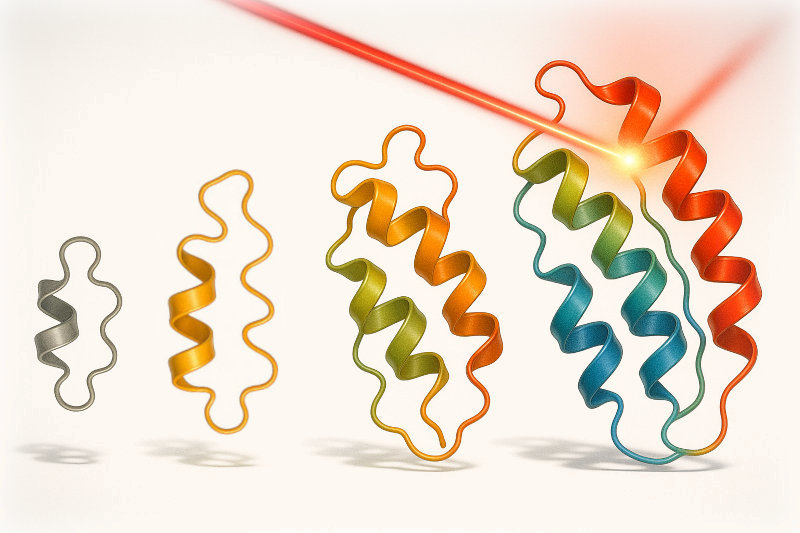
Dynamic, switchable proteins are central to cellular computation but have been challenging to engineer. We developed optovolution, the first continuous directed evolution platform for such proteins. This method enables the continuous evolution of switching properties, logic functions, and signal responsiveness. Now, we are combining directed evolution with AI-based design and biophysical analyses to create single-protein computers.
3. Neural Computation Across Timescales
We extend our focus on timing to the nervous system, using C. elegans as a model. With custom imaging systems, microfluidics, and deep learning analysis, we map how interneurons compute sensorimotor transformations. Our work reveals that neurons influence behavior across unexpectedly long timescales and through synergistic, non-additive interactions, enabling better predictive models of brain function.

4. Cross-Cutting Tools and Concepts
Conceptually, our research interests are centered on timing, computation, and evolutionary engineering in living systems across projects. We pursue these topics also across scales, from proteins and cells to neural circuits. We develop and apply molecular and computational tools that cut across all our projects. On the molecular side, we design light- and chemical-controlled perturbation systems, biosensors, and evolution platforms that allow us to probe and re-engineer biological dynamics with precision.
On the computational side, we advance machine learning approaches for analyzing complex biological data, such as our deep learning models for image processing: machine learning-based approaches for yeast cell segmentation and tracking and a neural network pipeline for analyzing C. elegans brain activity, relying on targeted augmentation methods for efficient 4D neuron tracking.
All images on this page were generated with ChatGPT 5.
Last update: 23.09.2025