Current Projects
Data science as a discipline located at the interface between statistics and computer science, is increasingly becoming part of administration practices at all levels of government. Driven by the ever-growing scale of data collection and processing, the emergence of data science requires new kinds of expertise and new kinds of infrastructures. This project aims to study the development of data science practices in the context of public administration through an ethnographic approach. It will investigate the technical practices of quantification and their constitution through social interactions and organizational dynamics, with a focus on Switzerland.

Completed Projects
The archive of science is the place where scientific practices are sedimented in the form of drafts, protocols of rejected hypotheses and failed experiments, obsolete instruments, outdated documentation, internal correspondence, and other leftovers. Today, just as science goes more and more digital, so does its archive, giving rise to new research practices and opening new frontiers of knowledge for the historian (from big data to the longue durée). These collections clearly differ from the traditional lieux de mémoire filled with thoroughly selected and carefully stored tangible objects. What do these new digital repositories do to archival items? What regimes of knowledge and memory do they presuppose? How can they be made meaningful for queries of the historians and of the wider public?
To answer these questions, the project outlines new hermeneutics for the digital archive of science, looking both at its infrastructures (Linked Data technologies) and its methods (distant reading). Mixing theoretical reflection with case studies based on the archives of CERN and EPFL, the study assembles the elements of a humanist (instead of engineering-oriented) ontology for the scientific archive, transferring concepts and perspectives from the history of science into a computational language. By questioning the epistemological foundations of the digital archive of science, as well as the ways of processing and interpreting such an archive, the research provides a critical contribution to the good practices of both the computational history of science and the archival policies of scientific institutions.
The project is funded by a doc.CH fellowship from the Swiss National Science Foundation.
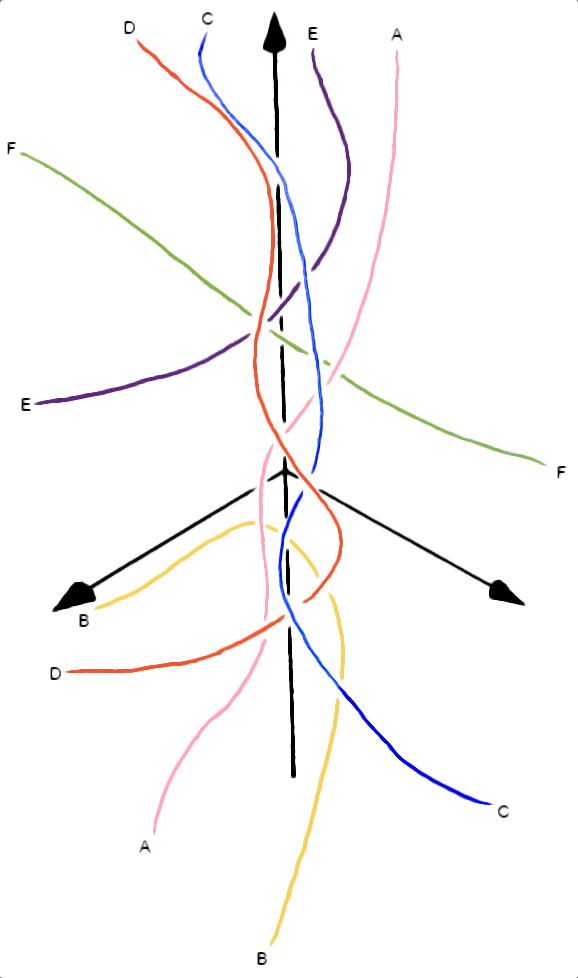
In an effort to understand our digital culture, recent studies have demonstrated the importance of online mobility: on the one hand, search engines never fully satisfy users who tend to rely more on step-by-step contextual navigation, while, on the other hand, existing recommendation algorithms do not foster navigability. Indeed, the investigation of “interaction traces” (understood as the sequential records of a user’s interactions within one or across multiple platforms) shows that users favor personal navigation over search algorithms, steering their own personal course through an ever-growing cloud of data.
In spite of this strong evidence, no tool has in turn been given the user to regain control over her digital mobility, nor has there been any humanistic study on matters of navigation practices within a digital environment. Bringing anthropological queries and concepts into the picture, and drawing on recent efforts in software engineering to model different types of navigation practices, this project aims at furthering the inquiry on intellectual mobilities within anthropology, and empowering the user by providing her with the tools to generate her own personal mobilities.
This project is funded by the Collaborative Research on Science and Society (CROSS) Program of the University of Lausanne and EPFL. Our research partner at the University of Lausanne is Dr. Jean-François Bert.
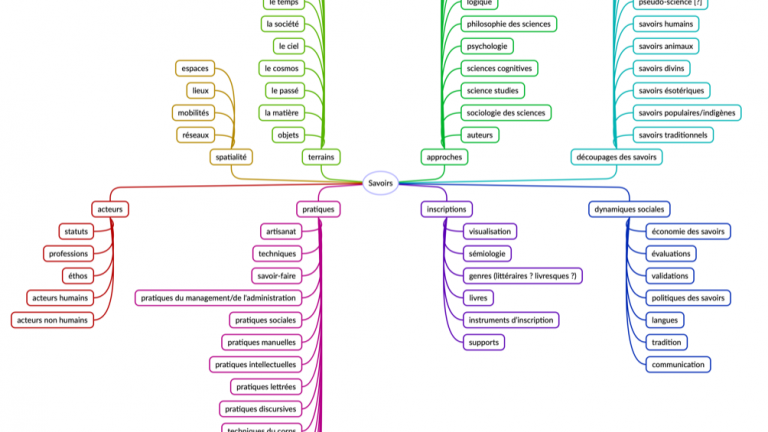
Building on the editorial success of the Lieux de savoirs led by Christian Jacob, Savoirs is a born-digital platform that offers its users to navigate a massive database of works gathering the essays of the Lieux de savoirs, publications from OpenEdition, as well as dedicated new contributions, colloquia proceedings, and peer-reviewed student works. A complement to published printed books, Savoirs is not a search engine nor a simple repository to the extent that, feeding on the specific potentialities inherent to the digital, it fosters new forms of research and visualisation, generates new links and ceaselessly reshapes the chart of the field of history and anthropology of knowledge.
Conceiving of intellectual reflexion as a journey through questions and hypotheses allowing the steering of a problematized course within source materials, Savoirs helps generate reading paths through topical associations and recommendations. Embedded within a web page accessible to anyone with a standard internet browser, the platform is structured in three columns: the central one displaying the contribution to be viewed, and two side columns giving the user full control over the parameters of her research so that she can easily and freely roam the database through suggestions and navigation strategies. Fleshed out around three indexing tools — a chronology, a conceptual thesaurus, and geographical localisation —, the platform’s path-generating algorithm enables readers to fine tune step-by-step the settings of their queries.
Savoirs is a collective and collaborative endeavour that brings together contributors from the École des Hautes Études en Sciences Sociales in Paris, the École Nationale des Sciences de l’Information et des Bibliothèques in Lyon, the Bibliothèque Nationale et Universitaire de Strasbourg, the University of Lausanne and EPFL.