
Bright single-photon emitters (SPEs) are essential building blocks for quantum communication, linear optical quantum computing, and sensing as they can emit exactly one photon at a time and thus be used to encode information. However, most of those emitters require cryogenic temperatures to operate as a single photon source, which constitutes a bottleneck for large-scale applications.
III-nitrides are a class of wide bandgap semiconductors that feature a large variety of quantum light sources, spanning from the UV to the telecom O-band. Benefiting from a well-established technological platform inherited from the solid-state lighting revolution, they offer a unique versatility for facilitating the development of room-temperature (RT) SPEs. Our aim is to investigate and tailor such promising III-nitride based quantum emitters for energy- and cost-efficient single-photon generation.
Among III-nitride emitters, GaN/AlN quantum dots emerged as the first promising candidates, and have been shown for over a decade to act as bright UV RT SPEs [1-2]. Their fundamental properties remain however largely unraveled, hindering their practical use and motivating their long-lasting investigation in our group.
More recently, radiative point defects present in bulk GaN and AlN epilayers have also been shown to act as RT SPEs, spanning a wide wavelength range with emitters reported both in the visible-near infrared and around the telecom O-band. Their fundamental origin and formation mechanism, however, remain elusive. Our current research activities are focusing on the identification of such point defects, the control of their formation and the enhancement of the single photon collection efficiency through the development of tailored photonic structures. The combination of these aspects should enable the deterministic positioning of photonic structures around SPEs – an essential requirement to obtain scalable photonic devices.
[1] S. Tamariz et al., ACS Photonics 7, 1515-1522 (2020).
[2] J. Stachurski et al., Light: Science & Applications 11, 114 (2022).

Fig. 1: Artist’s impression of the excitation and collection scheme of a single GaN/AlN quantum dot. Inset: Second-order autocorrelation function measurement showcasing a record high single-photon purity of 0.17 at room temperature, highlighting the quantum nature of the emitted light.
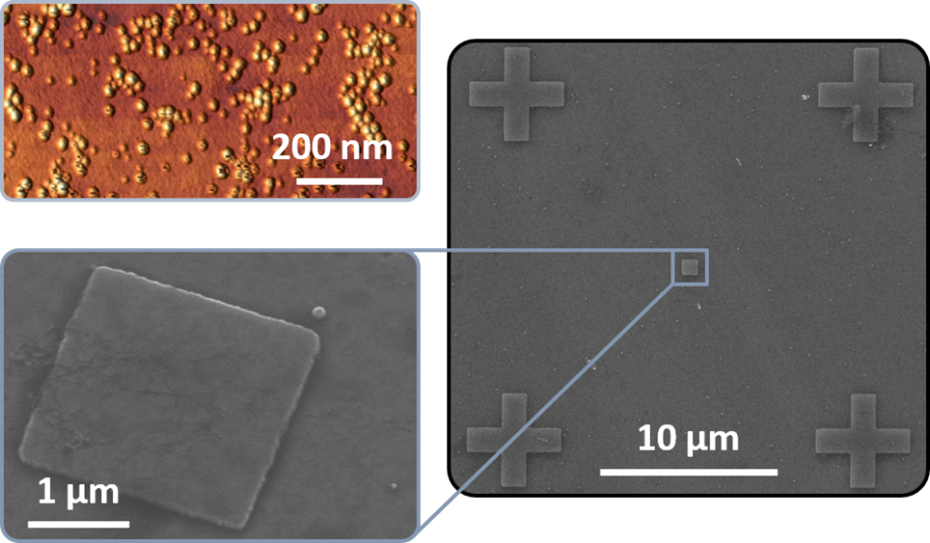
Fig. 2: AFM image (top-left) of a self-assembled quantum dot sample before evaporation of the top layer, plan (bottom-left) and birds eye view (right) SE images of the patterned surface after etching.
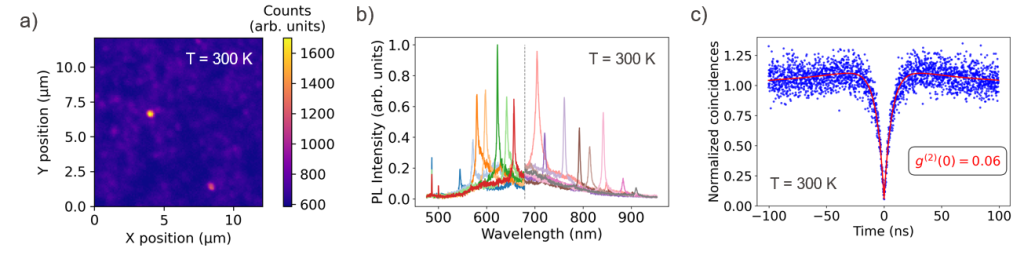
Fig. 3:
(a) Room temperature micro-photoluminescence (PL) intensity map of an MOVPE-grown GaN on sapphire layer centered at 580 nm. This map features two bright spots identified as single-photon emitters (SPEs). (b) Optical signatures of 15 distinct SPEs with emission wavelengths ranging from 550 nm to 910 nm, selected from two micro-PL maps acquired with complementary spectral windows. (c) Second-order autocorrelation function measurement of a GaN SPE at room temperature fitted with a 3-level system model, yielding an excellent single-photon purity of about 94%.