
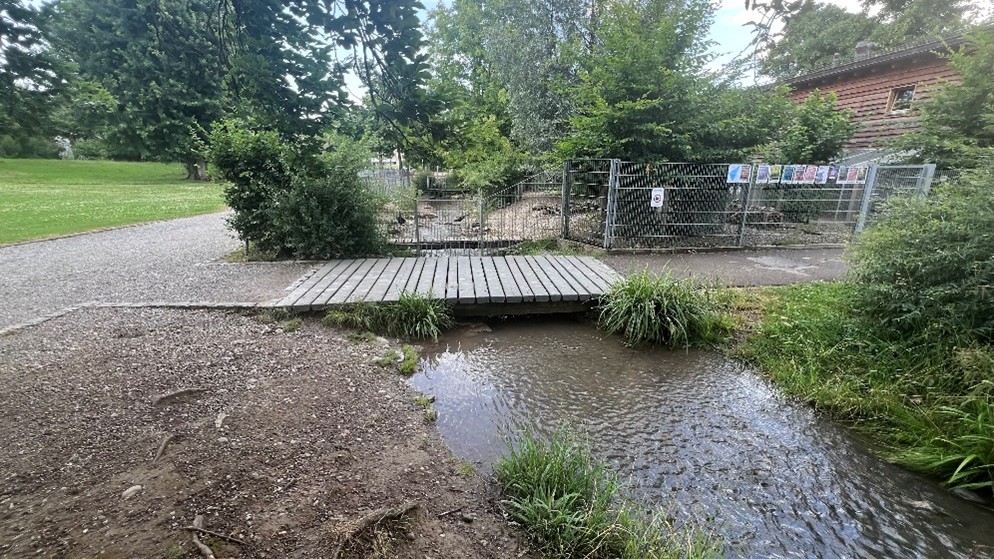
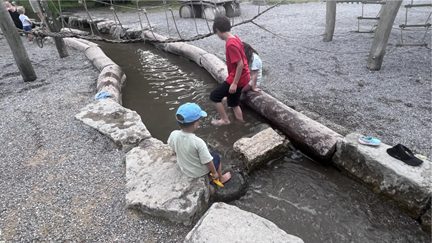
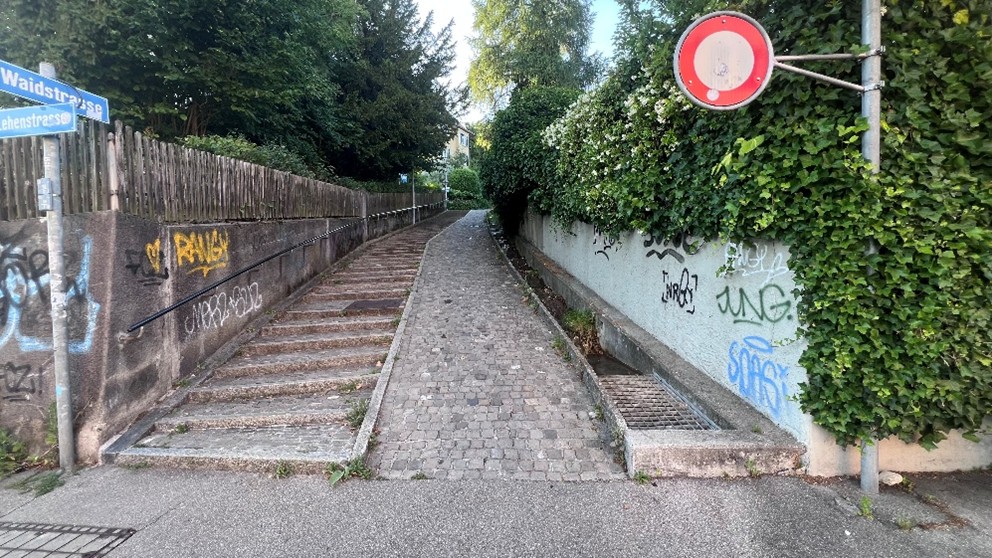
Photos by Yiqun Wang (2025). Faces have been intentionally blurred for privacy. Used with research purpose only.
This research examines urban stream daylighting as a spatial and cultural instrument for ecological and perceptual transformation. Focusing on Zurich’s Bachkonzept (1988–present), a long-term initiative that has reintroduced over 30 waterways into the urban fabric, the project engages with the program not only as an ecological intervention but as a process of cultural re-inscription. While the initiative is internationally recognized for its hydrological and biodiversity contributions, its aesthetic, historical, and symbolic dimensions remain underexplored.
Situated at the intersection of landscape architecture, urban ecology, and infrastructure studies, this research draws on the theoretical model of the Hyper Landscape Cyborg—a framework proposed by Yiqun Wang to conceptualize the entangled, post-natural condition of hybrid landscapes shaped by both technological mediation and cultural narratives. The Hyper Landscape Cyborg integrates aesthetics, ecology, technology, and culture to address the complexity of post-toxic landscapes. Grounded in assemblage theory, it views landscape not as a unified whole but as a dynamic constellation of heterogeneous elements—pollution, restoration, memory, and infrastructure—temporarily held together through design. By embracing multiplicity, partial perspectives, and open-ended succession, the framework reframes stream daylighting and ecological repair as culturally charged, materially situated acts of reassembly.
Through a multi-scalar, mixed-method approach, five stream cases in Zurich are analyzed across three core dimensions: spatial transformation, perceptual experience, and cultural legibility. Methods include GIS-based chronomapping of morphological change, AI-supported aesthetic and object recognition analysis, and participatory tools such as community surveys and symbolic memory mapping. Together, these methods seek to capture both the visible and submerged dynamics that shape the urban waterscape as a lived and evolving entity.
At LAND, we contribute to the broader exploration of green space transitions by foregrounding the hydrosocial function of landscape infrastructures. This research critically addresses how reassembled water flows—though technically “clean”—intersect with historical sanitation ideologies, community narratives, and emerging notions of urban commons. By highlighting the cultural and affective dimensions of water infrastructure, the project seeks to question dominant framings of stream restoration as neutral or technical, instead advancing a more situated, narrative-rich understanding of design outcomes.
Ultimately, the project reframes stream daylighting as more than an ecological fix. It positions water reappearance as a critical design practice that enables new relationships between infrastructure, public space, and collective environmental imagination. In doing so, it contributes a transferable framework for evaluating the symbolic and experiential dimensions of urban ecological infrastructures within climate-adaptive city-making.