
Double Truth II is an immersive, interactive installation that investigates how contemporary technologies can replicate cultural artefacts with unprecedented fidelity.

At its core is a selection of sacred sculptures from the Bihar Museum collections—drawn from Jain, Hindu, and Buddhist traditions—which are digitally reinterpreted with exact replications and ultimate fidelity.
The installation invites visitors to engage with a seminal collection of nineteen sculptural forms through a meditative practice of circumambulation, echoing traditional modes of engagement. As participants rotate a human-scale platform, they encounter both photorealistic and abstracted renderings of these objects, offering dual perspectives on materiality and transformation. This sensory journey is deepened by a spatialized soundscape composed of ethnographic music recordings, enriching the experience and drawing visitors into an embodied, multisensory dialogue with the objects.
Double Truth II not only showcases the power of digital reproduction but also reflects on the philosophical and spiritual dimensions of presence, perception, and cultural memory in the post-digital age. As algorithms and computer vision systems reprocess and interpret these objects, they reveal latent visual structures—what may be described as the “optical unconscious” of art—inviting us to question how meaning and presence are constituted in digital representations.
The 3D models in Double Truth II offer new ways of perceiving what is not immediately visible, opening up speculative connections and previously unexamined materialities. These re-presentations evoke affective resonances with the original objects, inviting an intimate encounter with texture, patina, and geometry. The installation draws on the philosophical concept of “double truth” to suggest the coexistence of multiple ways of knowing—material and immaterial, historical and speculative. At the same time, it reflects critically on the evolving nature of cultural artefacts in the age of digital transformation.
Credits:
Concept, design and direction: Sarah Kenderdine, EPFL
Application software: Sherif Medhat, Adriano Viegas Milani, Samy Mannane, Nikolaus Völzow, EPFL
Sound: Mathieu Clavel, EPFL
Platform engineering: Countdown Company
Photogrammetry: Paul Bourke, Sarah Kenderdine, EPFL
Research: Marnie Feneley
Collection: Bihar Museum, Patna, India
Curatorial Support: Moumita Ghosh, Bihar Museum, Patna, India
Acknowledgements
Double Truth II (2025) Ⓒ EPFL Laboratory for Experimental Museology, created in collaboration with Bihar Museum as part of Digital Twins: Negotiating identity and translocated heritage in the global age (2023-2026), an Indo-Swiss Joint Research Programme: Heritage and Cultural Exchange in Global Age, an initiative of Swiss State Secretariat for Education, Research and Innovation (SERI) and the Indian Department of Science and Technology (DST), administered by the Swiss National Science Foundation. Research partners include EPFL, Indian Institute of Technology Jodhpur, IIT Indore, Flame University and Université de Genève.
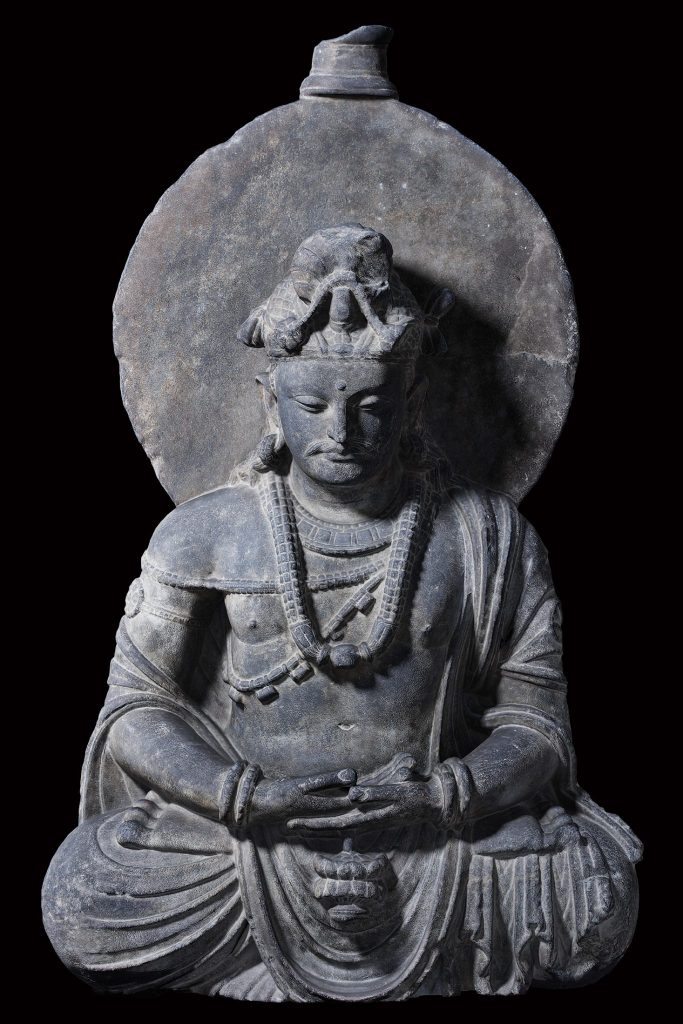
Representation: Seated Bodhisattva, Dhyanmudra
Tradition: Buddhist
Provenance: Charasadda, Pakistan
Date: 1st century CE
Material: Schist Stone
Dimensions: 30 x 60 x 25 cm
Collection: Bihar Museum
Accession: Arch. 10781
Object description:
This sculpture is in the Ghandaran style and is from the region formally known as Gandara in Pakistan/Afghanistan. This seated Bodhisattva is in mediation in the dhyanmudra position, with a lotus hanging below his hands. It is possible to identify this as a Bodhisattva rather than a Buddha by the small buddha seated in his headdress. His clothes are heavy and draped which is typical for this region. As is usually the case the Bodhisattva has rich jewelry and clothing like that of a prince. He has a curled moustache and a jewel in the middle of his forehead. He sits in front a large round halo with a small parasol at the top. A Buddha has achieved enlightenment for themselves, while a bodhisattva stays on earth and delays their own enlightenment to help others.
Audio:
Performer: Master Krishnarao – Buddha Vandana
Source: 78rpm record His Master’s Voice, N 92901, 1956
Description: Buddha Vandana refers to the act of paying homage to the Buddha, usually through recitation, chanting, or devotional practice; to express gratitude and respect for the Buddha’s teachings, cultivate humility and mindfulness, and reaffirm commitment to the Buddhist path. Here verses of praise are sung by Pandit Krishnaji Phulambrikar (1898–1974), important Indian vocalist of the 20th century, in his own composition commissioned by minister B. R. Ambedkar in 1956 for official Buddhist events in India.
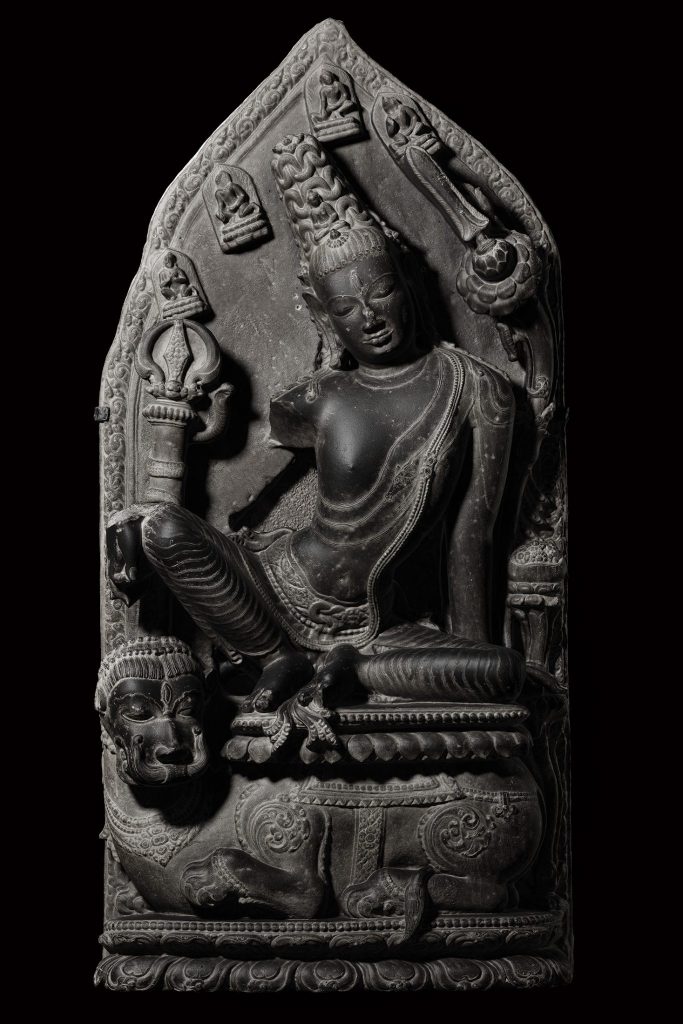
Representation: Bodhisattva Simhanada
Tradition: Buddhist
Provenance: Chilor, Bihar, India
Date: 10th century CE
Material: Black Basalt
Dimensions: 161 x 81 x 29 cm
Collection: Bihar Museum
Accession: Arch. 11396
Object description:
Bodhisattva Simhanada is seated on a lotus placed on the back of a lion. The posture as known as the Maharajalilasana. Left hand is resting on the seat holding the stalk of a lotus from where the sword rises up. The right arm although broken shows the hand resting on the knee. Bodhisattva has a jutamukuta. He has the auspicious Buddhist symbol of a curl (dot) in the middle of his forehead. The vahara (mount) Simha [lion] also has this mark. Four Dayana Buddhas are depicted floating on the back of the pedestal.
Audio:
Performance: Pali Prayer
Source: Religions of INDIA – Argo, ZFB55, 1971
Description: Prayer in Pali in praise of lord Buddha. Held in the Mulagandha Kuti Vihar at Sarnath by Tibetan monks. Recorded by Indian ethnomusicologist Deben Bhattacharya (1921-2001) in Sarnath, 1968.
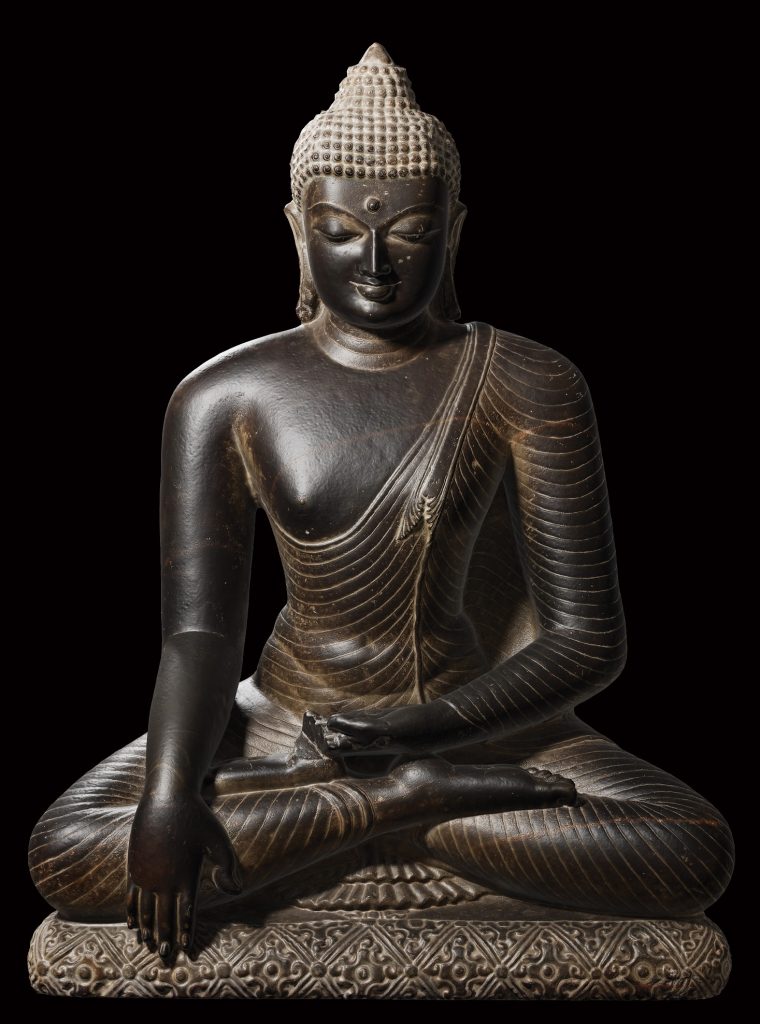
Representation: Seated Buddha, Bhumisparshamudra
Tradition: Buddhist
Provenance: Vishnupur, Gaya, Bihar, India
Date: 11th century CE
Material: Grey Phyllite Stone
Dimensions: 147 x 100 x 47 cm
Collection: Bihar Museum
Accession: Arch. 1681
Object description:
This is a statue of Buddha with curly hair. The right hand is in bhumisparsamudra, and the left hand is on the lap in sthitasana. A conical ushnisha is bulging out at the top of the head from the top knot of the curly locks of hair. This gesture is about the Buddhas victory over the demon King Mara. In it he is calling the earth to witness. If meditated on, this mudra it is believed to bring transformation from anger to wisdom.
Audio:
Performance: Pali Prayer
Source: Religions of INDIA – Argo, ZFB55, 1971
Description: Evening prayer referring to man’s fate and the importance of faith and religion by 20 Buddhist monks from Tripura and Chittagong. Recorded by ethnomusicologist Indian ethnomusicologist Deben Bhattacharya (1921-2001) in the temple of the Mahabodhi Society, Kolkata, 1954.
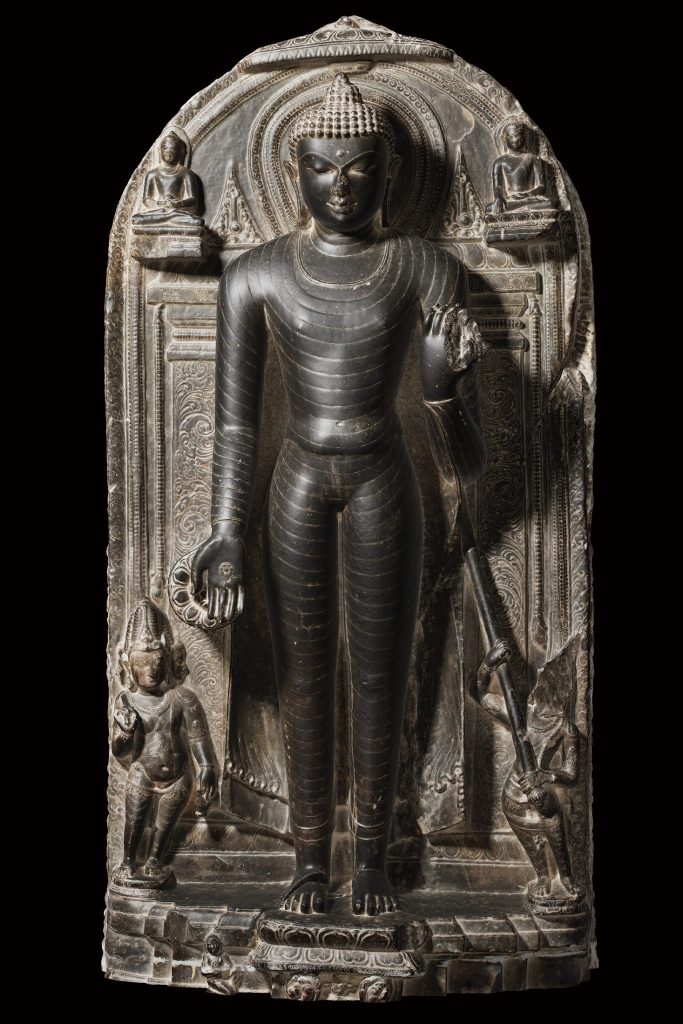
Representation: Buddha, Varadamudra
Tradition: Buddhist
Provenance: Lakhisarai, Bihar, India
Date: 11th century CE
Material: Grey Phyllite Stone
Dimensions: 157 x 82 x 56 cm
Collection: Bihar Museum
Accession: Arch. 23
Object description:
This is a Black basalt Buddha depicting Buddha’s descent from trāyastriṃśa Heaven. With hands in the gesture varadamudra. The left hand holds his robe – Buddha is standing on a double lotus base. In the lower section of the sculpture buddha is flanked by a tiny Brahma and Indra holding the parasol which is above the head of the Buddha. Either side of the main standing Buddha are the figures of Dhyanamudra and Bhumiparamudra (standing on a pedestal with a lotus scroll).
Audio:
Performer: Namo Tatsat
Source: Religions of INDIA – Argo, ZFB55, 1971
Description: Extract from the evening prayer in Pali by the Indian monks at Mulagandha Kuti Bihar in Sarnath, where Buddha delivered his first teachings. Opening with a verse of reverence to lord Buddha, it speaks of the virtues of religion and religiousness. Recorded by Indian ethnomusicologist Deben Bhattacharya (1921-2001) in 1968.
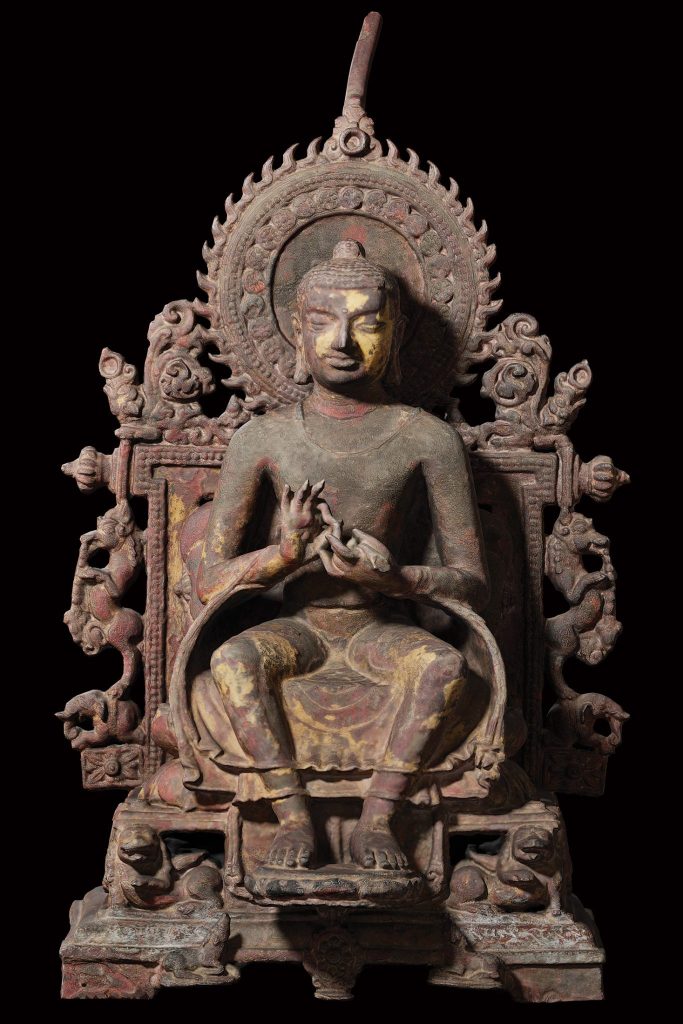
Representation: Buddha, Dhamachakramudra
Tradition: Buddhist
Provenance: Nalanda, BIhar, India
Date: 9th century CE
Material: Bronze Alloy
Dimensions: 33 x 19 x 16 cm
Collection: Bihar Museum
Accession: Arch. 8459
Object description:
This sculpture is a small bronze and a very portable object. It is superior in its casting shows a trace of amalgam gold patina. The feet are in the royal pose. Buddha is seated on a throne with the knees slightly apart. This style of seated Buddha can also be found on occasion in Cambodia and Vietnam. His hands are in the dhamachakramudra – the preaching of the law of the Buddha or turning of the wheel of law. By the 7th century more portable works in bronze were being made and these travelled along the maritime silk route and influenced the iconography of Southeast and East Asia.
Audio:
Performance: Mangalacharana & Trisharana
Source: Musique Religieuse de l’Inde – BAM, LD 5015, 1973
Description: Opening prayer and hymn to the Three Jewels of Buddhism sung in Pali by Buddhist monks in Kolkata. A passage of the Pali Canon, the only completely surviving early Buddhist corpus of sacred texts in Theravadan lineages of Buddhism, composed in North India, and preserved orally until it committed to writing approximately 450 years after the death of the Buddha. Recorded by Indian ethnomusicologist Deben Bhattacharya (1921-2001), 1954
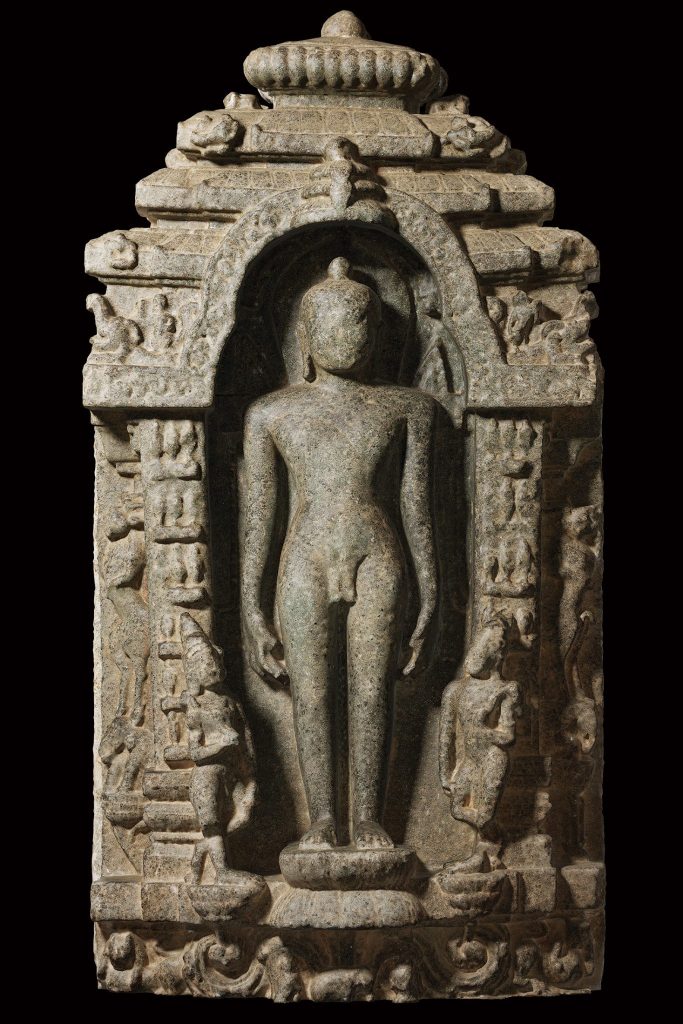
Representation: Tirthankara Ajitanatha
Tradition: Jain
Provenance: Palma, Singhbhum, Jharkhand, India
Date: 11th Century CE
Material: Granite Stone
Dimensions: 214 x 113 x 39 cm
Collection: Bihar Museum
Accession: Arch. 1
Object description:
This is an image of Tirthankara Ajitnath, the second of twenty-four Tirthankaras of the time cycle of Lord Rishabhdev. He is called Ajitnath because he won over all the Kashays, namely those of anger, pride, deceit and greed. His cognizance, the elephant, is depicted on the pedestal.
Audio:
Performer: Bhagwan Nemi Rajul Samwad
Source: LP, Jain Bhajan Sangrah, The Brijwani Records Co. BRALP-1003, 1981
Description: This performance captures Narayan Lal Bohra’s devotional elegance with Bhagwan Nemi Rajul Samwad, a lyrical dialogue between Lord Neminath and his devotee Rajul. Bohra (male vocal) and Pushpa (female vocal) blend seamlessly over Sohanlal’s melodic accompaniment, rendering the hymn in a deeply reflective and devotional tone.

Representation: Brahmani
Tradition: Hindu
Provenance: Saraikela, Singhbhum, Jharkhand, India
Date: 12th Century CE
Material: Grey granite stone
Dimensions: 79 x 49 x 10 cm
Collection: Bihar Museum
Accession: Arch. 10818
Object description:
This sculpture represents Brahmani, primarily known as the consort of Brahma, the creator god. She represents the feminine aspect of Brahma’s power, she is the goddess of creation who facilitates creation, order, and cosmic harmony, just as Brahma’s role is to create the universe. She is a symbol of the creative energy that flows through all aspects of life, and she plays an integral role in the act of creation. The rosary held in her hand identifies this sculpture symbolizing meditation and spiritual wisdom. Brahmani is one of the Sapta Matrikas or the seven divine mothers, representing the saktis, or the energies of the important familiar deities are Brahmani (Saraswati) Mahesvari (Raudani) Kaumari (Karttikeyani) Vaishnavi (Lakshmi) Varahi, Indrani and Chamunda (Chamundi)—each with protective and at times destructive qualities.
Audio:
Performer: Pandit Omkarnath Thakur – Garawa Mayi Sang Lage
Source: 78rpm record, Columbia, VE.1016, 1934
Description: Bhajan in praise of the Goddess, sung by Pandit Omkarnath Thakur (1897-1967) in raag Todi. Born in poverty, he eventually spent years in Pandit Vishnu Digambar’s music school in Bombay and became the principal of a music school by age 20. By ca. 1934-1935, when this record was pressed in India, he was already recording masterworks.
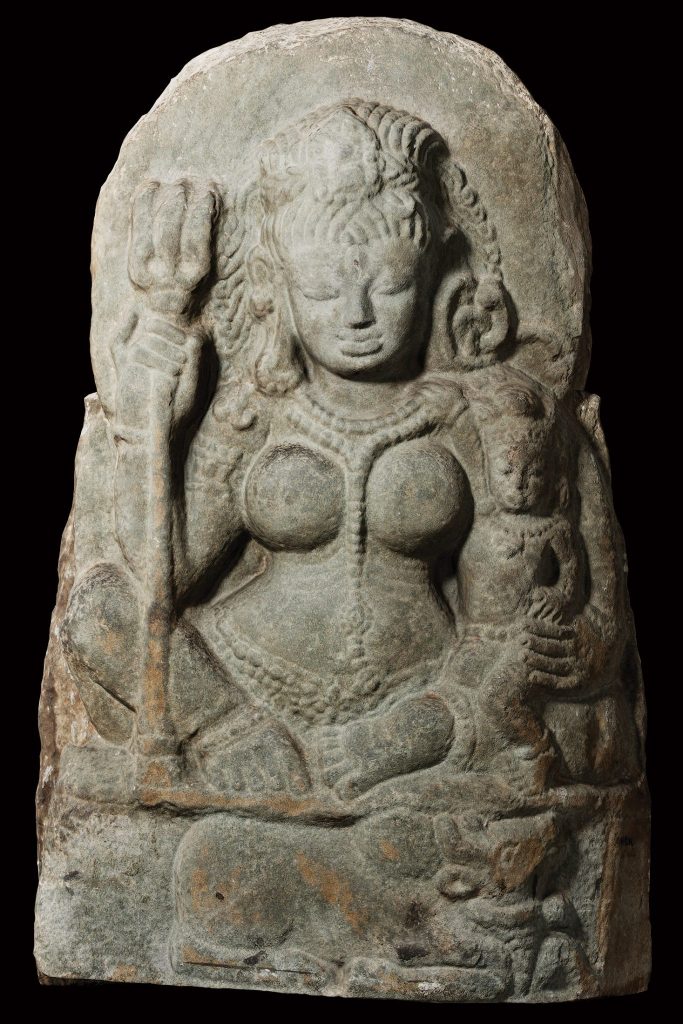
Representation: Maheswari
Tradition: Hindu
Provenance: Saraikela, Singhbhum, Jharkhand, India
Date: 12th Century CE
Material: Grey granite stone
Dimensions: 91 x 58 x 18 cm
Collection: Bihar Museum
Accession: Arch. 10816
Object description:
This sculpture represents Brahmani, primarily known as the consort of Brahma, the creator god. She represents the feminine aspect of Brahma’s power, she is the goddess of creation who facilitates creation, order, and cosmic harmony, just as Brahma’s role is to create the universe. She is a symbol of the creative energy that flows through all aspects of life, and she plays an integral role in the act of creation. The rosary held in her hand identifies this sculpture symbolizing meditation and spiritual wisdom. Brahmani is one of the Sapta Matrikas or the seven divine mothers, representing the saktis, or the energies of the important familiar deities are Brahmani (Saraswati) Mahesvari (Raudani) Kaumari (Karttikeyani) Vaishnavi (Lakshmi) Varahi, Indrani and Chamunda (Chamundi)—each with protective and at times destructive qualities.
Audio:
Performer: Pandit Omkarnath Thakur – Garawa Mayi Sang Lage
Source: 78rpm record, Columbia, VE.1016, 1934
Description: Bhajan in praise of the Goddess, sung by Pandit Omkarnath Thakur (1897-1967) in raag Todi. Born in poverty, he eventually spent years in Pandit Vishnu Digambar’s music school in Bombay and became the principal of a music school by age 20. By ca. 1934-1935, when this record was pressed in India, he was already recording masterworks.
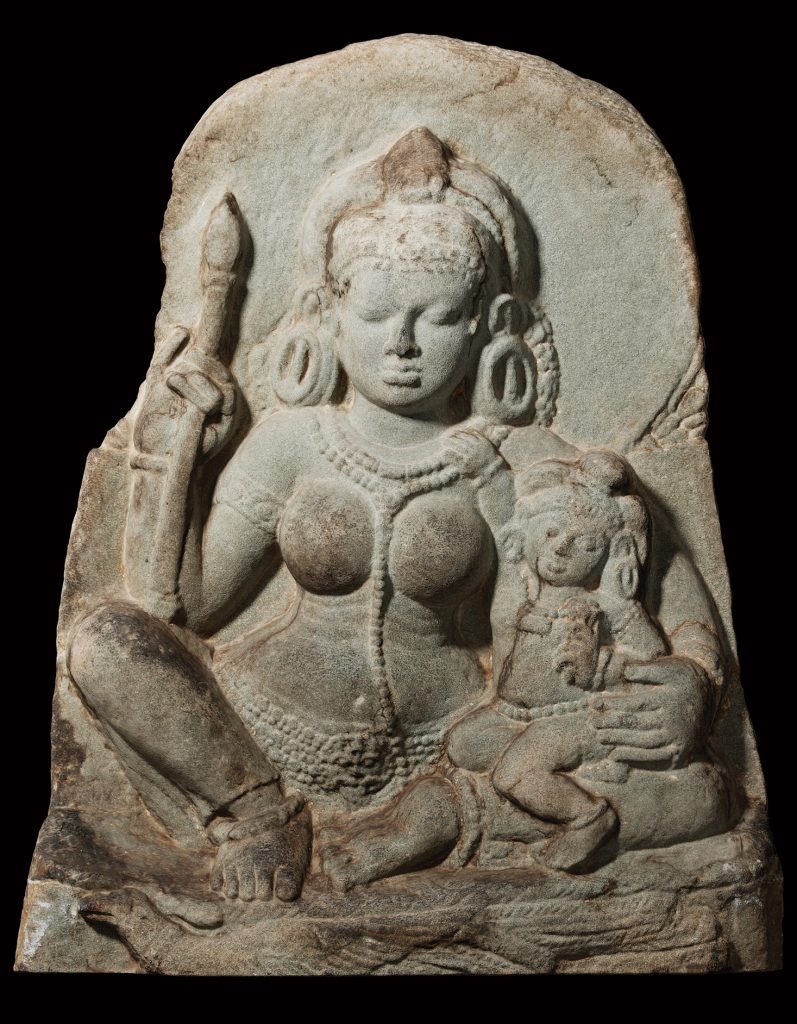
Representation: Kaumari
Tradition: Hindu
Provenance: Saraikela, Singhbhum, Jharkhand, India
Date: 12th Century CE
Material: Grey granite stone
Dimensions: 65 x 54 x 10 cm
Collection: Bihar Museum
Accession: Arch. 10819
Object description:
The sculpture Kaumari is the Shakti (feminine energy) of Lord Skanda (Kumara), she is also known as Kartikeyani. Kaumari is shown with her sacred vahana, the peacock, symbolizing wisdom and agility, and holds a Vel, a small spear-like weapon associated with her divine power Kartikeya. This intricately carved sculpture embodies the spiritual and artistic essence of early Hindu tradition, capturing Kaumari’s protective and nurturing presence with remarkable craftsmanship. Kaumari is one of the Sapta Matrikas or the seven divine mothers, representing the saktis, or the energies of the important familiar deities are Brahmani (Saraswati) Mahesvari (Raudani) Kaumari (Karttikeyani) Vaishnavi (Lakshmi) Varahi, Indrani and Chamunda (Chamundi) —each with protective and at times destructive qualities.
Audio:
Performer: Gangabai – Seethapathi Rama
Source: Archive of Indian Music
Description: A devotional song in the Carnatic (South Indian) classical style, which bears several differences from the Hindustani (North Indian) style, in praise of lord Rama, the seventh and one of the most popular avatars of Vishnu, archetype of the ideal being. The vocalist is identified as Gangabai Subramaniam, a voice that time forgot.
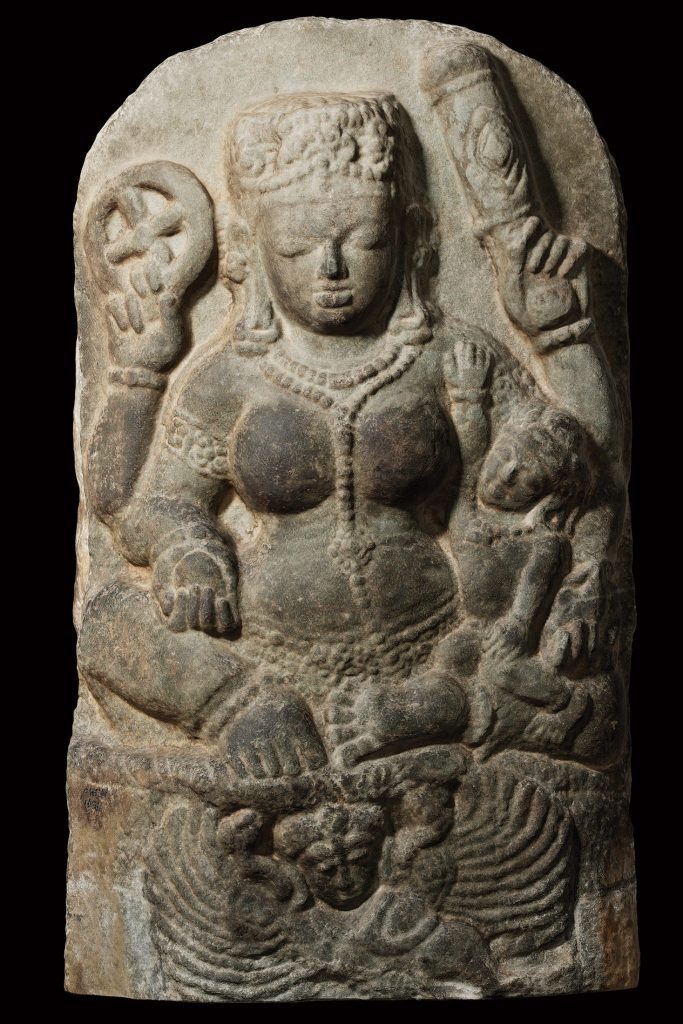
Representation: Vaishnavi
Tradition: Hindu
Provenance: Saraikela, Singhbhum, Jharkhand, India
Date: 12th Century CE
Material: Grey granite stone
Dimensions: 89 x 50 x 11 cm
Collection: Bihar Museum
Accession: Arch. 10815
Object description:
The Vaishnavi sculpture, believed to have emerged from Lord Vishnu, she shares his divine attributes. Vaishnavi is portrayed with four arms, holding a conch (Shankha), discus (Chakra), mace (Gada), and lotus (Padma), along with a baby, symbolizing her protective and nurturing nature. Like Vishnu, her sacred vahana, Garuda, reinforces her strength and divine authority. This finely crafted sculpture reflects the artistic and spiritual depth of early Hindu tradition, capturing Vaishnavi’s power and grace with remarkable detail. Vaishnavi is one of Sapta Matrikas or the seven divine mothers, representing the saktis, or the energies of the important familiar deities are Brahmani (Saraswati) Mahesvari (Raudani) Kaumari (Karttikeyani) Vaishnavi (Lakshmi) Varahi, Indrani and Chamunda (Chamundi) —each with protective and at times destructive qualities.
Audio:
Performer: Amirbai Karnatki – Vaishnav Jan To Tene Kahiye
Source: 78rpm record, Regal, RL 2074, 1940s
Description: A beloved Hindu devotional song and a cornerstone of the Bhakti movement, this bhajan was written by Narsinh Mehta, a 15th-century Gujarati poet-saint. It describes the ideal Vaishnav (devotee of Lord Vishnu) – someone who empathizes with others, is humble and selfless, highlighting virtues like compassion, humility, and non-violence. Amirbai Karnataki (1906-1965) was a noted Indian playback singer and actress in Hindi and Gujarati films, who rose to fame in the 1940s. Her soulful rendition of “Vaishnav Jan To”, Mahatma Gandhi’s favourite bhajan, contributed to its popularity during the Indian freedom struggle.

Representation: Varahi
Tradition: Hindu
Provenance: Saraikela, Singhbhum, Jharkhand, India
Date: 12th Century CE
Material: Grey granite stone
Dimensions: 92 x 54 x 10 cm
Collection: Bihar Museum
Accession: Arch. 10820
Object description:
The Vaishnavi sculpture, believed to have emerged from Lord Vishnu, she shares his divine attributes. Vaishnavi is portrayed with four arms, holding a conch (Shankha), discus (Chakra), mace (Gada), and lotus (Padma), along with a baby, symbolizing her protective and nurturing nature. Like Vishnu, her sacred vahana, Garuda, reinforces her strength and divine authority. This finely crafted sculpture reflects the artistic and spiritual depth of early Hindu tradition, capturing Vaishnavi’s power and grace with remarkable detail. Vaishnavi is one of Sapta Matrikas or the seven divine mothers, representing the saktis, or the energies of the important familiar deities are Brahmani (Saraswati) Mahesvari (Raudani) Kaumari (Karttikeyani) Vaishnavi (Lakshmi) Varahi, Indrani and Chamunda (Chamundi) —each with protective and at times destructive qualities.
Audio:
Performer: Amirbai Karnatki – Vaishnav Jan To Tene Kahiye
Source: 78rpm record, Regal, RL 2074, 1940s
Description: A beloved Hindu devotional song and a cornerstone of the Bhakti movement, this bhajan was written by Narsinh Mehta, a 15th-century Gujarati poet-saint. It describes the ideal Vaishnav (devotee of Lord Vishnu) – someone who empathizes with others, is humble and selfless, highlighting virtues like compassion, humility, and non-violence. Amirbai Karnataki (1906-1965) was a noted Indian playback singer and actress in Hindi and Gujarati films, who rose to fame in the 1940s. Her soulful rendition of “Vaishnav Jan To”, Mahatma Gandhi’s favourite bhajan, contributed to its popularity during the Indian freedom struggle.
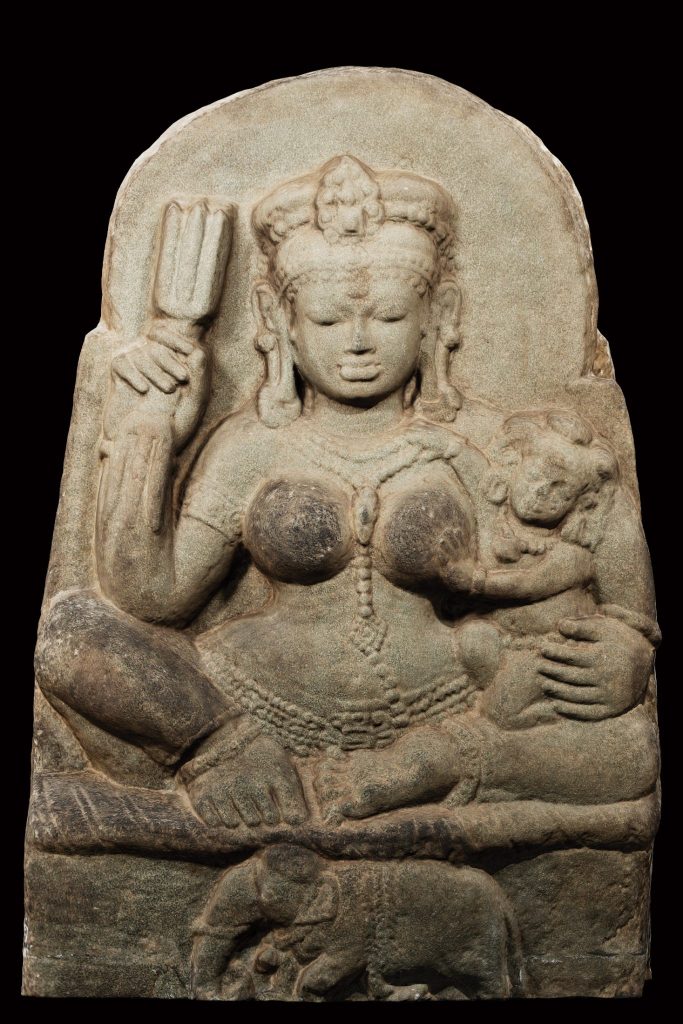
Representation: Indrani
Tradition: Hindu
Provenance: Saraikela, Signhbhum, Jharkhand, India
Date: 12th century CE
Material: Grey granite stone
Dimensions: 85 x 56 x 12 cm
Collection: Bihar Museum
Accession: Arch. 10817
Object description:
This sculpture represents Indrani, also known as Shachi, one of the Sapta Matrikas, the seven divine mother goddesses in Hindu tradition. As the Shakti of Lord Indra, she shares his attributes and rides his sacred vahana, the white elephant, symbolizing strength and royalty. Indrani is depicted holding a thunderbolt (Vajra) in her right hand and carrying a baby in her left, reflecting both power and maternal care. This sculpture showcases the spiritual symbolism and refined craftsmanship of early Hindu art. Shachi is one of Sapta Matrikas or the seven divine mothers, representing the saktis, or the energies of the important familiar deities are Brahmani (Saraswati) Mahesvari (Raudani) Kaumari (Karttikeyani) Vaishnavi (Lakshmi) Varahi, Indrani and Chamunda (Chamundi) —each with protective and at times destructive qualities.
Audio:
Performer: Sushila Tembe – Datta Guru Datta Guru
Source: 78rpm record, Jay Bharat Record, SJ.5005, 1950
Description: This bhajan invokes the divine presence of Lord Dattatreya, revered as the embodiment of the Hindu trinity—Brahma, Vishnu, and Shiva, collectively known as the Trimurti. It is set in Raag Malkauns, a melody suitable to listen to at night. Sushila Tembe (born c. 1917) was a classical vocalist who produced a handful of shellac records in the 1940s
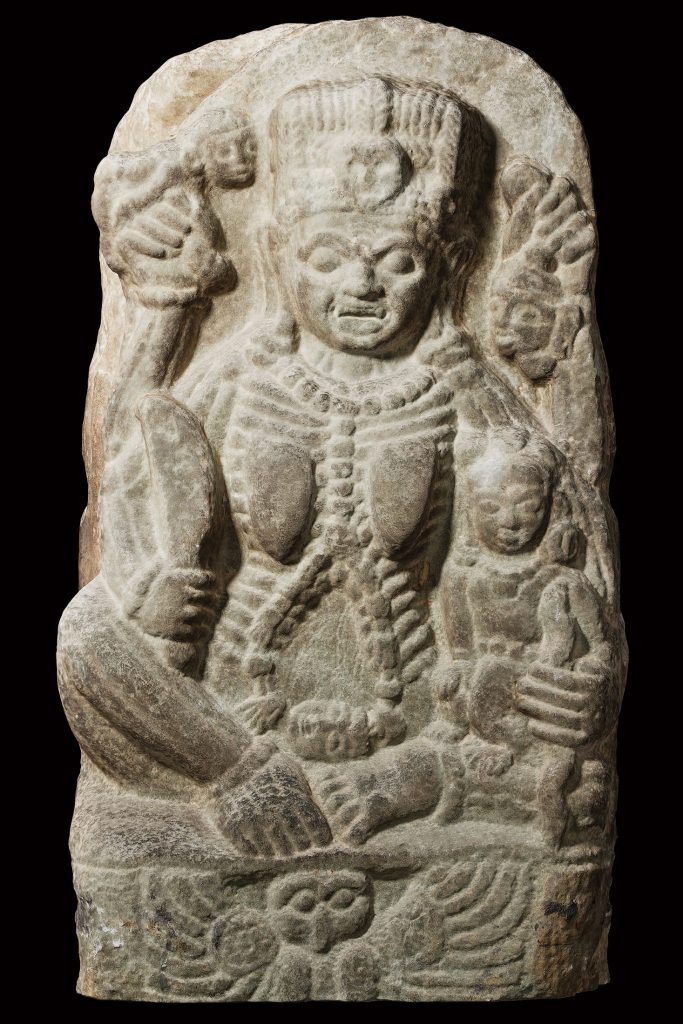
Representation: Chamunda
Tradition: Hindu
Provenance: Saraikela, Singhbhum, Jharkhand, India
Date: 12th Century CE
Material: Grey granite stone
Dimensions: 86 x 47 x 11 cm
Collection: Bihar Museum
Accession: Arch. 10821
Object description:
This sculpture depicts Chamunda, one of the Sapta Matrikas, the seven divine mother goddesses in Hindu tradition. Fierce and powerful, she embodies the energy of Goddess Chandi and shares attributes with Kali, also known as Chamundi or Charchika. Chamunda is portrayed with four arms, holding a sword and a skull (Kapala), symbolizing destruction and transformation. Her emaciated body, hollow belly, and grinning, terrifying face, adorned with a garland of skulls, reflect her fearsome aspect. She rides an owl, and her banner bears an eagle emblem. This showcasing the dramatic intensity and artistic mastery of early Hindu sculpture. Chamunda is one of Sapta Matrikas or the seven divine mothers, representing the saktis, or the energies of the important familiar deities are Brahmani (Saraswati) Mahesvari (Raudani) Kaumari (Karttikeyani) Vaishnavi (Lakshmi) Varahi, Indrani and Chamunda (Chamundi) —each with protective and at times destructive qualities.
Audio:
Performer: M. R. Vasavambal – Kai Ratnamam
Source: Hutchins & Co. Madras, HCM 31 1, 1934
Description: Although they differ in numerous ways, the classical traditions of Hindustani (North Indian) and Carnatic (South Indian) music are both based on the melodic framework of raga (Sanskrit for “colouring”). Each raga consists of an array of melodic structures with musical motifs; and, from the perspective of the Indian tradition, the resulting music has the ability to “colour the mind» with emotions. This Carnatic song in Tamil by M. R. Vasavambal is set in ragam Punnagavarali, which is usually associated with emotions such as anger, one defining feature of Chamunda.

Representation: Yakshini
Tradition: Hindu
Provenance: Didarganj, Patna, Bihar, India
Date: 3rd Century BCE
Material: Buff sandstone
Dimensions: 153 x 51 x 51 cm
Collection: Bihar Museum
Accession: Arch. 134
Object description:
This sandstone sculpture of a Yakshini was found at Didarganj, Bihar and is considered too be one of the most famous examples of early Indian sculpture dated to around the Maurya period c. 3rd century BCE. The Yakshini is depicted as a standing female figure holding a chauri (a flywhisk), a symbol of royalty and divinity in ancient Indian art. Estimated to be more than 2,300 years old, it was found on the banks of the Ganges over a century ago. The sculpture is believed to represent a Yakshini, a type of female spirit or goddess associated with fertility, abundance, and protection in ancient Indian belief systems. The statue showcases the grace and fluidity typical of Mauryan sculpture, with soft drapery on the lower half of the body that enhances its naturalistic quality. The body of the figure is curved, a characteristic of the tribhanga posture, which was prevalent in Indian sculpture and denotes a sense of elegance and balance. The Yakshi, depicted holding a chauri, or fly-whisk in her hand, embodies the ultimate feminine beauty of pre-modern India. Her figure is voluptuous with a full bust, slender at the waist and wide at the hips. Perhaps, what is also striking about the statue is the endearing grace of her posture and demeanour. The Yakshi stoops slightly forward instead of standing upright, seeking a posture of humility. The smile on her lips is elusive, yet hauntingly sweet.
Audio:
Performer: Lakshmi Shankar – Rain Dina Mohe Shyam
Source: His Master’s Voice, ECSD. 2782, 1977
Description: The thumri is a popular form of light classical Hindustani music where melodic structures are less rigid than in the purely classical styles, based on romantic or devotional lyrics. In this thumri sung by Lakshmi Shankar (1926–2013), the text, which is improvised upon, translates to “day and night, I long for my Shyam (Krishna)”.
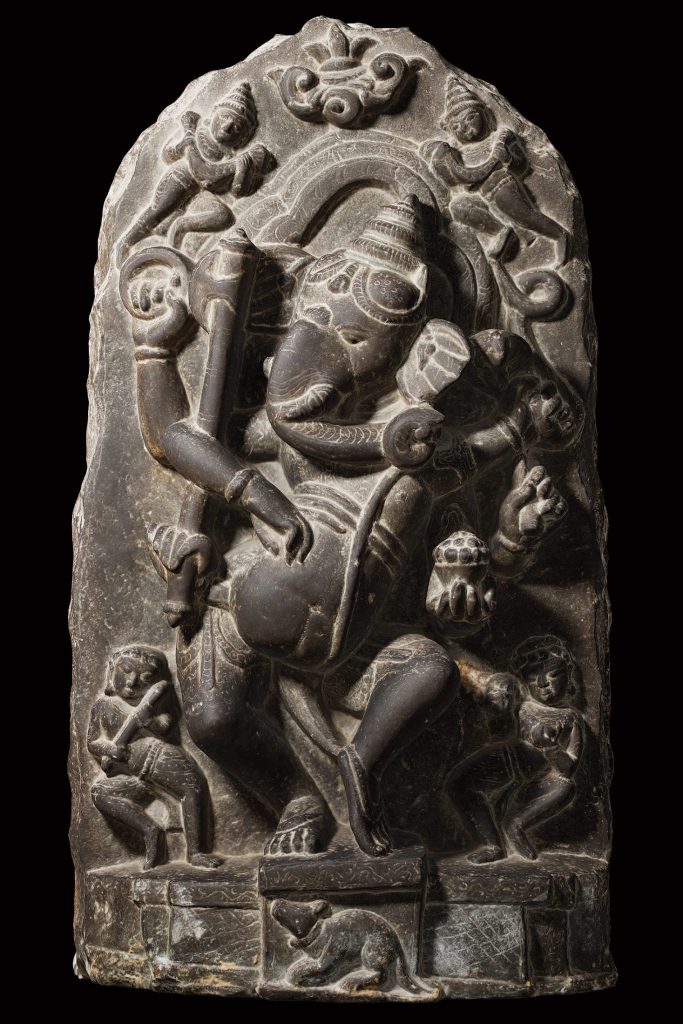
Representation: Nrityarata Ganapati
Tradition: Hindu
Provenance: Eksari, Saran, Bihar, India
Date: 11th Century CE
Material: Black Basalt
Dimensions: 72 x 34 x 10cm
Collection: Bihar Museum
Accession: Arch. 10611
Object description:
Ganesha (Niritya-Ganapati), in five of his hands, he holds the angulia (upper right), Kuthara (lower right), the coil serpent (upper left), the rubypot with modakas (lower left) and the danta (middle left); while the sixth hand is shown as hanging freely to accentuate the dancing posture. His belly is girdled by a serpent, while the sacred thread, which is also in the form of a serpent, hangs from over his left shoulder. He is wearing a three-tiered crown-like headdress, above are two flying Gandharvas carrying garlands. Two attendants are in a dancing posture with musical instruments, and the lyre and Khanjura are shown on the pedestal on either side of Ganesha. The mouse, the vehicle of Genesha, appears in a niche of the pedestal.
Audio:
Performance: Bhajana
Source: India – Columbia, KL-215, 1955
Description: This Hindi bhajan, sung by wandering ascetics Mahadeva Giri, Munna Giri, and their companions, was recorded in the 1950s in Varanasi by French ethnomusicologist Alain Daniélou (1907–1994), whose deep engagement with Indian music and spirituality helped introduce these sounds to the West. Capturing the raw, devotional spirit of India’s holy men, the recording offers a rare glimpse into the sacred musical traditions of Naga sadhus, blending deep spirituality with the earthy tones of folk and classical Indian music.
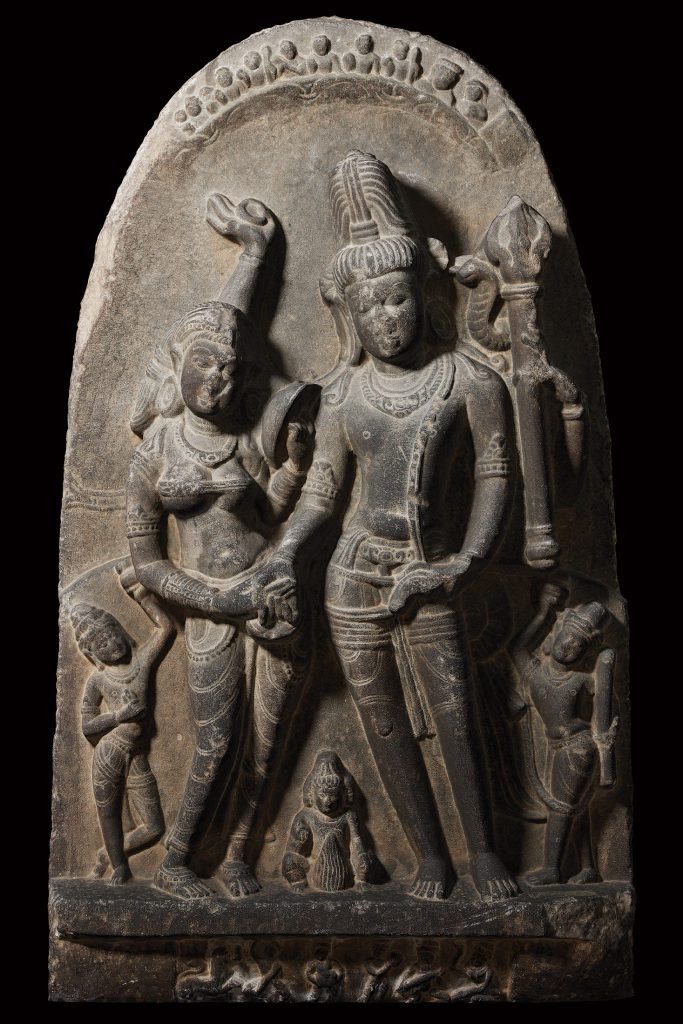
Representation: Siva and Parvati Kalyanasundarmurti
Tradition: Hindu
Provenance: Gaya, Bihar, India
Date: 10th Century CE
Material: Black Basalt
Dimensions: 89 x 47 x 13 cm
Collection: Bihar Museum
Accession: Arch. 6047
Object description:
Kalyansundar is a Tamil word that means ”auspicious marriage”. It symbolically depicts the marriage of Lord Shiva and Goddess Parvati and is crafted from black stone. The image of Panigrahan (Accepting the Hand) has been engraved, where the groom (Shiva), is affirming the bride in his right hand (Parvati). Parvati is standing on the left side of Shiva, and her left hand has a mirror, and the second right hand of Shiva is lifted closely to Parvati’s head with a flat and spherical object (a mirror) in her palm. His other right-hand holds Trishula with Naga Deva, which is depicted near the Trishula. Trimukhi Brahma sits in the role of a priest between Shiva and Parvati, with the holy fire blazing in front of him. On Pedestal, the lions, dancers and musicians are depicted in low relief. In the upper part of the sculpture, the Navagraha has been engraved as a witness to marriage.
Audio:
Performance: Bhajana
Source: Musique Religieuse de l’Inde – BAM, LD 5015, 1973
Description: Devotional chant of mystical love known as bhajan. This genre of music developed with the Bhakti movement and is found in the various traditions of Hinduism and Jainism. Performed here in Hindi in the dhrupad style, considered the oldest and most classical style of Hindustani music. Recorded by Indian ethnomusicologist Deben Bhattacharya (1921-2001) in Varanasi in 1954.
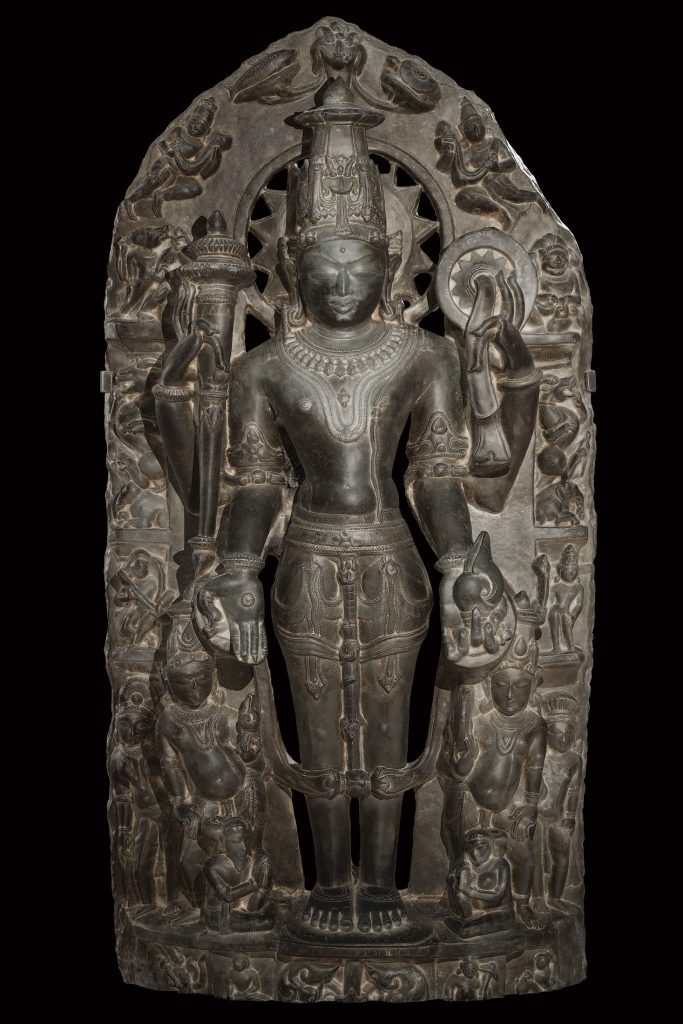
Representation: Vishnu Dasavatara
Tradition: Hindu
Provenance: Silour, Saran, Bihar, India
Date: 12th Century CE
Material: Black phylite stone
Dimensions: 108 x 58 x 19 cm
Collection: Bihar Museum
Accession: Arch 6361
Object description:
This exquisite Vishnu sculpture from the Pala period embodies divine grace and artistic mastery. Standing in perfect symmetry (samapada), Vishnu holds his four iconic attributes: the lotus (purity), conch (creation), discus (destruction of evil), and mace (power). A floral garland (vanamala) cascades elegantly to his knees, while the intricately carved stella features protective lions, celestial beings, and a fierce kirtimukha. Vishnu’s Dasavatara (ten incarnations) adorn the piece, reinforcing his cosmic role. This sculpture showcases the Pala artisans’ exceptional craftsmanship and devotion, blending spiritual symbolism with artistic excellence
Audio:
Performance: Holi Dhamar
Source: Religions of INDIA – Argo, ZFB55, 1971
Description: Temple singers of the Radhavallabh Mandir temple sing a dhamar, a song from the dhrupad music tradition associated with Holi, the festival of spring. It describes the enchanting beauty of lord Krishna, 8th avatar of Vishnu, embodiment of divine love, wisdom, and dharma Recorded by Indian ethnomusicologist Deben Bhattacharya (1921-2001) in Vrindavan, 1968.
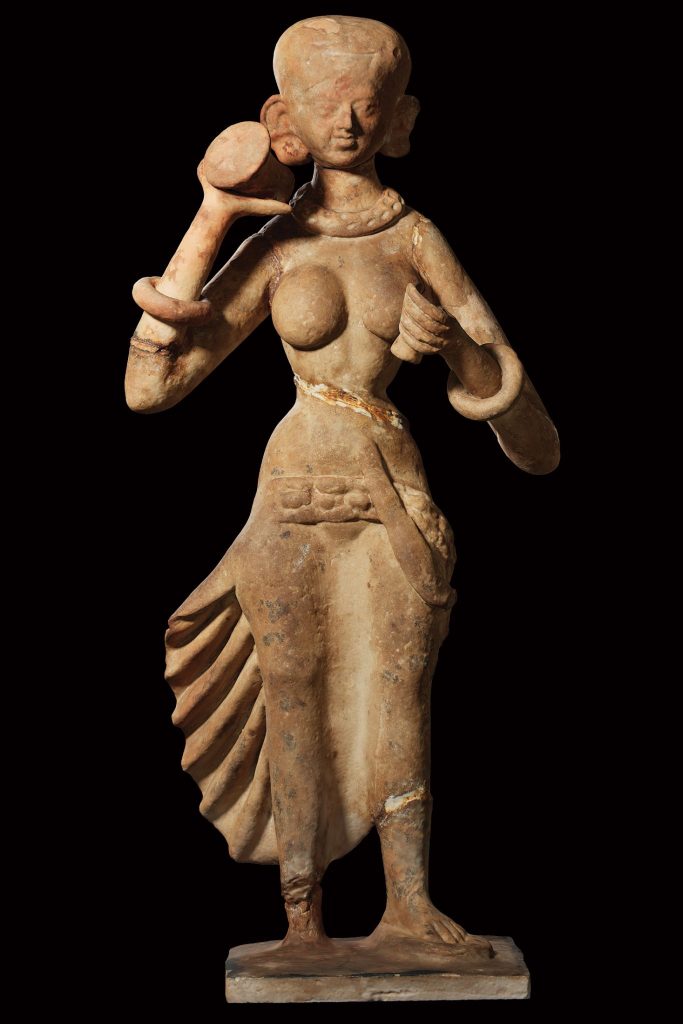
Representation: Dancing Girl
Provenance: Bulandibagh, Patna, Bihar, India
Date: 3rd century BCE
Material: Terracotta
Dimensions: 22 x 8 x 3 cm
Collection: Bihar Museum
Accession: Arch. 8510
Object description:
Kalyansundar is a Tamil word that means ”auspicious marriage”. It symbolically depicts the marriage of Lord Shiva and Goddess Parvati and is crafted from black stone. The image of Panigrahan (Accepting the Hand) has been engraved, where the groom (Shiva), is affirming the bride in his right hand (Parvati). Parvati is standing on the left side of Shiva, and her left hand has a mirror, and the second right hand of Shiva is lifted closely to Parvati’s head with a flat and spherical object (a mirror) in her palm. His other right-hand holds Trishula with Naga Deva, which is depicted near the Trishula. Trimukhi Brahma sits in the role of a priest between Shiva and Parvati, with the holy fire blazing in front of him. On Pedestal, the lions, dancers and musicians are depicted in low relief. In the upper part of the sculpture, the Navagraha has been engraved as a witness to marriage.
Audio:
Performance: Bhajana
Source: Musique Religieuse de l’Inde – BAM, LD 5015, 1973
Description: Devotional chant of mystical love known as bhajan. This genre of music developed with the Bhakti movement and is found in the various traditions of Hinduism and Jainism. Performed here in Hindi in the dhrupad style, considered the oldest and most classical style of Hindustani music. Recorded by Indian ethnomusicologist Deben Bhattacharya (1921-2001) in Varanasi in 1954.
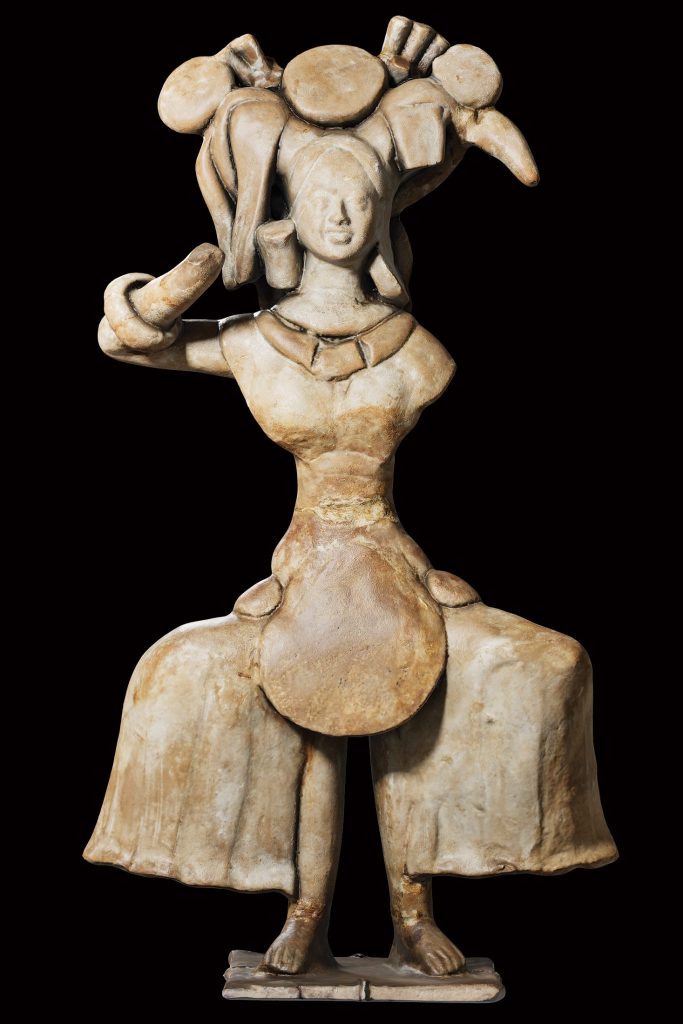
Representation: Dancing Girl
Provenance: Bulandibagh, Patna, Bihar, India
Date: 3rd century BCE
Material: Terracotta
Dimensions: 30 x 16 x 6 cm
Collection: Bihar Museum
Accession: Arch. 4177
Object description:
One of two sculptures of The Dancing Girls, this representation tell us a lot about the close ties that existed between India and the Greeks during the Mauryan rule. We can see that artistically there was a lot of give and take between the two cultures – the Hellenistic features of the sculpture- the defined movement of the dancer in motion, draw deeply from the aesthetic expression of Greece. The sculptor shows the dancer’s movement through the flurry of her skirt floating around her, in one hand the damru or two-headed drum held above her head in a play of rhythm and motion, her other hand by her waist as she keeps to the beat of the music. The first sculpture shows an intricate headdress, which is another borrowing from the Greeks who popularized the elaborate hair-do’s and decorations. The way the drapes fall against the form of both the dancing girls, close to the body but in a sideward motion speak of the skill of the craftsmen who were able to render realistically the experience of nritya, or dance and shringaar or embellishment through their work in terracotta or clay. The exquisite expression of pleasure and animation on the features of the figurines, the graceful movement of their hands skillful and precise is the depiction of the Rasas – capable of arousing the essence of emotions.
Audio:
Performer: Gauhar Jaan – Meri Agan Lagi Manva
Source: 78rpm record, The Gramophone Company, Ltd., Calcutta, 1914
Description: Gauhar Jaan (1873- 1930) was an Indian singer and dancer, or tawaif, from Calcutta. She was the first Indian artist to have her voice recorded on 78rpm records and sung over 600 songs for the Gramophone Company of India. In this recording from 1913 she sings a Dadra, a form of light entertaining song forms the Hindustani classical tradition.