
EDCH – Chemistry and Chemical Engineering
About the program
The 4-year Doctoral Program in Chemistry and Chemical Engineering is entirely taught in English and provides an educational and research environment in chemical sciences and engineering. We aim for top international level.
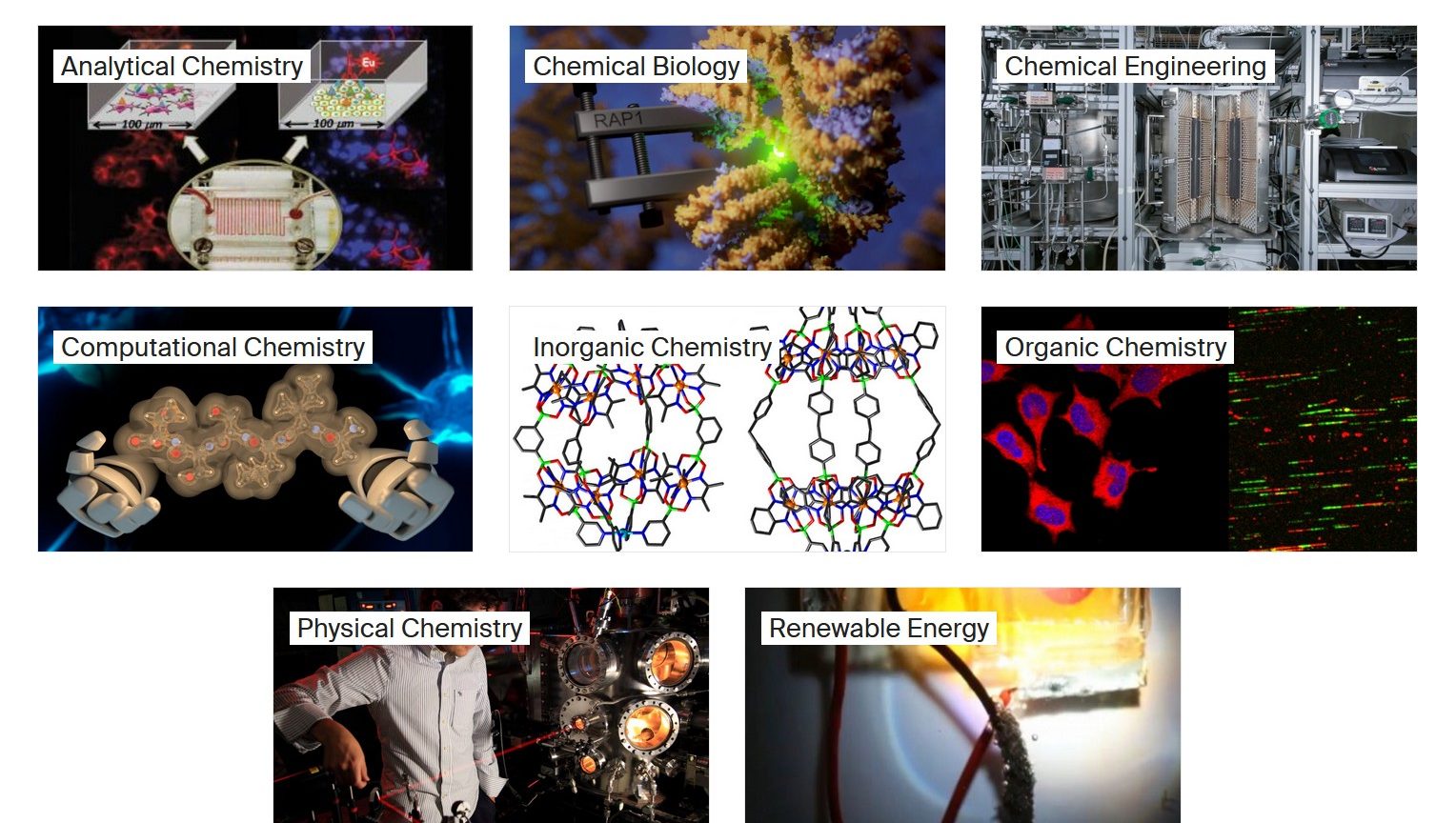
Current key challenges, such as the generation of novel therapeutics or addressing energy sustainability, require controlling the matter on the molecular level. Thus, chemical sciences are of vital importance across a multitude of domains. To that end, the research opportunities offered by the doctoral program in chemistry and chemical engineering span the expanse from fundamental studies in AI in chemistry to biochemistry, and from applications on the nanoscale to devices and engineering.
Applying to EDCH
Applications can be submitted three times a year.
Deadlines: Submission prior to January 15, April 30 or September 15.
- Admission to our program is centralized.
- To apply to this doctoral program, you have to complete and submit an online application form.
- Visit our website to get an idea of ongoing research in Chemistry and Chemical Engineering at EPFL and see the PhD advisors linked to our doctoral program.
Further information on the EDOC admission criteria and application procedures visit the webpage.


Research
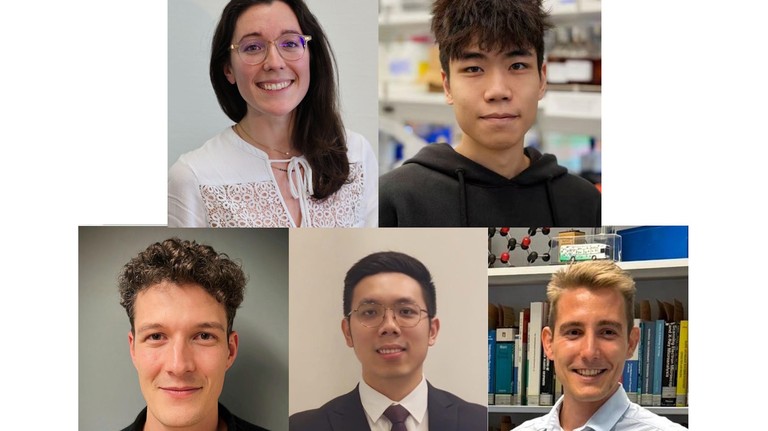
By working on the design of membrane systems for gas separations, this time I have the chance to incorporate real-life data from the experimental work of the other members of the lab, in computational models that we are developing for such systems and applications.
My research focuses on techniques that help scientists and programmers gain confidence in the correctness and accuracy of numerical computations. These computations arise in a number of important areas, from cyber-physical systems such as train car controllers to scientific computing applications like simulations. Developing accurate numerical software is difficult because of finite representation of numbers, approximate numerical algorithms, and noisy data. The goal of my research is to facilitate the writing of numerical software by enabling the scientist to write programs using real arithmetic and a specification of uncertainties and let the compiler automatically choose the appropriate data type and algorithmic approximation. For example, my tools can verify that ranges of variables and roundoff errors in floating-point or fixed-point computations stay bounded below a certain threshold. My work builds on state-of-the-art theorem-proving technology, which is quickly evolving. This requires me to stay continuously up-to-date and follow up on changes, but also makes my work exciting. I appreciate very much that I was able to choose my PhD topic myself, allowing me to combine my interest in computer science, mathematics and physics. During my four years at EPFL and while presenting my work at conferences and seminars around the world, I met many interesting people and had many conversations that resulted in new ideas for my work. It feels great to be part of the international research community!
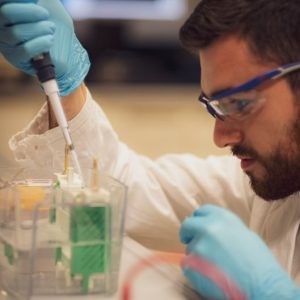
The interdisciplinary environment at EPFL encourages constant collaboration and exchange between chemistry, biology, and physics, equipped with world-class facilities.
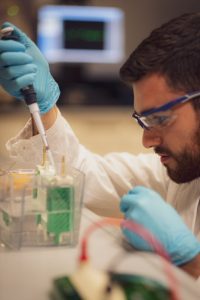
Joining the EDCH program came as a no-brainer. After completing my master’s degree in chemistry at EPFL, I wanted to further pursue my studies with a PhD, which felt like a natural extension of the values I had developed during my academic journey thus far. My research is based in the Laboratory of Biophysical Chemistry of Macromolecules of Prof. Beat Fierz, where I focus on understanding the interactions between transcription factors and DNA and their role in gene regulation. The interdisciplinary environment at EPFL encourages constant collaboration and exchange between chemistry, biology, and physics, outfitted with world-class facilities. This allows for diversification of the scope of projects while remaining at the forefront of precision and technology. The PhD journey at EPFL is not always smooth-sailing, but with the support of my supervisor and peers I have grown both as a scientist and as a person. My supervisor has been providing feedback and guidance while giving me the intellectual freedom to explore new directions. The combination of encouragement while questioning approaches and techniques fosters a stimulating atmosphere where critical thinking is crucial. Weekly seminars gather top researchers from around the world, and the doctoral school provides tailored training in both technical and transferable skills. These opportunities are essential to me for proper development and preparation for life after the PhD.
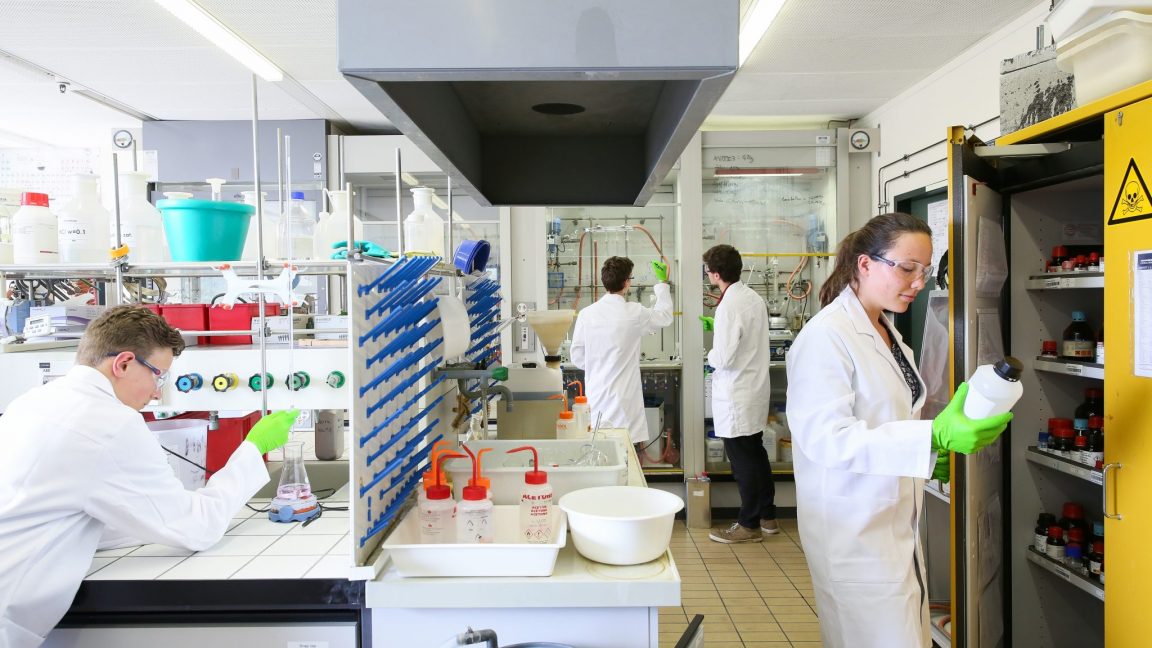

For applicants
Further information: how to apply, program details, testimonials
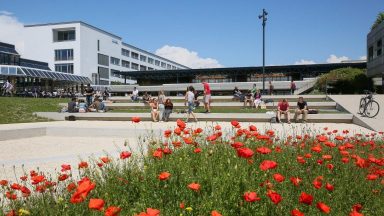
For PhD candidates
Practical information: what you need to know as an EDCH PhD student
People
Who is who: all you need to know about the EDCH community

EDCH Highlights
Upcoming public defenses


Contact
Program Director
Prof. Beat Fierz
Administration
Anne Lene Odegaard
EPFL EDCH program
Batochime 3313
CH-1015 Lausanne
Phone: +41 21 693 5846
[email protected]