


The cost of publishing Open Access
Over the past few years, the academic publishing ecosystem has been undergoing a significant transition from a subscription-based model, where publishing is free of charge but access to articles and books is restricted behind paywalls, to an Open Access (OA) model, where authors or institutions pay publishing fees to publishers to make articles and books freely available to all. These OA publishing fees are intended to compensate publishers for their work and offset the revenue lost by providing free access to articles or books. Currently, these two models (subscription-based and Open Access) coexist, reshaping the financial landscape of scientific publishing.
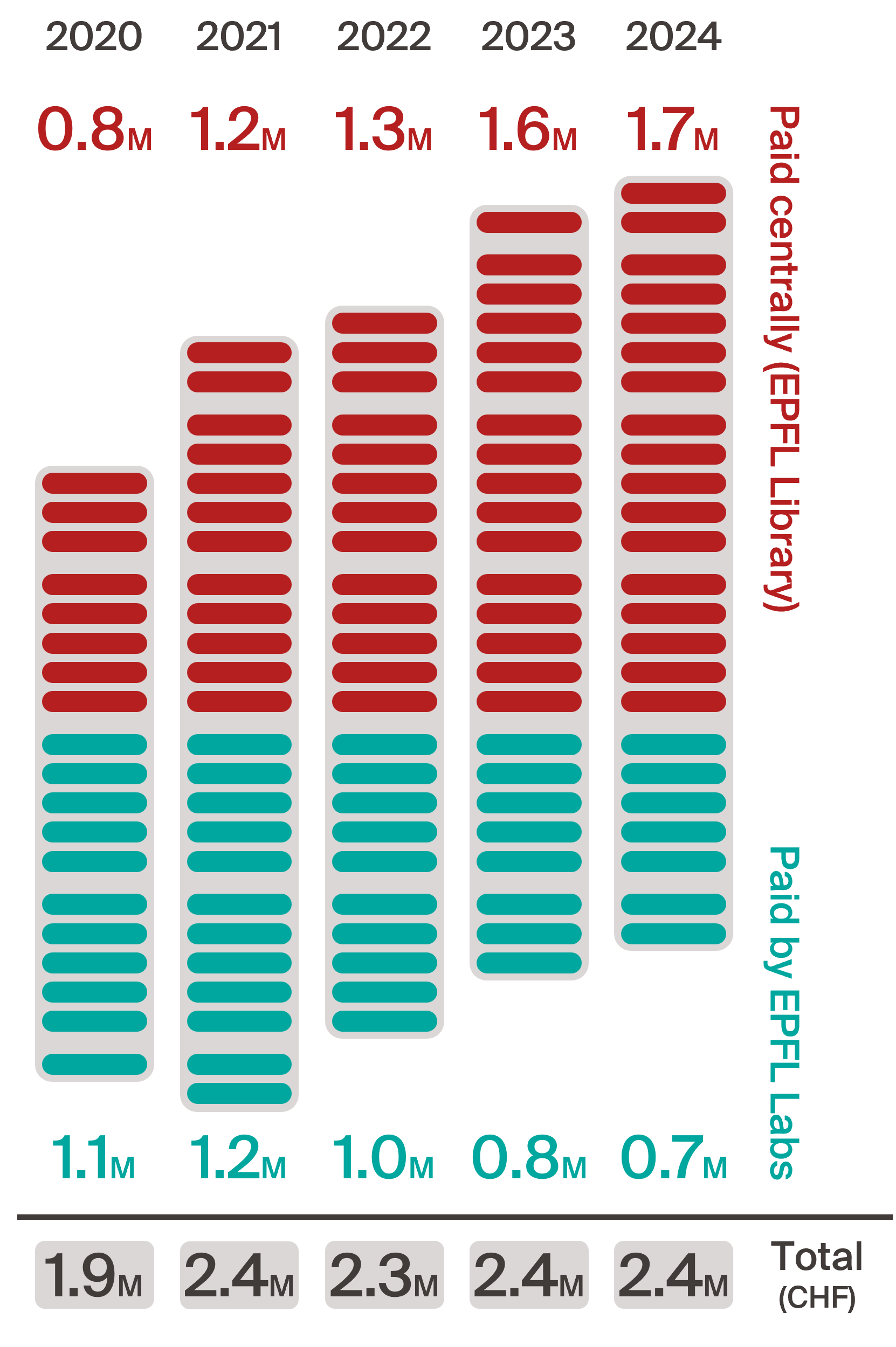
A key development in this shift has been the introduction of Read&Publish agreements between institutions and publishers. These agreements combine reading access to the publisher’s portfolios with the possibility for EPFL-affiliated authors to publish Open Access, all under a single contract and a single lump-sum payment. Since EPFL started adopting these agreements in 2020, the financial burden on the Library has significantly increased. Excluding expenses for reading access (i.e. Read-only agreements and the reading part of Read&Publish agreements), annual costs for OA publishing covered by the Library have more than doubled, rising from approximately 0,8 million CHF in 2020 to 1.7 million CHF in 2024. Additionally, EPFL laboratories continue to bear significant OA publishing costs not covered by these agreements, estimated at around 0.7 to 1.2 million CHF annually.
As a result, the estimated total expenditure for OA publishing at EPFL has increased from 1.9 million CHF to 2.4 million CHF over the past five years. Since expenses related to reading access have not decreased proportionally during this period, the rise in OA publishing costs reflects a significant overall increase in EPFL’s spending on the academic literature ecosystem.
Who pays for what?
The funding system for OA publishing at EPFL is inherently complex, and involves multiple funding sources and various types of expenses, such as agreements with scholarly publishers, the support of OA initiatives, and the payment of OA fees for individual articles or books. The entities covering OA costs include the EPFL Library, swissuniversities, the Swiss National Science Foundation (SNSF, alongside other funders), and EPFL laboratories.
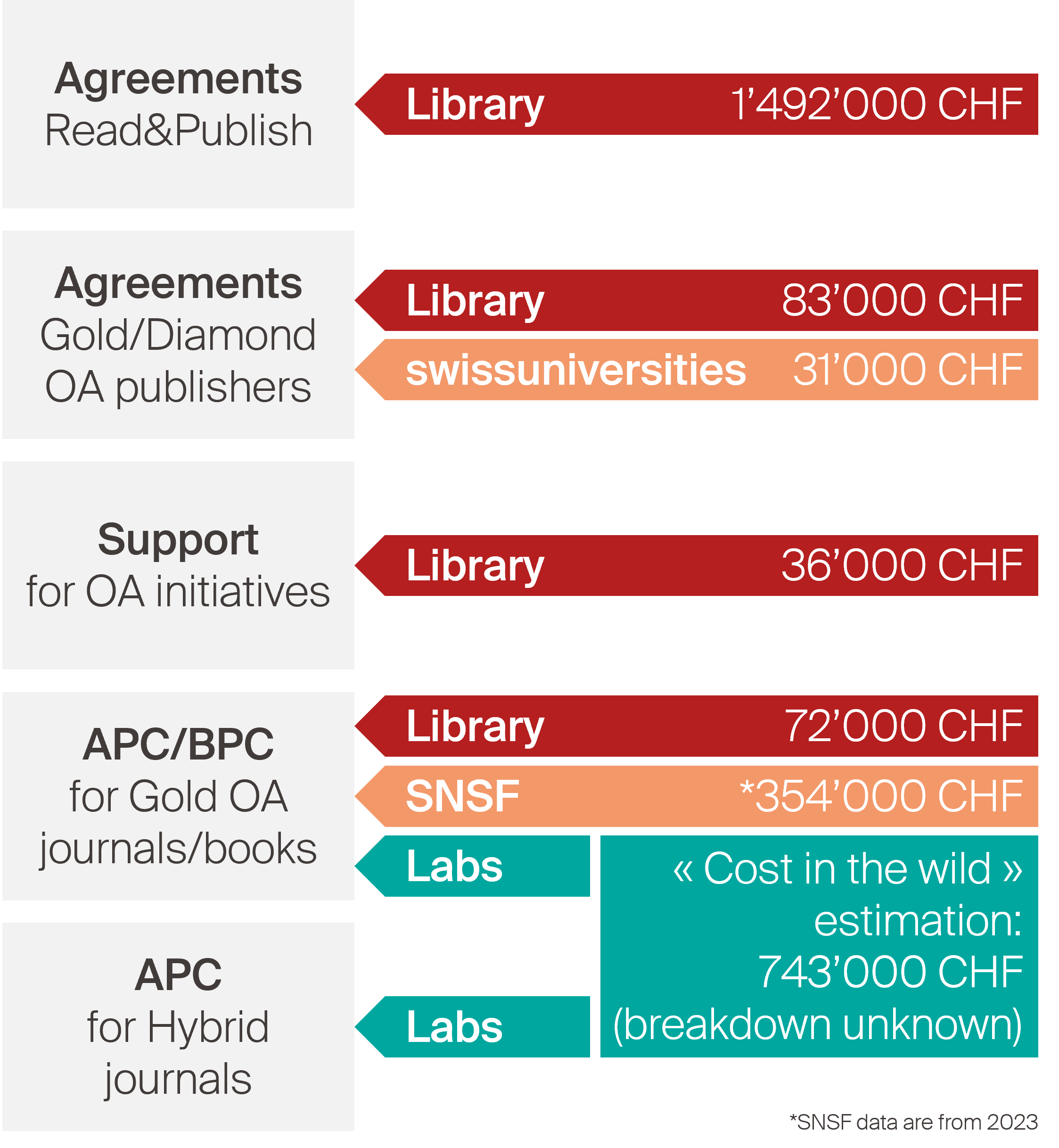
The chart below summarizes the main expense categories related to OA publishing, providing a breakdown of funding sources and cash flows. Additional context and details are available in the corresponding dropdown menu. While some figures are clearly identifiable, others (labeled as “cost in the wild”) are based on estimates, as these expenses are not centralized and are directly borne by laboratories. Improved tracking of these expenses in the future will enhance transparency in the OA financing landscape at EPFL, potentially strengthening its position in negotiations with publishers. All figures presented in this section are rounded for clarity and refer to 2024, with the exception of the SNSF figures, which refer to 2023.
Overview
As part of the Read&Publish agreements, the EPFL Library pays a fixed annual amount to several publishers to allow EPFL authors to publish Open Access free of charge.
Cost
1’492’000 CHF in 2024 (this amount only accounts for the publishing part of the Read&Publish agreements)
Funding source
EPFL Library
Negotiations
– Contracts with Elsevier, Wiley and Springer Nature (often referred to as “Big Deals”) are negotiated at national level by a dedicated team with a mandate from swissuniversities.
– Contracts with smaller publishers (ACS, AIP, CUP, IEEE, IOP, OUP, RSC, Taylor&Francis) are negotiated by the Consortium of Swiss Academic Libraries (CSAL).
Coverage
These agreements include:
– The reading access for the EPFL community to the journal portfolio of the publishers;
– The possibility to publish Open Access free of charge for EPFL-affiliated corresponding authors (i.e. APC fully covered). This opportunity is limited to the list of journals included in the agreement and is possibly subject to other limitations (annual quota, funder-related restrictions, etc.). Agreements usually cover Hybrid journals and, increasingly, Gold OA journals as well.
Number of publications
646 articles (in 2024)
Overview
As part of these agreements, the EPFL Library pays a fixed annual amount to certain fully Gold/Diamond OA publishers to allow EPFL authors to publish Open Access free of charge.
Cost
114’000 CHF (in 2024)
Funding source
– The EPFL Library contributed with 83’000 CHF in 2024
– swissuniversities contributed with 31’000 CHF in 2024
Negotiations
Overview
These are voluntary contributions from the EPFL Library to support the development of several Swiss and international initiatives for the promotion of Open Science and Open Access, many of which fall within the framework of the Global Sustainability Coalition for Open Science Services (SCOSS).
Cost
36’000 CHF (in 2024)
Funding source
EPFL Library
Overview
This expense is the sum of all individual APC and BPC paid outside the agreements to publish in Gold OA journals and books.
Cost
The exact total cost is unknown (please refer to the next paragraph APC for Hybrid journals for further details)
Funding source
– The EPFL Library Gold OA fund contributed with 72’000 CHF in 2024 (via reimbursement of APC to EPFL Labs).
– The SNSF OA fund contributed with 354’000 CHF in 2023 (via upfront payment or reimbursement of APC to EPFL laboratories). Other funders have also made financial contributions, but unfortunately these cannot be tracked.
– EPFL laboratories paid from their own budget for all APC that could not be covered otherwise. This expense includes all publications in full Gold OA journals that [1] could not receive (or received only a partial) reimbursement from the EPFL Library Gold OA fund, [2] could not benefit from a financial support of a funder, and [3] were not covered by an institutional contract (i.e. agreements Read&Publish or with Gold OA publishers).
Overview
This expense is the sum of all individual APC paid outside the Read&Publish agreements to publish in Hybrid journals.
Cost
The precise amount is unknown (“cost in the wild”, as already mentioned in the previous paragraph APC/BPC for Gold OA journals/books), but the total expenditure by laboratories on APC for Hybrid and Gold OA journals is estimated to be approximately CHF 743’000 in 2024.
Funding source
EPFL laboratories paid from their own budget for all Hybrid journals’ APC that were not covered by an institutional contract (i.e. a Read&Publish agreement), either because [1] no institutional agreement was available for the corresponding journal/publisher, [2] the publication did not meet all eligibility requirements, or [3] the annual quota had already been reached when the article was accepted for publication.
The evolution of Open Access
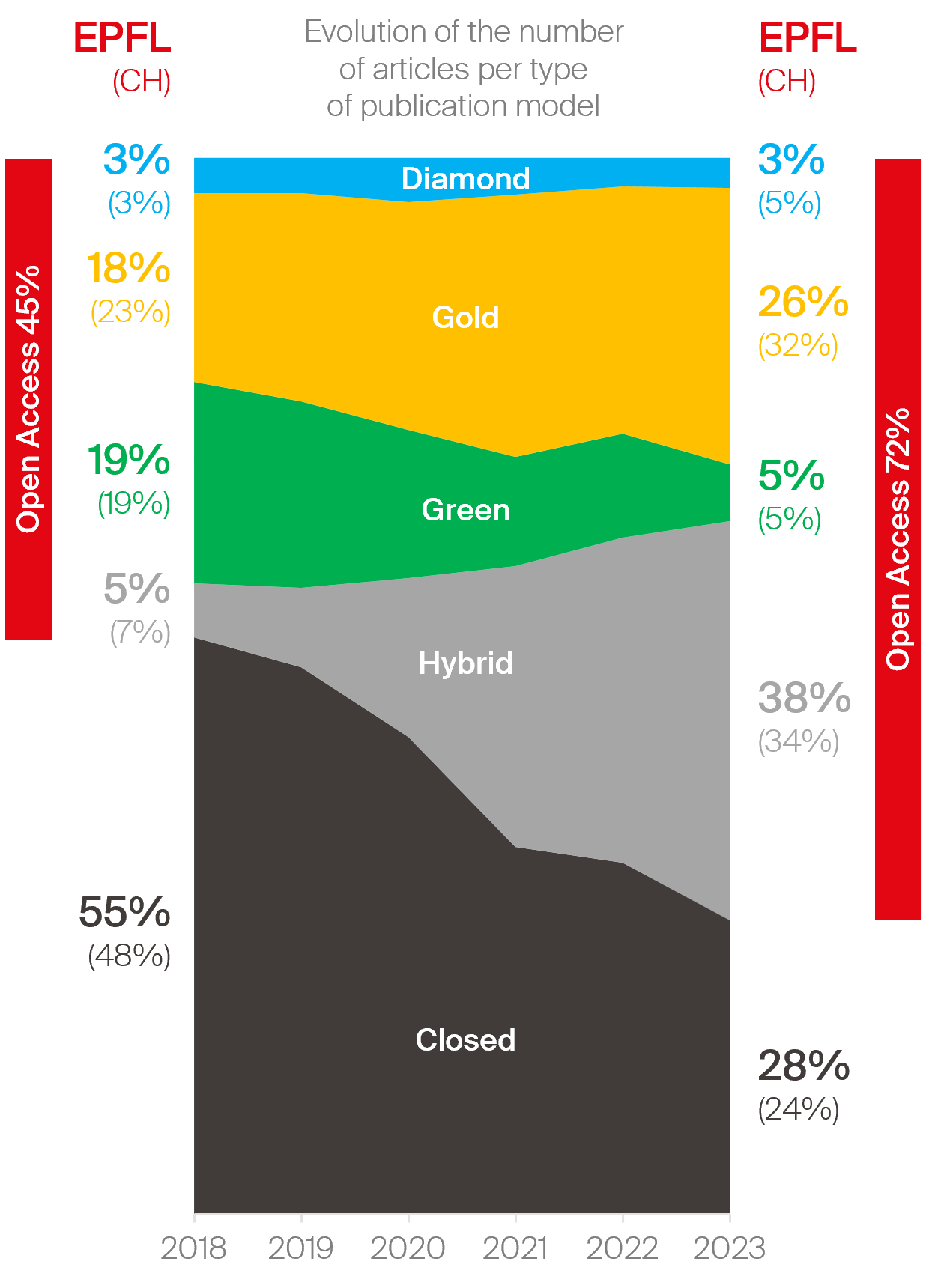
The chart above illustrates the evolution of OA at EPFL between 2018 and 2023, based on data from the Swiss Open Access Monitor, which relies on the OpenAlex database. While these figures represent estimates — they may be incomplete and are subject to regular updates and corrections — they provide significant insights into overall trends. The analysis considers all published articles with a corresponding author affiliated with EPFL, and all percentages are rounded, meaning minor rounding errors are possible.
Over this six-year period, closed-access articles published at EPFL have steadily declined, dropping from over half (55%) in 2018 to almost a quarter (28%) in 2023. As a result, the share of all OA models combined grew from 45% to 72%, mirroring trends observed at the national level (as indicated by the figures in brackets). This shift occurred for a number of reasons, including the commitment of EPFL and funders to advancing Open Access, the transformation of publishing and business models, and the financial support provided through institutional agreements and other funding mechanisms.
Hybrid OA saw the most significant growth, accounting for over half of all OA articles published at EPFL in 2023, and seven times more than in 2018. This increase can be partly attributed to the introduction and spread of Read&Publish agreements, which often allow authors to publish OA free of charge in hybrid journals.
Furthermore, it can be argued that many of the most prestigious journals are hybrid: for example, among the top 100 journals ranked by the SCImago Journal Rank (SJR) indicator, 94 are hybrid, with the highest-ranked Gold OA journal appearing only in 38th place. Similar results can be seen in the ranking based on the Source Normalized Impact per Paper (SNIP) journal indicator from the Centre for Science and Technology Studies (CWTS) at Leiden University. Only ten of the top 100 journals are Gold OA, with the first one appearing in 37th place. It should also be noted that Hybrid OA is highly profitable for commercial publishers, as they generate revenue from both OA fees (APC) and subscription paywalls. Consequently, Read&Publish agreements and the APC for hybrid journals now account for the largest portion of EPFL’s OA budget.
Gold OA also grew over the same period, but at a slower rate than Hybrid. Its expansion has been supported by various funding sources, including the SNSF, the European Commission, and the EPFL Library. These funding schemes exist because Gold OA, compared to the Hybrid model, better aligns with the OA philosophy and the long-term commitments of funders and institutions. However, its growth has been constrained by the slow overall transition of hybrid journals to full Gold OA.
In contrast to Hybrid and Gold, Green OA has declined significantly, now representing just 5% of all published articles—almost four times less than in 2018. Two key factors can explain this reduction: first, the availability of institutional funds and agreements has made Hybrid and Gold OA more accessible and appealing; second, publishers have often failed to update the self-archiving conditions of their journals, rendering them non-compliant with the funders’ most recent Open Access policies. As a result, unless authors are willing to negotiate with publishers to obtain better self-archiving rights, they often opt for the Hybrid model to meet funder mandates. Nonetheless, Green OA remains a valuable option to offset the costs associated with Hybrid OA and further reduce the share of closed-access articles without additional financial burden. Initiatives like the Rights Retention Strategy (RRS) and ongoing improvements to platforms such as Infoscience are key steps toward revitalizing Green OA.
Finally, Diamond OA has remained relatively stable at 3% of all publications. Its limited growth reflects the fact that Diamond OA is predominantly community led and supported by smaller, non-commercial publishers, such as institutions, scholarly societies, or even individual laboratories. While Diamond OA is less common in Europe, it plays a more significant role in regions like South America, where it is more widely adopted.
Where do EPFL authors publish?
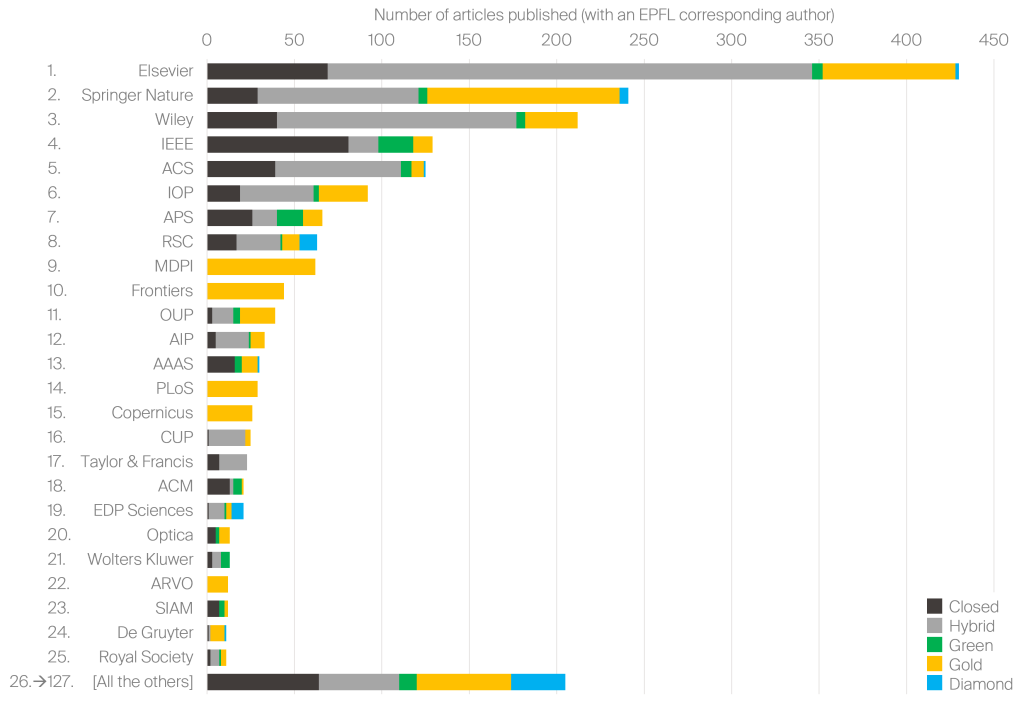
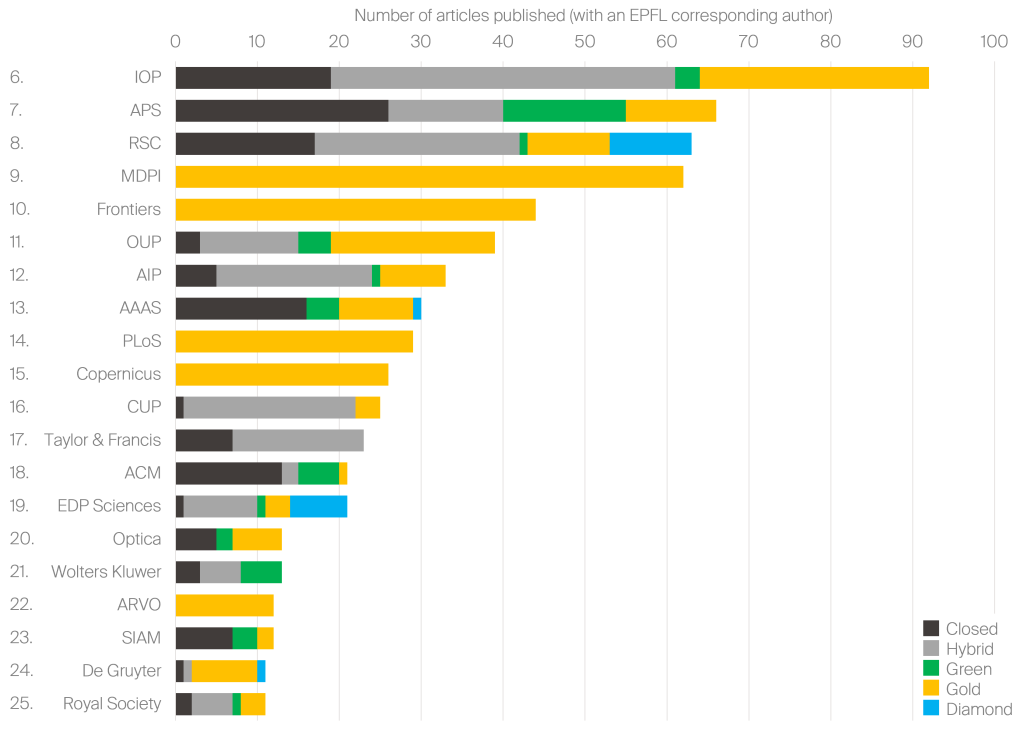
The chart above illustrates where EPFL authors most frequently publish, focusing on the 25 publishers (out of a total of 127) with more than 10 articles in 2023. The data considers only articles with a corresponding author affiliated with EPFL, categorized by publication type (Closed, Hybrid, Green, Gold, or Diamond).
Elsevier leads the ranking, publishing 22% of all EPFL articles (430 out of 1’988). Collectively, the top five publishers—Elsevier, Springer Nature, Wiley, IEEE, and ACS—account for nearly 60% of all articles, while the top 25 publishers represent almost 90%. Among these 25, five are fully Open Access publishers: MDPI (62 articles), Frontiers (44), PLoS (29), Copernicus (26), and ARVO (12). Notably, the EPFL Library has agreements with 16 of the top 20 publishers, helping to cover Open Access publishing charges, either fully or partially, for their journals. For a detailed breakdown of these numbers, the complete data underlying this chart can be accessed on the Swiss Open Access Monitor platform.