
Author(s) : Francesca Bono, Anna Puiggalí-Jou, Greta Cocchi, Mariangela Miccoli, Katharina Maniura-Weber, Marcy Zenobi-Wong, Esther Amstad
Supervisor(s) : Esther Amstad
Journal : Advanced Functional Materials
Editor : Wiley
Year of publication : 2026
Bone combines mechanical resilience with low density and the ability to repair itself when damaged. Inspired by the fascinating
density-normalized mechanical properties of bone, synthetic porous hydroxyapatite (HA)-based materials have been introduced.
However, their production typically involves sintering, which is energy-intensive and restricts incorporation of biologically active
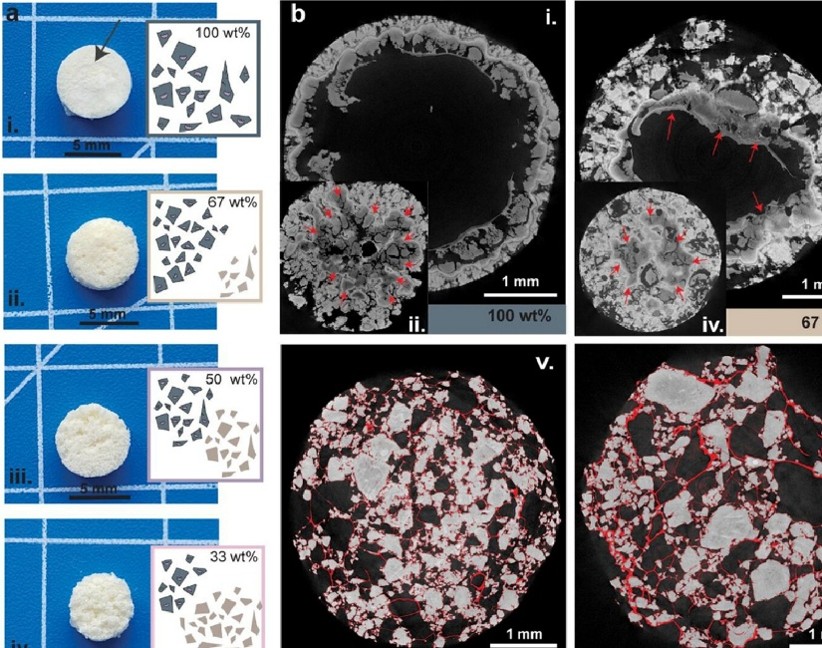
components. Here, we introduce an enzyme-mediated strategy to 3D print HA-based composites that become load-bearing within 7
days of mineralization through an energy-efficient room-temperature process. This is achieved by embedding alkaline phosphatase
in naturally derived hydrogel microfragments that are jammed to enable direct ink writing at room temperature. To control the
porosity of the mineral-based composites, we include enzyme-free fragments. The resulting scaffolds exhibit compressive strengths
of 3.65 MPa (5.5 MPa g−1 cm3 specific strength) and low cytotoxicity. Through the introduction of open pores constituting up to
52 vol.% of the scaffold, we enable cells to infiltrate the scaffolds, thereby opening up new possibilities for cells to remodel them.
We foresee the combination of mechanical performance, bioactivity, and energy-efficient processing to open new avenues for
bone tissue engineering and mineral repair, where broken structures have the potential to bear significant loads much faster than
currently available solutions do.
More information : https://doi.org/10.1002/adfm.202526568