
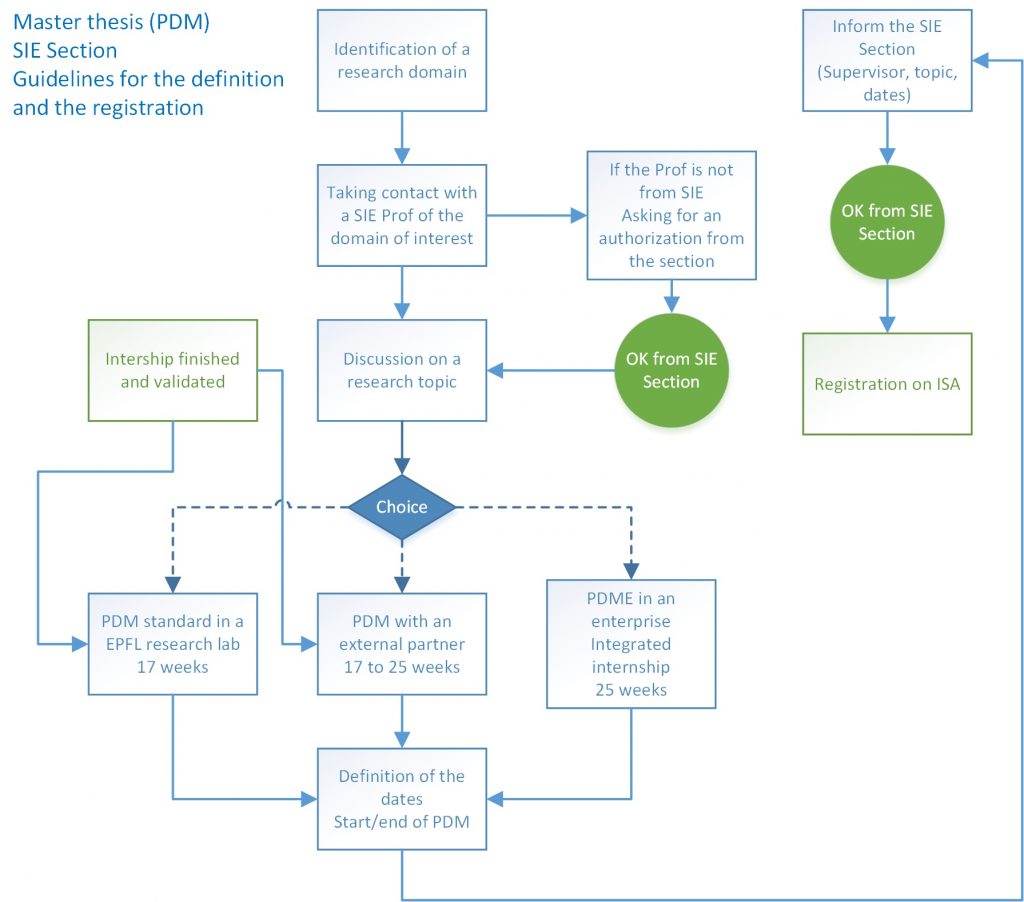
The Master thesis (“PDM”; 30 ECTS) is the research work that is achieved after the successful completion of the Master course cycle (i.e. 90 ECTS). It is a unique opportunity to conduct personal research on a topic related to environmental engineering under the supervision of a professor of the Section. The internship must also be completed before the start of the PDM, unless it is integrated into an in-enterprise PDM.
The Master Thesis can be done in an institution outside EPFL in Switzerland or abroad. The conditions are:
- getting all the credits for the Master program;
- have a commitment from an EPFL professor affiliated with the SIE Section to supervise the work
More information for doing your master thesis outside EPFL.


Useful information
In SIE, the Master thesis lasts 17 weeks when it’s achieved at EPFL. The length can be extended to 25 weeks, depending on the cases, if:
- the project is achieved outside EPFL
- the extension request is made before the Master thesis starts
- the SIE Section approves the request
Extension requests made during the Master project will not be considered.
The oral defense must be scheduled within 4 weeks from the hand-in, but before Friday 25th September 2026 at the latest. After this deadline, the students will receive their Master diploma the following year.
The 2025 Graduation Day will take place on Saturday 3rd October 2026.
- Please look at the list of Master thesis topics proposed by the SIE Professors and/or get in touch with them directly.
- You can also have a look at the ENAC semester Projects web page.
- All the Master theis topics that come from the “Internship portal” or from personal contacts by the students (university, companies) have to be approved (level, goals) by an SIE Professor who will supervise the project, at least one month before the Project’s start. Master Projects that are taking place out of EPFL or abroad must also be approved by an SIE Professor.
A Master thesis can take place either within an IIE Laboratory (Environmental Engineering Institute), or within an external institution (academic or another research institution) under an SIE Professor’s or a MER’s supervision.
A Master thesis is usually not achieved within a Minor’s topic.
The oral defense is not public. Following Art. 4 of the Ordinance on the Evaluation of Bachelor and Master studies at EPFL, the oral defence must take place in front of the EPFL supervisor and an expert chosen by the EPFL supervisor, after approval of the SIE Director. Only the EPFL supervisor is allowed to invite other people to the oral defence. They do not participate in the final evaluation.
- Read the document carefully : SIE Master thesis guidelines
- Choose your topic and contact the professor in charge in order to specify the goals
- In the case of an external supervisor (outside SIE) or a scientific colleague, a JUSTIFIED REQUEST must be made to the SIE Section with the detailed project description.
- You may receive financial compensation in some cases. See this page for more details and follow the procedure.
- Register the Master Project on IS-Academia and set the project’s dates (with course registration module) – same deadline as for the courses registration
- Become a member of “International SOS” for medical assistance during your Master project abroad. This is mandatory when doing your Master project abroad.
- Ordinance on the Evaluation of Bachelor and Master Studies at EPFL
- Intellectual property, interpretation of the EPF rules
- SIE Master thesis guidelines
- Contract for Master Projects outside EPFL and Best practice regarding projects of Master’s degree in a company: please contact the Section. Document is not available online.
- Master Project Thesis Protocole
EPFL rewards the best academic results and the best Projects of Master by awarding several prizes in its own name, but also on behalf of private companies or foundations.
The majority of the prizes are awarded to the winners during the Graduation Day which takes place in October (with the exception of the research prizes). Some prizes are awarded at other times of the year and the dates are indicated in the respective prize information.
Some prizes are on application (max. 2 applications per student), others do not require registration. The conditions are indicated next to each price.
The deadline for application has been scheduled by the SAC on Friday 21st August 2026.

“I wanted to study a subject that has meaning”
For her EPFL master’s project, Polina Holub developed a plan for recycling the rubble from buildings destroyed during the war in Ukraine – a particularly meaningful endeavor for someone who grew up in a Ukrainian town near the Russian border.

Reconciling hydropower generation with biodiversity
For his master’s project in environmental science and engineering, EPFL student Raphaël Angeles came up with methods for making hydropower generation more environmentally responsible, taking the Dynamo hydropower plant in Courrendlin, in Jura Canton, as his case study.

EPFL student applies engineering to public health
For his Master’s project, Noé Fellay mapped the presence of an autoantibody known to increase the risk of cardiovascular disease. This cross-disciplinary study, carried out in the Lausanne area, was an opportunity for Fellay to broaden his skillset.

Trees are not always a miracle cure for improving air quality
MASTER’S PROJECT – Donato Kofel has quantified the positive and negative effects of trees on outdoor air quality in Geneva Canton. His method can be used by city planners to design their large-scale planting programs more effectively.

EPFL ENAC SB STI IC SV CDM CDH All Preventing heat islands is a priority for the future of our cities
Two EPFL Master’s students carried out meticulous research on heat islands, or densely packed urban areas with features that can aggravate high temperatures during heat waves, posing a serious threat to vulnerable residents.

3D modelling of the Flon river helps engineers plan a new metro line
MASTER’S PROJECT – Lausanne will soon be getting a new metro line, the m3, but question marks remain over the best way to build the tunnel at the Flon station – already one of the busiest metro stations in French-speaking Switzerland. Leona Repnik, who just graduated from EPFL with an environmental engineering degree, studied this problematic for her Master’s thesis and put forth a feasible solution to this complex problem.

Modeling avalanche protection in forests
Two EPFL students have compared the ability of a forest in Vaud Canton to protect against avalanches before and after it was ravaged by fire in 2018. Their method could be applied to other forested slopes, helping to enhance local reforestation strategies.

A new technique to concentrate a fertilizer produced from wastewater
Summer series: Two EPFL Master’s in Environmental Engineering students have developed a novel method for recovering nitrogen from wastewater. For their semester project, they adapted a system typically used to concentrate fruit juice and tested it out at the Yverdon-les-Bains wastewater treatment plant in Vaud.