
On 27 February 2026, Jolanda Devalle presented the paper “Few and Simple Elements: Lauretta Vinciarelli, the Puglia Project and the Idea of Spatial Fabric” at the 10th Womxn in Design and Architecture Conference: Lauretta Vinciarelli, held at the Princeton University School of Architecture.
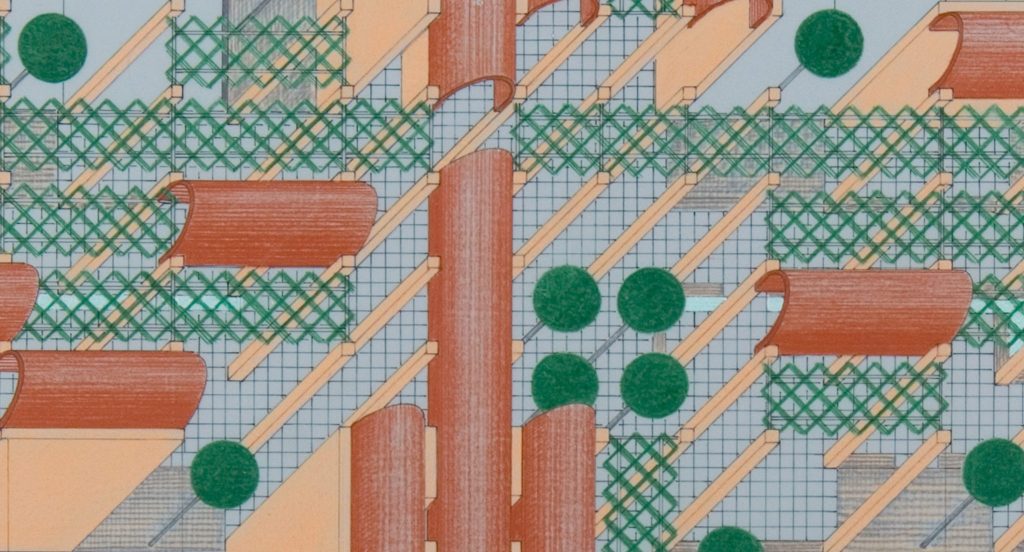
Jolanda Devalle’s paper “Few and Simple Elements” was presented at Princeton Architecture’s 10th Womxn in Design and Architecture Conference, dedicated to the life and work of Lauretta Vinciarelli. The paper offered a close reading of Vinciarelli’s Puglia Project (1975–77), developed in collaboration with Leonardo Foderà—an unbuilt proposal for public parks across the Apulian landscape presented as a revealing cross-section of Vinciarelli’s thinking as architect, theorist, and educator. Situated within the 1970s culture of drawn architecture and Vinciarelli’s early investigations—her critique of the neutral grid and of the notion of architecture-as-object—the project began by questioning the very premise of the competition brief, rejecting the picturesque park as an absurd typology for an agricultural region. The two architects turned instead to two historical precedents, the Islamic “marvel garden” and the Apulian villa comunale, to reconceive the park as a distinctly architectural scheme composed of few and simple elements rooted in local materials and conditions. Moving through the thirteen drawings of the series, the paper traced the project’s progression from a taxonomy of elements, to modular “micro-gardens,” to their aggregation into linear systems and interwoven fields—the tessuto spaziale, or “spatial fabric,” that Vinciarelli described as “exactly the contrary of what a building is.” Connecting this analytical approach to Vinciarelli’s Carpet Housing studio at Columbia and to the broader typological debates of the period, the paper argued that Vinciarelli’s pursuit of a design grammar transcending the single author and the singular brief deserves reappraisal in contemporary practice.