
A. Yurdusen, P. Malik, A. Mansouri, I. Dovgaliuk, M. Garvin, A.-Y. Song, A. Pourghaderi, X. Jin, L. Stuart, D. Chakraborty, S. Nandi, L. A. Fernando, A. Beauvois, V. Briois, J. A. Reimer, S. Garcia, B. Smit, G. Mouchaham, and C. Serre, Tunable Microporous Bimetallic Carboxylate-Pyrazolate Metal–Organic Frameworks for CO2 Capture J. Am. Chem. Soc. 148 (26), 27657 (2026) doi: 10.1021/jacs.6c07605
Abstract
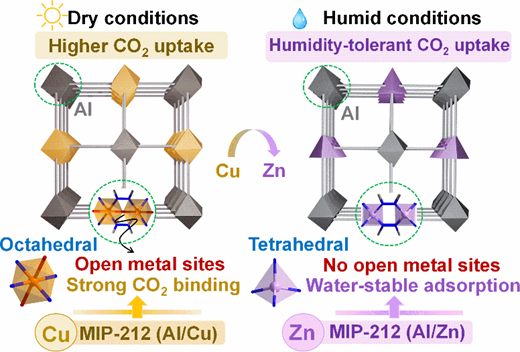
Herein, we report two heterometallic ultramicroporous metal–organic frameworks, MIP-212(Al/Cu) and MIP-212(Al/Zn) (MIP stands for Materials from Institute of Porous Materials of Paris), synthesized via a hard–soft acid–base design strategy. In these robust pyrazolate–carboxylate architectures, pyrazolates selectively coordinate Cu2+ or Zn2+, while carboxylates bind Al3+, generating chain-based inorganic building units built up from connected M2+-pyrazolate polyhedra and μ2–OH-corner-shared AlO6 octahedra, respectively. The resulting structures feature dual ultranarrow tunnel-like pores, one decorated with μ2–OH groups. MIP-212(Al/Cu) combines pore confinement with Cu2+ open metal sites (OMS) to deliver benchmark-level CO2 uptake at low pressure (2.30 mmol g–1 at 0.15 bar, 298 K) and a CO2/N2 Ideal Adsorbed Solution Theory (IAST) selectivity of ∼30. However, the OMS also imparts marked hydrophilicity, diminishing CO2 uptake under humid conditions. Markedly, replacing octahedral Cu2+ with tetrahedral Zn2+ centers in MIP-212(Al/Zn) suppresses OMS while preserving framework topology, resulting in significantly lower water affinity (up to ca. 4-fold reduction at 0.2 bar of H2O) and superior CO2 breakthrough performance at 50% RH. These findings demonstrate that metal coordination geometry is a powerful lever to modulate hydrophilicity and sorption behavior in MOFs, enabling the rational design of sorbents for efficient CO2 capture under realistic, moisture-rich environments.