
N. Taheri, T. Schertenleib, T. M. O. Felder, L. Piveteau, B. Mouriño, B. Smit, M. K. NAazeeruddin, and W. L. Queen, Lead, Locked Away: Porous Zr–Phytate Coordination Polymers for Rapid and Selective Removal of Pb2+ from Water J. Am. Chem. Soc. (2025) doi: 10.1021/jacs.5c11825
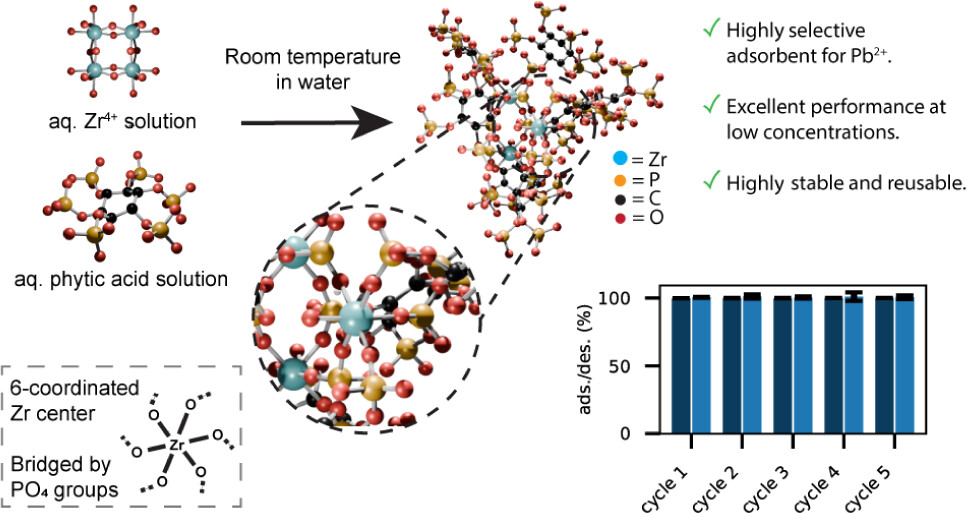
Abstract: Coordination polymers (CPs) often suffer from poor hydrolytic and chemical stability, limiting their use in water remediation. Herein, we report a highly robust, amorphous CP synthesized from Zr4+ and phytic acid, a natural source of phosphorus in plants and seeds. The CP, which features stable Zr–O–P bonds that resist degradation even in 10 M HCl and HNO3, forms a micro- and mesoporous network under mild reaction conditions in water. The material consists of mononuclear ZrO6 units bridged by phosphate groups. Zr–Phytate exhibits excellent Pb2+ removal performance, maintaining high efficiency even in the presence of excess competing ions. Pair Distribution Function (PDF) analysis and solid-state NMR (ssNMR) provide insight into the coordination environment of the Zr-phosphate centers and the mechanism of lead complexation. The exceptional chemical durability of Zr–Phytate allows efficient regeneration using 1 M HCl, with no detectable leaching of Zr or phytic acid and no loss of structural integrity over multiple cycles. Compared to commercial ion-exchange resins, Zr–Phytate offers superior selectivity and reusability. This work demonstrates the importance of designing stable coordination polymers and highlights the promise of zirconium-phosphate networks for applications in water remediation.