
Student Projects in the LMTS – Spring 2026
If you are interested in a project, please contact the Ph.D. student or postdoc in charge of that project. The working languages in our group are English (primarily) and French.
For EPFL students: Please note the LMTS is located in Neuchatel. Semester project students are expected to come to Neuchatel at least one day a week, while Master projects students are in Neuchâtel every day. Travel is reimbursed according to EPFL’s HR rules.
For non-EPFL students, it might be possible to do your Master’s project at the EPFL, project duration is typically 6 months.
Instructions for projects in our lab:
– Instructions for semester projects
Student projects on the following topical areas (for complete descriptions please scroll on down)
- Soft Robotics and Haptics
- MEMS and Printed Microsystems
1. SOFT ROBOTICS AND HAPTICS

|
Type:
|
only as Master project
|
|
Period:
|
Spring 2026
|
|
Section(s)
|
GM, MT, ME, MX, or from another university
|
|
Type of work:
|
Design, fabricate and test a novel flexible artificial muscle
|
|
Requirements:
|
Strong interest in soft robotics
|
|
Subject(s):
|
Soft robotics, artificial muscle, wearable robot, exosuit |
|
Contact:
|
Dr. Junsoo Kim |

|
Type:
|
only as Master project
|
|
Period:
|
Spring 2026
|
|
Section(s)
|
GM, MT, ME, MX, or from another university
|
|
Type of work:
|
Design, fabricate and characterize new generations of FiberPumps
|
|
Requirements:
|
Strong interest in soft robotics, strong Physics background
|
|
Subject(s):
|
Soft robotics, wearable robotics |
|
Contact:
|
Dr. Jacob Rogatinski |
More than 500 years ago, Leonardo da Vinci sketched a vision of man walking on water, a dream of freedom and mechanical harmony. Yet, despite half a millennium of technological progress, current commercial solutions are heavy, inefficient, and unsatisfactory. Skis drift apart, poles offer little mechanical advantage, and existing designs fail to harness the full power of the human body. 
The goal of this project is to bridge this gap by developing Cross-Water Skiing, an innovative discipline merging cross-country skiing mechanics with the sensation of gliding on water.
This project offers a unique opportunity for two motivated students to work at the forefront of sports engineering.
Student 1: Mechanical systems & Flexure design.
Your mission is to engineer the ski system’s structural backbone. Following a preliminary comparative analysis of flexure architectures, materials, joint configurations, and load paths, you will design, model, and prototype high-performance flexure mechanisms—including dedicated post flexures—and structural solutions that preserve perfect ski parallelism under dynamic loads. The goal is to achieve precise force transmission, controlled compliance where needed, minimal energy loss, and lightweight, reliable performance in real-world conditions.
Student 2: Fluid dynamics & Propulsion optimization.
Your mission is to master the interface between the ski and the water. A preliminary comparative analysis of alternative geometries, kinematics, and control strategies will guide design selection. You will conduct advanced CFD simulations and physical prototyping to optimize hinged flap propulsion systems that maximize forward thrust while minimizing drag, ensuring that every movement translates efficiently into explosive speed.
Common Goals
Both students will collaborate closely on 3D manufacturability and prototyping.
This is not just a simulation project — you will build, test, and iterate. Together, you will develop a functional prototype of the complete ski system, based on commercial inflatable platforms, demonstrating that the centuries-old dream of running on water is finally within our grasp.
|
Type:
|
only as Master project
|
|
Period:
|
Spring / Fall 2026
|
|
Section(s)
|
ME, MT, or from another university
|
|
Type of work:
|
Design, build and test on-water human powered skiing
|
|
Requirements:
|
Strong skills in mechanical engineering
|
|
Subject(s):
|
flexure design, CFD, 3D printing. |
|
Contact:
|
prof H Shea |
The start-up Elecyor is developing a flexible fiber-format linear motor, based on a PhD thesis done at EPFL-LMTS. Working near Lyon, France, the student will develop advanced manufacturing methods and automated test benches to characterize this new type of linear actuator.
 Detailed info in this pdf
|
Type:
|
Master project in a company
|
|
Period:
|
Spring 2026
|
|
Section(s)
|
MT, ME, or from another university
|
|
Type of work:
|
Develop fabrication and test bench for electrostatic fiber motor
|
|
Requirements:
|
Strong skills in electronics, mechanics and physics
|
|
Subject(s):
|
linear motor, technology transfer, wearable robotics |
|
Contact:
|
Dr. Sylvain Schaller |
2. MEMS & PRINTED MICROSYSTEMS
We aim to create transient metallic conductors and device elements by electroplating zinc onto laser-induced graphene (LIG) patterned on eco-responsible bipolymeric substrates. LIG serves as a conductive seed enabling localized Zn growth at low temperature, yielding maskless, low-waste metallization with higher conductivity versus bare LIG. In this project, we will also explore the formation of LIG on wood, paper, and similar carbon-rich biodegradable substrates, assessing how substrate composition, surface roughness, and laser parameters influence conductivity and pattern quality. We will optimize LIG formation and electrodeposition conditions. We will validate performance on passive and sensing demonstrators. In the frame of a master project, reliability will be evaluated under bending and humidity; end-of-life will be assessed through controlled Zn dissolution and substrate recyclability/compostability. The outcome is an end-to-end processing route linking LIG on natural substrates with transient Zn metallization for eco-friendly low-power sensing and wireless/passive electronics.
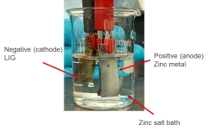
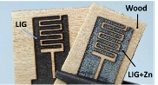
In this project, you will work on the full fabrication chain, from LIG formation to Zn electroplating and device testing. The student will optimize LIG patterning by adjusting the process conditions on different biodegradable substrates. The student will then tune Zn electroplating parameters to improve conductivity, adhesion, and coating uniformity. Morphology, electrical and mechanical properties will be characterised. Demonstrators will be designed and characterized such as printed sensors, electronics and RF components. In the frame of a master project, reliability can be further evaluated under bending, humidity exposure, and thermal ageing, while end-of-life behavior will be studied through controlled Zn dissolution and compositing.
| Type: | For Semester or Master project |
| Period: | Fall 2026 |
| Section(s) | MT, EL, MX |
| Type of work: | Design, fabrication and characterization |
| Requirements: | Interest in development of processes and devices, and characterisation of morphological, electrical, and mechanical properties |
| Subject(s): | Additive manufacturing and transient electronics/sensors |
| Contact: | Lorenzo Travaglini & Danick Briand |
In the frame of a semester project, the work will focus on the design, fabrication, and characterization of biodegradable wireless labels for chemical sensing. Students will print degradable zinc-based conductive conductors on the selected substrates to form a RLC circuit with given resonance frequency and optimised Q-factor. The device will implement micro-fluidic channel to confine the liquid sample to the sensing element. The study will involve the detection of different ionic solutions by monitoring their influence on the RF characteristics of the labels such as their impedance, amplitude, or resonant frequency. In the frame of a master project, this platform can be further developed through biofunctionalization of the zinc resonator surface to realize biosensors for the recognition of specific analytes in relevant body fluids. The outcome is a simple and scalable route toward eco-friendly disposable wireless sensors for point of care diagnostics in various body fluids, such a sweat.

In this project, you will work on the development of biodegradable zinc LC tanks on eco-responsible and bio-sourced substrates for wireless ion sensing. Depending on the student’s interest, the semester project can focus on transducer development, including LC tank design, printing processes, micro-fluidics integration, electrical/RF and sensor characterization. For a master project, the work can be extended toward biofunctionalization, including eco-friendly surface treatments, recognition layers, and testing in more complex fluids. This project may therefore range from design, fabrication and characterization of the zinc-based wireless transducer to the development of a more selective biodegradable biochemical sensor.
| Type: | For Semester and Master project |
| Period: | Fall 2026 |
| Section(s) | MT, EL |
| Type of work: | Electrode manufacturing, printing, chemical functionalization and testing |
| Requirements: | Interest in sensors, bio-functionalisation, printed electronics, RF sensors |
| Subject(s): | Chipless sensing resonators, additive manufacturing, chemical functionalization |
| Contact: | Lorenzo Travaglini & Danick Briand |
Currently, wireless IoT RFID devices used for identification and sensing rely on some harmful components making their environmentally friendly disposal impossible after service life. In the frame of an European project with partners in France, we are developing eco-friendly RFID and NFC sensing tags made by the additive manufacturing of biodegradable materials on paper substrates. These tags can aim at identification of items or at the monitoring of perishable goods during their transport. At their end of life, these tags being developed could be recycled or safely disposed not being harmful to the environment.

In this student project, work will be performed on the development of biodegradable sensors and their integration on eco-responsible RFID tags. The biodegradable RFID tags are based on the printing of a biodegradable metal and dielectric layers, with the silicon chip being the only non biodegradable component remaining. As Master project, the project will focus on the development of temperature threshold sensors, the design and fabrication of RFID tags, and their characterization, including their biodegradation. As Semester project, the project will focus on one or some of these aspects depending on the status of the project and the student’s interest.
| Type: | Semester and Master project |
| Period: | Fall 2026 |
| Section(s) | MT, MX, EL |
| Type of work: | Sensor and tag design, fabrication, and characterisation |
| Requirements: | Interest in experimental work on sensor, printed and sustainable electronics |
| Subject(s): | Biodegradable and recyclable electronics, environmental sensing, RF tags |
| Contact: | Danick Briand |
We will develop biodegradable biointerfaces on zinc and carbon (printed carbon and/or graphene) electrodes that can be functionalized for a broad range of analytes. Water-compatible chemistries will immobilize diverse receptors while preserving full device transience and avoiding persistent materials. Functionalization efficiency will be evaluated with surface analysis (e.g., XPS, FTIR, Raman, and contact-angle) to confirm composition, coverage, and uniformity. Electrochemical impedance spectroscopy (EIS) will be performed in relevant electrolytes, fit with appropriate equivalent-circuit models. It will be applied to quantify interfacial parameters (charge-transfer resistance, film/double-layer capacitances, and diffusion elements) across baseline, post-functionalization, and target-binding states. The outcome is a general, environmentally conscious set of methods and validation guidelines for transient electrode functionalization.

In this project, students can focus on developing and testing biodegradable biointerfaces on zinc and carbon electrodes. They may formulate water-compatible surface chemistries, prepare and activate electrode surfaces, and attach generic recognition layers while preserving device transience. They can build a light surface-analysis workflow, such as XPS, ATR-FTIR or Raman, and contact-angle, to verify composition, coverage, and uniformity, and then implement electrochemical impedance spectroscopy in relevant electrolytes, fitting data with simple equivalent-circuit models to extract interfacial parameters and compare functionalization routes. Depending on interest, they can prototype basic sensing tests that track electrical changes before and after functionalization and upon exposure to representative analytes, examine nonspecific interactions and simple blocking strategies, and run short stability checks in relevant fluids.
| Type: | Semester or Master project |
| Period: | NOT AVAILABLE |
| Section(s) | MT, LS, EL |
| Type of work: | Electrodes manufacturing and their biochemical functionalization and testing |
| Requirements: | Interest for biosensors and electrochemistry |
| Subject(s): | Printed electrochemical transient electrodes and their bio-functionalisation |
| Contact: | Lorenzo Travaglini & Danick Briand |