Please find below a list of current semester project and master thesis opportunities. We are also open to suggestions of project topics. Interested students should directly contact Prof. Karapiperis at [email protected].
Geophysical flows such as landslides, rockfalls, and snow avalanches pose significant risks in Switzerland. High-fidelity simulations of these phenomena are essential for hazard assessment and early warning systems. However, traditional physics-based numerical simulations on complex 3D terrains are computationally intensive, which restricts their use in time-critical applications and large-scale risk analysis. The objective of this project is to accelerate geophysical flow simulations by leveraging modern machine learning techniques, including purely data-driven and physics-informed approaches. The final outcome is the development of surrogate models that approximate the outputs of physics-based simulations with high accuracy but at a fraction of the computational cost. The project will be supervised jointly with the Chair of Alpine Mass Movements at ETHZ.
More details can be found here.

Rockfalls remain a major natural hazard in Alpine regions, frequently threatening infrastructure and transportation corridors, and causing significant financial impacts each year. This project aims to develop a digital twin framework for simulating and assessing rockfall hazards in real-world terrains. Using terrain reconstruction and rock geometry characterization, the student will build virtual replicas of actual slopes and surrounding protection systems. The rockfall trajectories will be simulated using our in-house Discrete Element Method (DEM) code, capturing realistic dynamical behavior including impacts and interactions with flexible or rigid barriers. By leveraging the digital twin, the project will explore uncertainty quantification techniques — assessing how variability in rock properties and terrain roughness affects runout distance and energy dissipation – as well as machine learning surrogate models, enabling rapid risk mapping and probabilistic prediction of rockfalls. The project bridges computational particle mechanics, data-driven modeling, and natural hazard assessment, contributing toward smart, data-informed design and mitigation strategies for rockfall-prone regions.
More details can be found here.

Understanding internal material properties from surface measurements is essential across numerous scientific, industrial, and engineering fields, including structural integrity assessment, advanced material characterization, and non-destructive evaluation. This research proposes the development of a generalized inverse modeling framework that leverages state-of-the-art artificial intelligence (AI) methodologies, particularly deep learning (DL) algorithms, to reliably correlate observable surface responses to internal property distributions. The expected outcome is a robust computational method that precisely interprets complex surface data to infer internal characteristics, significantly enhancing material evaluation, structural diagnostics, and predictive maintenance across various industrial applications.
More details can be found here.

Architected materials can achieve properties not found in natural materials, such as negative Poisson’s ratios, programmable stiffness, or tunable energy absorption. This project will explore the emerging field of architected granular materials — ensembles of particles whose shape, surface properties, and packing arrangement are deliberately designed to control macroscopic mechanical behavior. Students will design and 3D-print custom particle geometries, assemble granular packings with controlled structure, and perform static and dynamic mechanical tests using the lab’s experimental facilities. Experimental campaigns will be complemented by high-resolution imaging and digital image correlation to capture evolving material characteristics. Data analysis will focus on linking microscale properties and interactions to macroscale response, revealing design principles for granular systems with tailored stiffness or energy absorption. The project combines additive manufacturing, experimental mechanics, and data-driven algorithms, contributing to the fundamental understanding and engineering design of new classes of programmable granular materials.
More details can be found here.

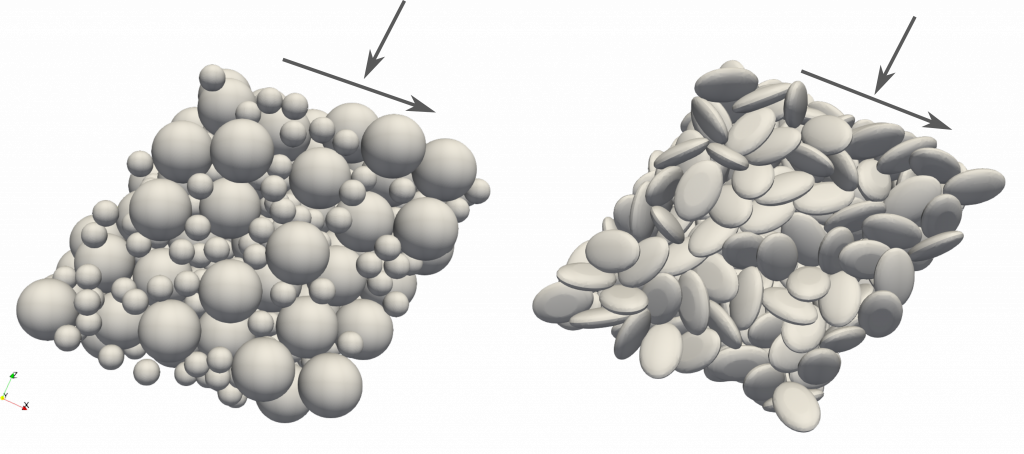
Segregation in granular flows is an important phenomenon influencing various natural and industrial processes, from landslides to pharmaceutical manufacturing. This project investigates the role of particle shape in segregation dynamics within granular flows. Using numerical simulations, the student will analyze how particles of varying shapes and sizes segregate under shear and gravity-driven flows, by analyzing the forces developed between particles. The final goal is to provide insight into the continuum modeling of segregation phenomena in different scenarios.
More details can be found here.
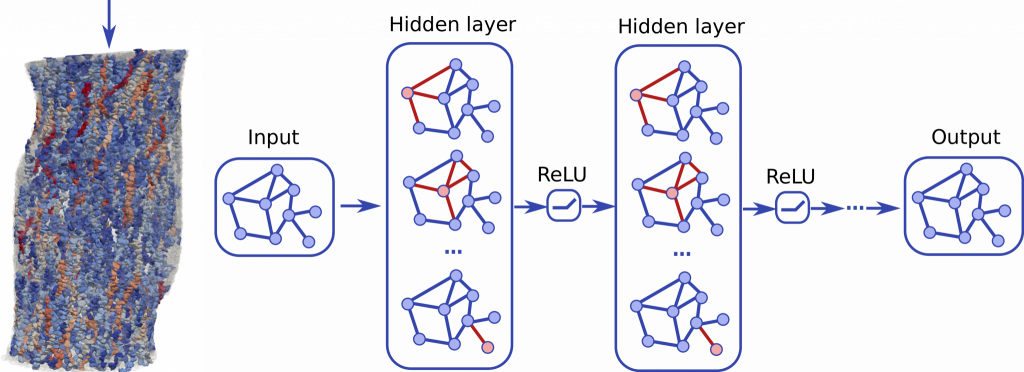
Granular materials form complex networks of force chains arising from frictional interactions between particles. Under applied shear, this network of contacts can undergo complex topological and geometrical rearrangements. The connection between these grain-scale patterns and the macroscopic behavior of the material is still a field of active research. In this project we will employ Graph Neural Networks (GNNs) to shed light on these processes, focusing on the regime where granular materials approach unjamming and failure. The models will be trained on data from high fidelity discrete
element simulations as well as experimental measurements with grain-scale resolution.
More details can be found here.
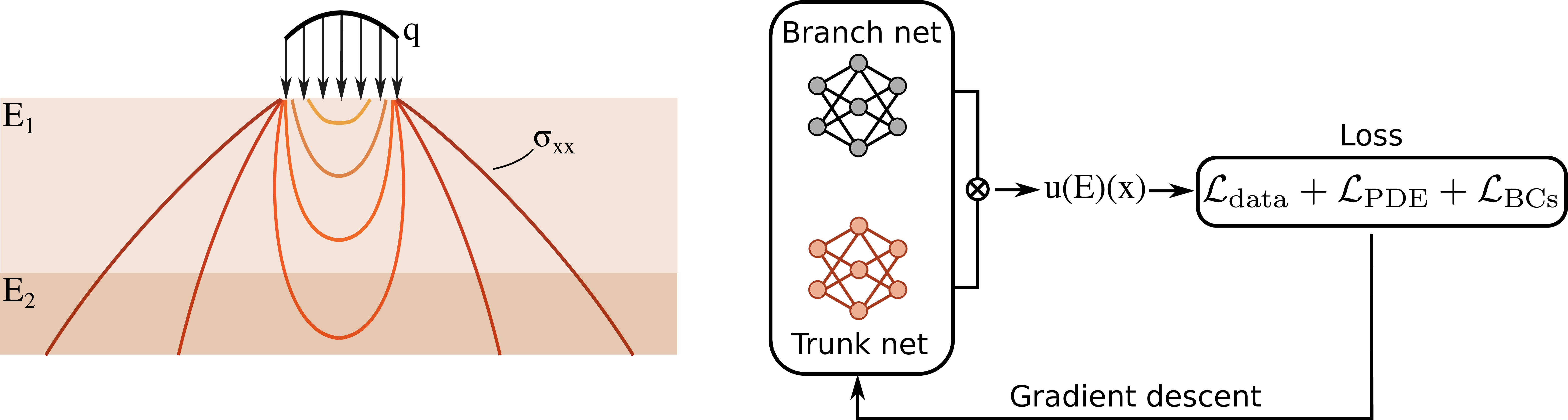
Recently, physics-informed neural operators (PINOs) have been introduced as a new approach for solving complex problems in engineering, by combining data with knowledge of the underlying governing equations. The concept is an extension of previously successful purely data-driven deep neural operators. In this project, the student will explore the application of PINOs on solid mechanics problems, with the goal of simulating the behavior of materials under various loading conditions. Applications will be considered in the context of geotechnical or structural engineering. The generalization capabilities of the method will be evaluated, and its accuracy will be compared to conventional numerical solutions. The findings aim to advance computational tools for engineering design and analysis, bridging the gap between traditional numerical methods and scientific machine learning.
More details can be found here.
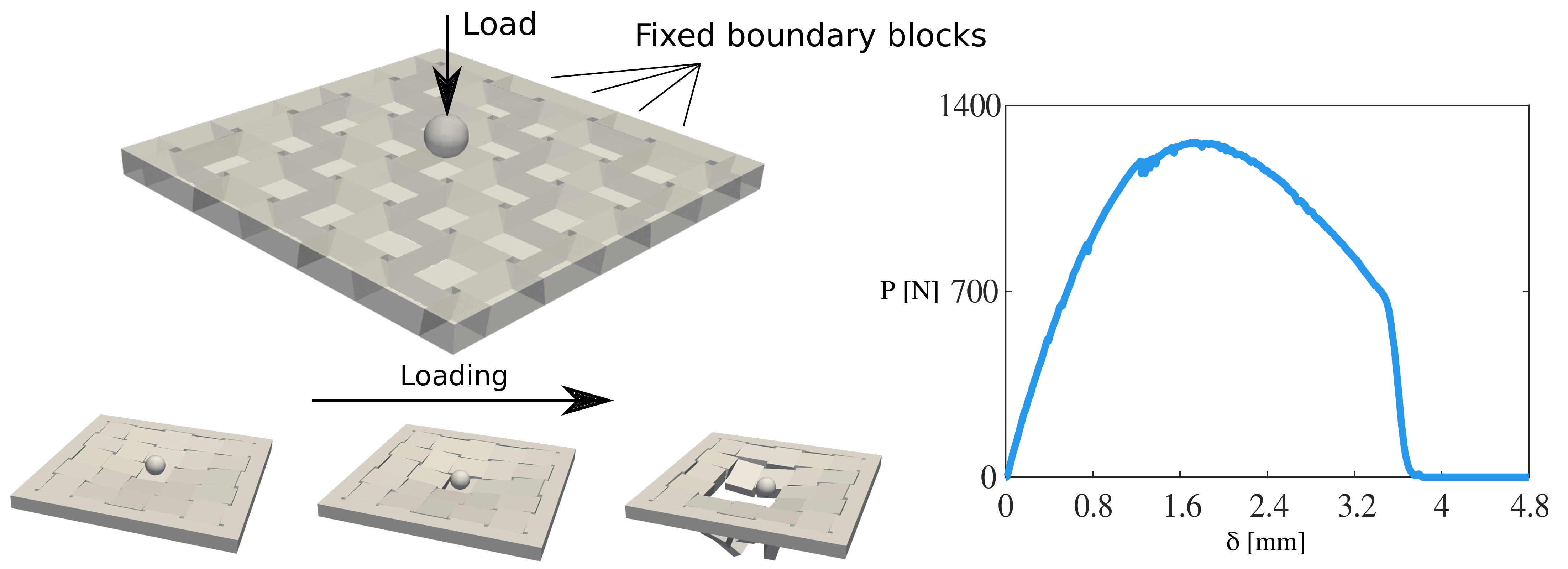
Topologically interlocked structures (TIS) represent a new class of innovative designs inspired by the mechanics of puzzles [1]. Constructed from individual building blocks that interlock without the use of adhesives, these structures exhibit remarkable mechanical properties, relying solely on contact and frictional forces for their integrity. Experimental observations have revealed sudden failures and sharp load drops in TIS, indicating that frictional slip instabilities play a significant role in their structural response. This project aims to explore the influence of stick-slip frictional instabilities and interfacial heterogeneity on the failure mechanisms of TIS. Using the level-set discrete element modeling framework, the student will investigate the dynamic behavior of these systems under various conditions. The project offers an opportunity to delve into the unique mechanical behavior of TIS and gain experience with modern computational tools in structural engineering.
More details can be found here.
Architected structural materials – such as truss lattices and bioinspired composites – can achieve properties not found in conventional structural materials, such as excellent stiffness-to-weight ratios, superior strength and fracture toughness. They derive these properties not only from their constituent materials but also from their carefully designed geometry and topology at a microstructural scale. This project will specifically explore the predictive modeling of fracture in those materials, which remains a major scientific challenge. To this end, the student will develop and apply phase-field fracture models to simulate crack initiation and propagation in these solids. The goal is to understand how microstructural features – such as periodicity, hierarchical organization, or intentional defects – influence the resulting fracture toughness, fracture modes, and overall energy dissipation. They will also have the opportunity to explore modern machine-learning based surrogate modeling techniques for phase-field evolution as alternatives to classical solvers to reduce computational cost, while collaborating with ongoing experimental efforts. The outcomes of the project is to establish new computational tools for predicting fracture in architected materials, and to provide insights that can guide the design of more resilient structures.
More details can be found here.

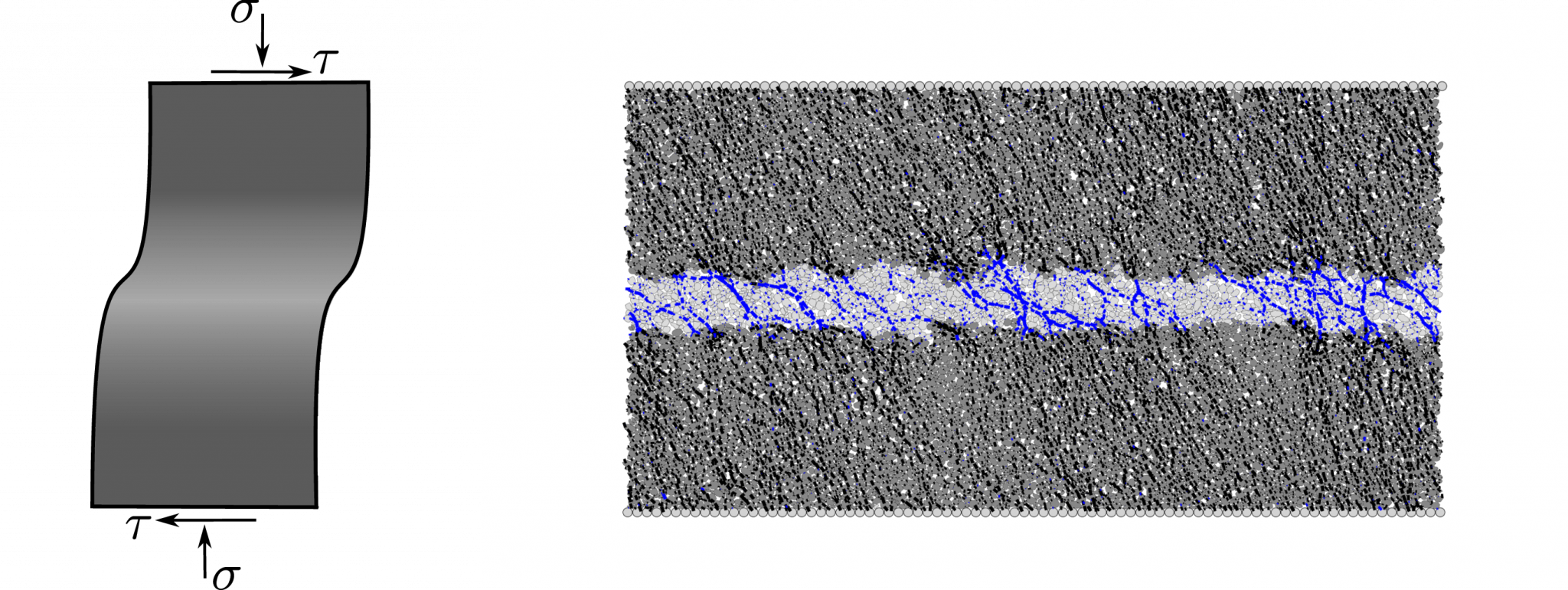
The fault gouge, a layer of cohesionless material formed by fragmentation of parent rock, plays a key role in the macroscopic frictional behavior of faults, including their stability and energy release. This material exhibits complex behavior influenced by mechanical deformation, thermal effects and pore fluid flow. In this project, we utilize a combination of discrete and continuum simulations to investigate gouge rheology. In particular, the student will explore the effect of material heterogeneity and grain-scale characteristics on the macroscopic behavior, including the influence of particle fracture. Additionally, phenomena arising from hydromechanical and thermomechanical coupling will be studied. The findings from the project aim to provide new insight into earthquake mechanics.
More details can be found here.