
Current projects
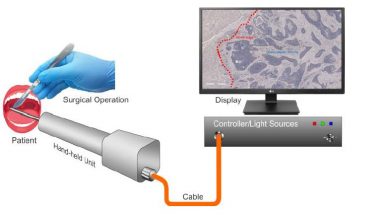
Minimally invasive deep-tissue endoscopy
Head and Neck Cancers (HNC) cases approach a million diagnoses each year worldwide. Treatment of HNC involves surgical resection, which is deemed complete if the biopsy comes back from histopathology with clear (negative) margins. Positive surgical margins leave microscopic residues of cancer in the wound bed and require a second resection, as this minimal residual disease in turn gives rise to local and possible non-lac recurrences, and consecutive death of the patient. A positive surgical margin increases the risk of local recurrence by 90%, reducing the overall survival expectancy by 50% and increasing all-cause mortality at 5 years by 90%. There is a need for a point-of-care method to map the exact tumor margins as a 3D model of the tumor before resection, and detection of residual malignant cells in the wound bed in real-time.
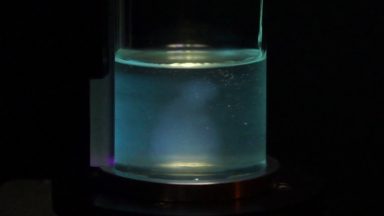
Volumetric 3D printing
Most additive manufacturing methods such as fused-deposition modelling, selective laser melting or stereolithography create objects sequentially one layer at a time. This type of process imposes limitations on the shapes and the materials that can be printed. For example, overhanging structures need additional supports during printing, and soft or elastic materials are difficult to print since they deform as new layers are added.
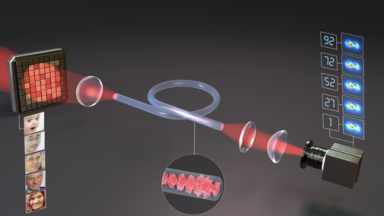
Optical Implementation of Neural Networks
Currently, neural networks are implemented on electronic chips such as central processing units (CPUs) and graphics processing units (GPUs). However, computational algorithms and more specifically neural networks were also realized with optical systems even though they are far from being as popular as their electronic counterparts. In our laboratory, we demonstrated spatiotemporal nonlinearities inside multimode optical fibers can be used as a neuromorphic neural network and its performance can be comparable to digital neural networks.