
Introduction and Goals
The energy transition consists in the definition of the investment in equipments and infrastructure for harvesting, converting, distributing and managing the renewable energy resources in order to build an energy system that securely satisfies the needs of the society. Engineering[1] this system requires to adopt a systemic approach that integrates technology innovation and exploits local resources and synergies. Sustainable engineering[2] practices need to be applied to consider the specific nature of the renewable energy and their management and the evolution of the technology portfolio in the perspective of the circular economy.
Over the years, Industrial Process and Energy Systems Engineering research team in EPFL has been developing a computer aided framework for the decision support in industrial process and energy systems engineering. The method is designed to show the options offered by technology innovations and how their integration contribute to the system’s transition. This method combines expertise in technology knowledge, modeling(Digital Twining), system integration and sustainability assessment.
The framework is supported by an open source data base of technology models representing the state of the art of the technolgy development in processing, energy conversion, distribution and conversion for various industrial and urban sectors. This initiative is developed under the umbrella of the International Energy Agency and aims at making available the state of knowledge and technology development for engineering of sustainable transition pathways.
The framework is integrated into a Master of Advanced Studies(MAS) continuing education program proposed EPFL in collaboration with University of Applied Science in Valais (Switzerland). This program aims at delivering literacy, knowledge and tools for engineering the transition to the next generations of engineers in Sustainable Energy System Engineering.
The offer
We propose a continuing education program associated with the use and the development of the open source computer aided platforms developed in EPFL.
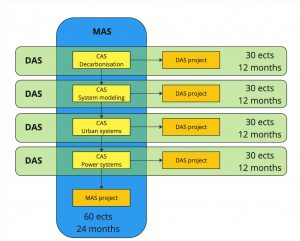
The continuing education program organised in 4 modules
- Energy systems and sustainable development : This module covers the aspects of system integration, energy system modeling, life cycle sustaionability assessment and generation of transition pathways.
- Urban system : This module concerns the integration of renewable energy resources in the urban environment. It covers the aspects of behavioural changes, planning, building stock evolution, infrastructure development and novel business models for the sustainable adaptation of the urban environment.
- Power systems and its infrastructure : This modules concerns multi-scale power management and the related technologies and infrastructures for the renewable based multi-energy system.
- Industry decarbonization : This modules covers the aspects of the rational use of energy in industrial production facilities, renewable energy integration, decarbonisation and the intergation of circular economy and the industrial symbiosis.
The program is structured upon the application of tools and methods using the open source computer framework developed in EPFL.
It is proposed as a set of on-line lectures delivering the theory basis and a project based on-site teaching for the use of the tools and their application.
Each module delivers a Certificate of Advanced Studies of 10 ECTS upon the success of the exam. Each certificate can become a Diploma of Advanced Studies upon the realization of a diploma thesis consisting in an EPFL coached application of the tools and methods on a real case study.
The Master of Advanced Studies diploma in Sustainable Energy Systems Engineering is obtained by successfuly passing the 4 certificates and the realization of a diploma thesis.
At the end of the studies, the students have not only acquired the scientific engineering knowledge but also gain a long term access to the computer framework developed by EPFL.
Who can attend ?
The program targets engineers with an engineering degree and/or energy related engineering professional experience such as:
- Engineers from the industry or the administration in the context of the employer’s continuing education program.
- Engineers or researchers targeting a new career specialising in sustainable energy system engineering.
- Freshly graduated engineers who want to perfect their training in the sustainable energy system engineering domain.
How much does it cost ?
Tuition fees
- Certificate of advanced studies: (6 months, 10 ECTS[3]): 10’000 CHF
- Diploma of Advanced Studies: (12 months , 10(Certificate) + 20(Diploma) ECTS): 20’000 CHF
- Master of Advanced Studies: (24 months, 4\*10(Certificates) + 20(Diploma) ECTS): 30’000 CHF
The tuition fees cover the access to the on-line lecturing materials and the associated coaching by program’s lecturers (video sessions), project based learning on-site, diploma coaching by program’s lecturers and the access to the tools via a web-app.
Duration
- Each certificate is organised over one semester, 10 ECTS credits corresponds ot 300 hours of student dedication. –
- A diploma thesis corresponds to the equivallent of 600 hours of personnal work (20 ECTS) spread over 2 semesters.
The program can be mainly followed remotely. Only 3 weeks of on-site presence is required per certificate. The location is our premises in Energypolis EPFL Valais-Wallis in Sion (Switzerland). Other locations can be organised upon demand and specific prices.
Scholarships
Although the program is built upon the concept of continuing education by the employer, the program offers the possibility for the students to be hosted in our research teams and premises in Switzerland during the full program.
In such a case and upon availability of the sponsoring grants, students will receive, on top of the registration fees, a scholarship of 1920 CHF/month is offered to cover the living expenses in Switzerland following the rate of the Swiss Governement Excellence scholarships program: –
- Certificate of Advanced Studies: (6 months): 11520 CHF
- Diploma of Advanced Studies: (12 months): 23040 CHF
- Master of Advanced Studies: (24 months): 46080 CHF
Sponsoring program
Public and private companies are invited to sponsor students in the Master of Advanced Studies program. The **sponsoring** is proposed at the following rates per sponsored student:
- Certificate of Advanced Studies: (6 months): 21520 CHF.
- Diploma of Advanced Studies: (12 months): 43040 CHF.
- Master of Advanced Studies: (24 months): 76080 CHF.
The recruitment and the distribution of the grants will be organised by the program following a specific sponsoring agreement with the sponsors allowing for the attribution of the scholarships under specific conditions.
[1]: « Engineering is the application of science to the optimum conversion of the resources of nature to the uses of humankind. » Britanica
[2]: « Sustainable engineering is the process of using energy and resources at a rate that does not compromise the natural environment, or the ability of future generations to meet their own needs, while promoting economic and social development. It involves designing systems, structures, and technologies that are environmentally benign, economically viable, socially acceptable, and resilient over time. » UNESCO. (2021). Engineering for Sustainable Development: Delivering on the Sustainable Development Goals (pp. 12–15).
[3]: ECTS: European Credit Transfer System