PhD positions
No offer for the momment
Semester projects
Contact me to discuss ideas if you are interested in doing a semester projects and learn more about the use of composite materials in structures. See also below in Master Theses proposals.
Master Theses
Master’s on the influence of fiber sizing on fatigue life and effect of hygrothermal aging on High-Performance mineral fiber composites
The fatigue behavior of fiber-reinforced polymer composites is strongly governed by the quality of the fiber–matrix interface. Fiber sizing is a thin organosilane-based coating applied during manufacturing that acts as a coupling agent between the reinforcing fiber and the matrix resin, and its formulation directly affects load transfer efficiency, damage initiation, and crack propagation under cyclic loading.
TENRON® HPM is a novel continuous high-performance glass fiber with a natural base of minerals. The sizing formulations are tailored to different matrix systems and that creates a unique opportunity to study how interface chemistry influences fatigue performance.
In parallel, aerospace composite structures combine thermal and moisture exposure (hot/wet conditioning), which can degrade both the matrix and the fiber–matrix interface. Understanding the coupling between sizing formulation and hygrothermal environment on fatigue life is critical for a material qualification in structural applications.
Objectives
- Generate S–N curves for TENRON/ epoxy laminates with at least two different sizing formulations, under tension–tension fatigue loading (R = 0.1), at room temperature dry conditions.
- Investigate the effect of hygrothermal conditioning (70 °C / 85 % RH saturation) on the fatigue response: shift of the S–N curve, change in failure modes, and degradation of the fiber–matrix interface.
- Characterize damage mechanisms at the microscale (fiber–matrix debonding, transverse cracking, delamination onset) using optical microscopy, SEM, and acoustic emission monitoring.
- Compare sizing formulations and correlate with the macroscopic fatigue performance.
Methodology
- Hygrothermal conditioning per ASTM D5229 until a given % of moisture.
- Fatigue testing on a servo-hydraulic machine (5-10kN) at 10 Hz, at 2-3 stress levels.
- Post-mortem fractographic analysis (SEM) and X-ray micro-CT on selected specimens.
Available Resources
TENRON® HPM fatigue coupons with multiple sizing variants will be supplied by ISOMATEX. Mechanical testing equipment, environmental chambers, and microscopy facilities are available at GR-MeC. The student(s) will benefit from close interaction with ISOMATEX’s R&D team.

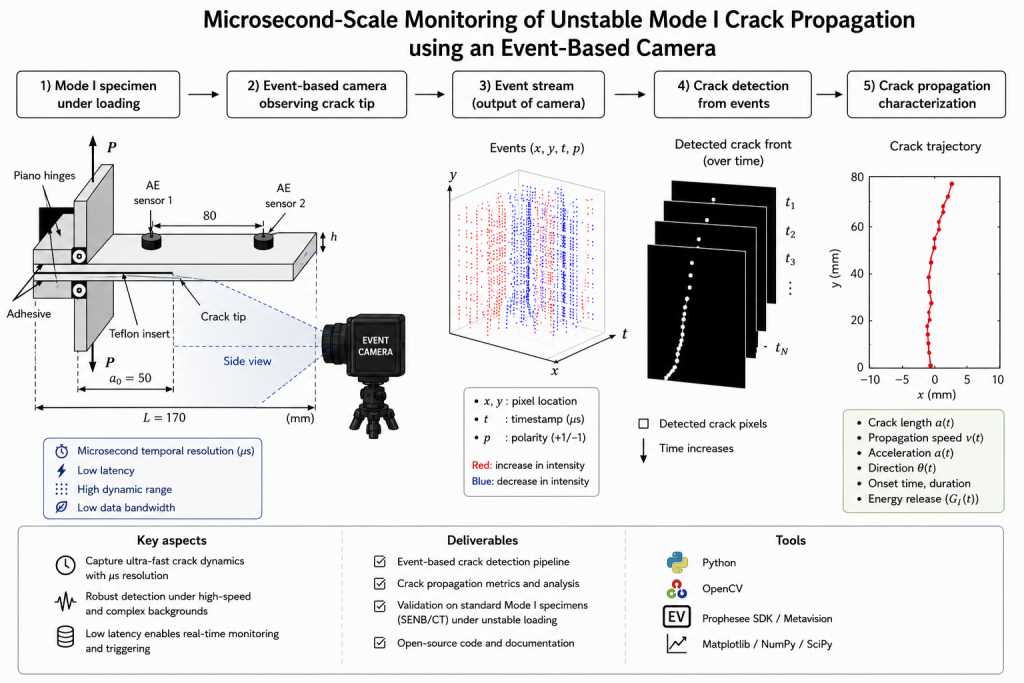
Master Thesis (MA) or semester project (BS) on thu use of Event-Based Imaging for Crack Propagation Monitoring
The objective of this Master’s thesis (or semester project) is to investigate the potential of event-based cameras for monitoring crack propagation in Mode I specimens. Conventional cameras provide high spatial resolution and are already widely used in strain-based methods for crack propagation monitoring. However, they acquire images at fixed time intervals, and their acquisition frequency is limited by the large size of the generated images. This can prevent them from capturing rapidly evolving fracture events, such as unstable crack propagation.
Event-based cameras offer an alternative imaging approach with microsecond-scale temporal resolution and low latency. Instead of acquiring full images at fixed time intervals, they record asynchronous streams of pixel-level events, triggered only when a change in brightness is detected. These characteristics make them particularly promising for analyzing the transient dynamics associated with unstable crack propagation.
The thesis will investigate the use of event-based imaging as a crack-monitoring technique for experimental fracture mechanics. The recorded event sequences will be processed to reconstruct crack evolution over time, and the results will be compared with those obtained using conventional image-based techniques. Based on this comparison, the capability of event-based cameras to capture and characterize rapid fracture events will be assessed.