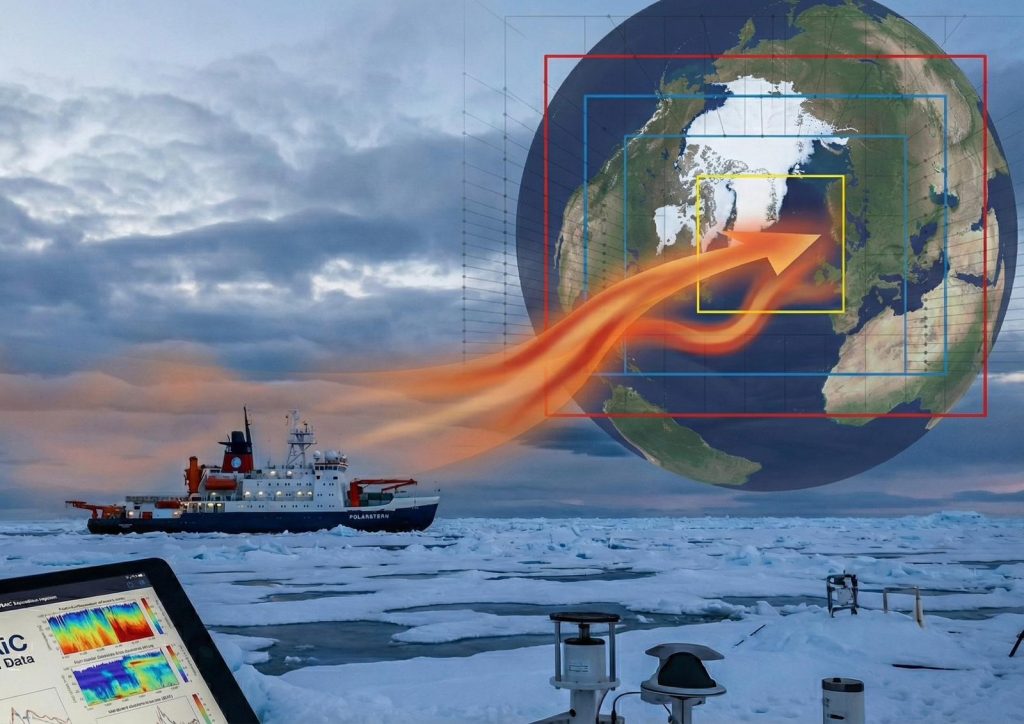
Arctic clouds strongly influence the regional energy budget and sea-ice evolution, yet they remain a major source of uncertainty in weather and climate models. Warm and moist intrusion events, episodes when comparatively warm, humid air is transported from lower latitudes into the Arctic, can rapidly modify boundary-layer structure and cloud microphysics and can potentially trigger transitions in cloud phase and precipitation, highlighting the need to assess how well models capture these processes.
This thesis will evaluate the performance of the Weather Research and Forecasting (WRF) model in representing the meteorology and cloud properties during one well-observed MOSAiC intrusion, and will test the sensitivity of simulated cloud phase to microphysics choices and secondary ice production (SIP). A high-resolution nested WRF setup will be run for the event using 2–3 commonly used microphysics schemes (e.g., Morrison and Thompson), with additional experiments enabling SIP. The Multidisciplinary drifting Observatory for the Study of Arctic Climate (MOSAiC) expedition (2019–2020) provides an exceptional observational benchmark, with comprehensive meteorological and cloud measurements collected during a full annual drift in the central Arctic. Model output will be evaluated against these observations for key meteorological variables (temperature, humidity, winds, boundary-layer height) and cloud diagnostics (liquid and ice water content, cloud base/top, and precipitation occurrence). ERA5 reanalysis will be used alongside the measurements to assess how comparable the large-scale meteorological and cloud conditions associated with the intrusion are reproduced.
The analysis will quantify (i) baseline model performance, (ii) whether including SIP improves cloud phase partitioning, and (iii) whether differences between microphysics schemes are larger than the SIP-induced changes in key cloud metrics (e.g., LWC/IWC, cloud occurrence, and precipitation).
Supervisors: Berkay Dönmez ([email protected]); Julia Schmale ([email protected])