
Location of CRYOS stations : interactive map.
1) Princess Elisabeth Tall Tower, Antarctica (71.950° S, 2.350° E at 1397 m a.s.l.)
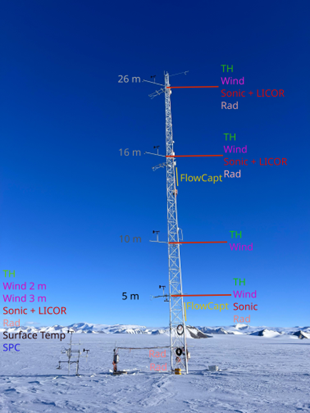
Originally established as a surface drifting-snow and eddy covariance station, this site has been expanded since 2023 into a multi-level tower system. It now includes temperature, wind, radiation, and eddy covariance measurements at several heights until 26 meters, enabling investigation of the vertical structure of the Antarctic boundary layer, turbulent heat and momentum fluxes, and blowing snow processes. The tower provides a rare insight into atmosphere-snow interactions in East Antarctica. Figure 1 shows the original drifting-snow station on the left, with measurements up to 3 meters, as well as the expanded 26-meter tower on the right, which adds four additional measurement levels.
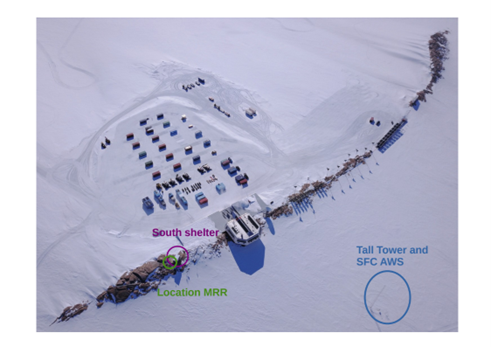
In december 2025 a new Micro Rain Radar (MRR) was also installed at the stationto investigate further in details the blowing snow events up to 200m. These data are valuable for the validation of the blowing snow model implemented in CRYOWRF. A drone view of the measurement test sites and the station is shown in figure 2.
See our most recent trip to Princess Elisabeth station.
2) Tschuggen, Switzerland, Alps (46.783° N, 9.923° E at 1965 m a.s.l.)
A full meteorological and eddy covariance station located in the long alpine valley of Flüela. The site includes air temperature sensors at multiple heights, countinuous snow measurements and several drifting snow instruments, including Snow Particle Counter and FlowCapt. The station is also used for dedicated field campagns in collaboration with partner research groups, supporting studies on snow-atmosphere interactions, turbulent fluxes and snow transport processes in alpine terrain.
3) Zugspitze, Germany, Alps (47.406° N, 10.983° E at 2410 m a.s.l.)
A drifting snow and eddy covariance station installed on the Zugspitze massif. The site contributes to the G-MONARCH project, which investigates cryospheric and hydrological processes using a unique supercomputing gravimeter. Measurements from this high-elevation observatory help link atmospheric forcing, snow dynamics and mass redistribution processes in complex alpine environment.
4) Sangvor, Tajikistan, Pamir (38.743° N, 71.354° E at 3909 m a.s.l.)
A full meteorological station located at the outlet of the Sangvor Glacier in the Pamir Mountains. The station contributes to the COROMO-ADAPT project, which monitors climate change impacts on water resources and natural hazards in Central Asia. The site is used to investigate cryospheric processes in High Mountain Asia, improve model predictions and provide long-term climate information to support regional adaptation strategies.