
SRWI Madagascar

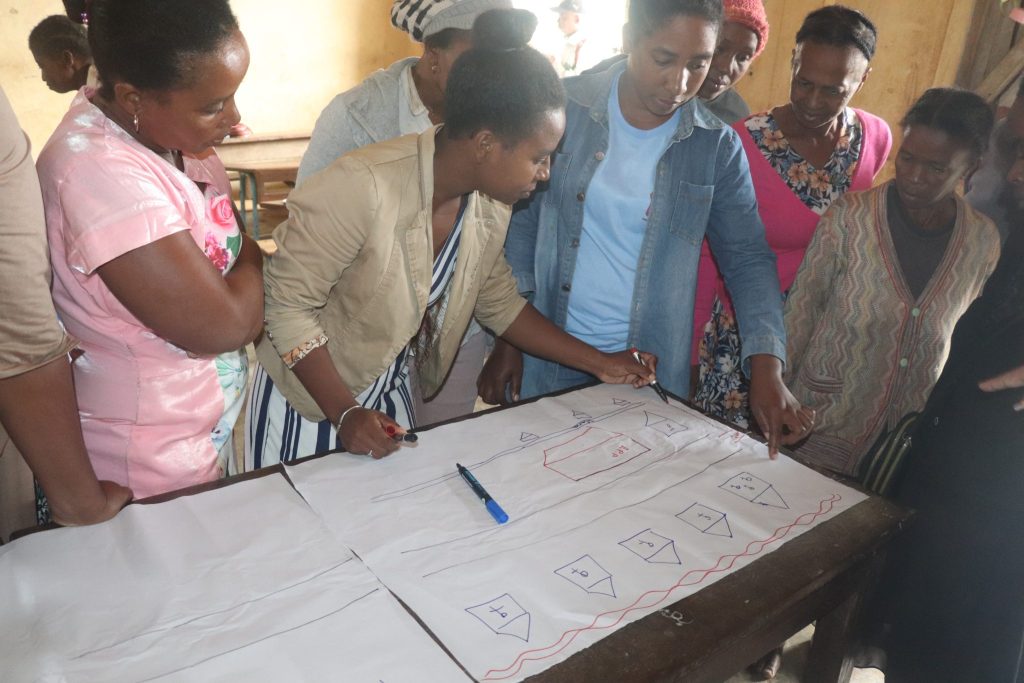
Mapping workshop with community members in Ankofa – June 2025 © EPFL ALICE Lab / Medair Madagascar
Co-Designing a Sensitive Risk Warning Infrastructure (SRWI) in Maroantsetra, Madagascar
This project investigates how disaster risk communication can be rethought as a situated, collective, and spatial infrastructure. Developed in Maroantsetra, a flood- and cyclone-prone region of northeastern Madagascar.
During the exploration phase (June 2025), fieldwork revealed a persistent disconnection between institutional alerts (SMS, radio, meteorological bulletins) and the local practices through which communities sense, interpret, and respond to environmental risk. While national systems are often disrupted by power outages, limited connectivity, and linguistic barriers, communities rely on embodied and trusted forms of communication—such as environmental observation, town criers (dalala), drums, conch shells, visual signals, and social networks. These systems remain largely unrecognized within formal risk governance frameworks.
The project proposes the co-design of a Sensitive Risk Warning Infrastructure (SRWI): a hybrid, low-tech and off-grid assemblage that bridges traditional ecological knowledge and institutional warning systems. Conceived as a process-based infrastructure, the SRWI combines participatory cartographies, tactile and visual signaling tools, role-based rehearsals, and shared situational spaces where risk communication is collectively practiced, tested, and transmitted across generations.
The project is supported by the EPFL Tech4Dev Program, led by EPFL’s ALICE Lab in collaboration with Medair Madagascar, the CPGU (national disaster risk management authority), the University of Antananarivo, and local communities in Anbinanitelo, Ankofa, and Anjananzana, the project emphasizes inclusivity, intergenerational knowledge transfer, and community ownership. Its modular design allows adaptation to other climate-vulnerable contexts, positioning risk communication as a spatial, cultural, and relational practice.
PROJECT TEAM
ALICE
Estefania Mompean Botias, Lucía Jalón Oyarzun
MEDAIR MADAGASCAR
Lara Chevalley, Gaëlle Deperrier, Patricia Gomez, Sitraka Rafetraharilanto, Olivia Raharindrato, Ravo Ratovo
CPGU – Cellule de Prévention et de Gestion des Urgences (Madagascar)
Julot Herman Randriamanalina
UNIVERSITY OF ANTANANARIVO
Anthropology Department
IOGA (Geophysical and Meteorological Institute)
LOCAL COMMUNITIES
Ambinanitelo, Ankofa, Anjanazana (community leaders, women, youth, traditional communicators)
Funding by EPFL Tech4Dev Program

© EPFL ALICE Lab
© EPFL ALICE Lab / Medair Madagascar

© EPFL ALICE Lab / Medair Madagascar

© EPFL ALICE Lab