
Author(s) : Mohsen Talebkeikhah, Brice Lecampion
Supervisor : Brice Lecampion
Journal : Engineering Fracture Mechanics
Editor : Elsevier
Year of publication : 2026
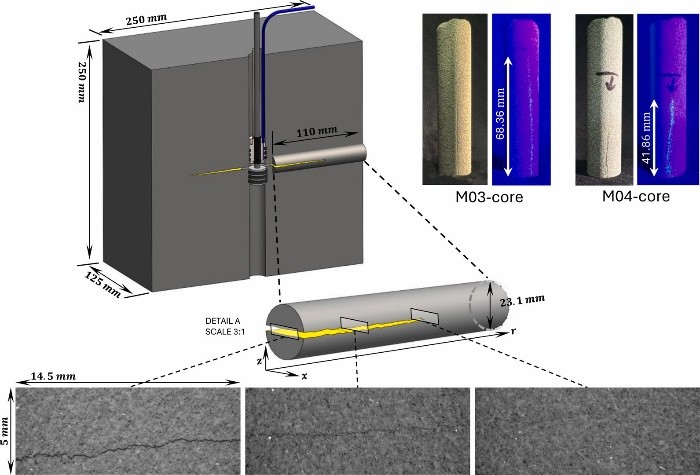
This study investigates the fracture morphology in core samples extracted from two hydraulic fracturing experiments, named M03 and M04, conducted on 250 mm cubic sandstone blocks using fluids of different viscosities. In the M03 experiment, a high viscous glucose with a viscosity of 65 was used, whereas in M04, a low viscous glycerol with a viscosity of 0.57 was used for injection. Following fracture propagation, core samples were extracted and analyzed using high-resolution CT-scanning. A dedicated image processing workflow was applied to reconstruct both the upper and lower fracture surfaces to the highest possible accuracy. The distribution of contact and/or bridge points was mapped, revealing an increase toward the fracture front indicative of the fracture process zone. Residual fracture opening profiles show that as the number of contact and bridge points increases, fracture surface roughness increases simultaneously. In a region near the fracture front, the Hurst exponent of both the lower and upper surfaces decreased, as well as the Pearson correlation coefficient. The autocorrelation function decays more rapidly, signifying a loss of long-range correlation of the fracture surface near the fracture front. The variations of these indicators align to provide a spatial characterization of the fracture process zone, whose extent along the propagation direction is estimated to be about 17– for M03 and 10– for M04. These experimentally inferred values are slightly larger than the material length scale estimated directly from tensile strength and fracture toughness which ranges between 5 to 15 mm for the present sandstone. In addition, the surface roughness is isotropic for both experiments, with M03 exhibiting slightly higher roughness than M04, reflected in its lower Hurst exponent. While both experiments exhibit the same main qualitative micro-morphological features, the higher-viscosity case (M03), associated with a viscosity-storage-dominated propagation, shows a somewhat larger residual opening than the lower-viscosity case (M04), which corresponds to a viscosity-leakoff-dominated propagation. Moreover, the inter-versus trans-granular nature of the fracture propagation was examined from thin-sections and higher-resolution CT images. The fractures in this sandstone propagate predominantly along pores and grain boundaries. The measured low Hurst exponent (of approximately 0.4) is consistent with values previously reported for sandstone and other heterogeneous brittle materials, and is interpreted here as reflecting crack-path deflection by grain boundaries and pores. The fracture opening field, obtained relative to the mid-plane of the two surfaces, reveals that a residual opening remains even after complete unloading of the specimen. Unlike the fracture’ surfaces, the residual opening profile is anisotropic with a long range decrease in the direction of the propagation. This residual fracture opening in the fully unloaded state should be accounted for in rock-fracture modeling when unloading/reloading is important.
Project information
M03 core CT-scan images
M04 core CT-scan images
M03 CT-scan higher resolution images (tip region)
M04 CT-scan higher resolution images (tip region)
M03 and M04 upper and lower surface cloud points