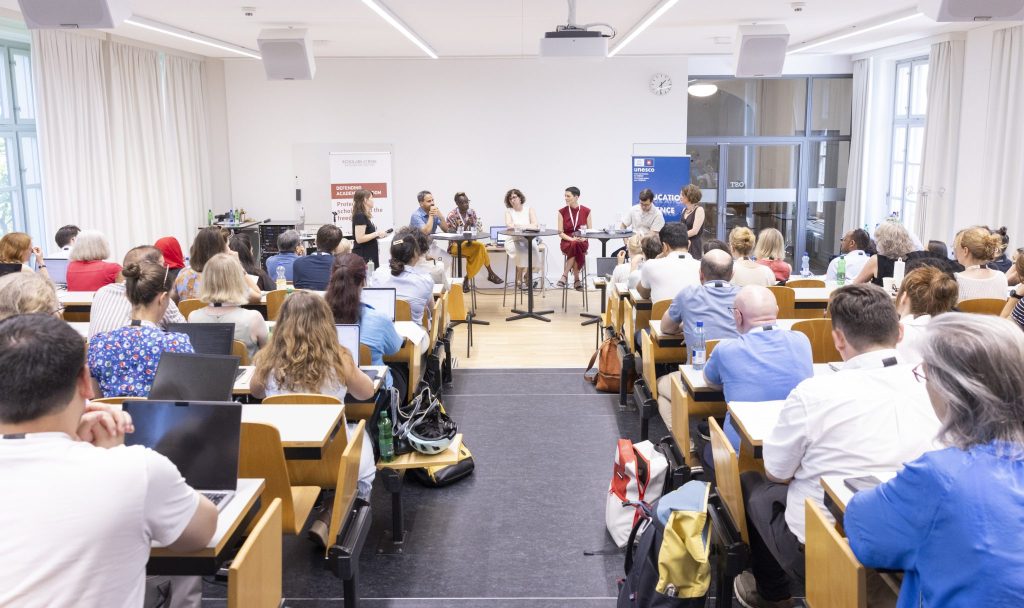
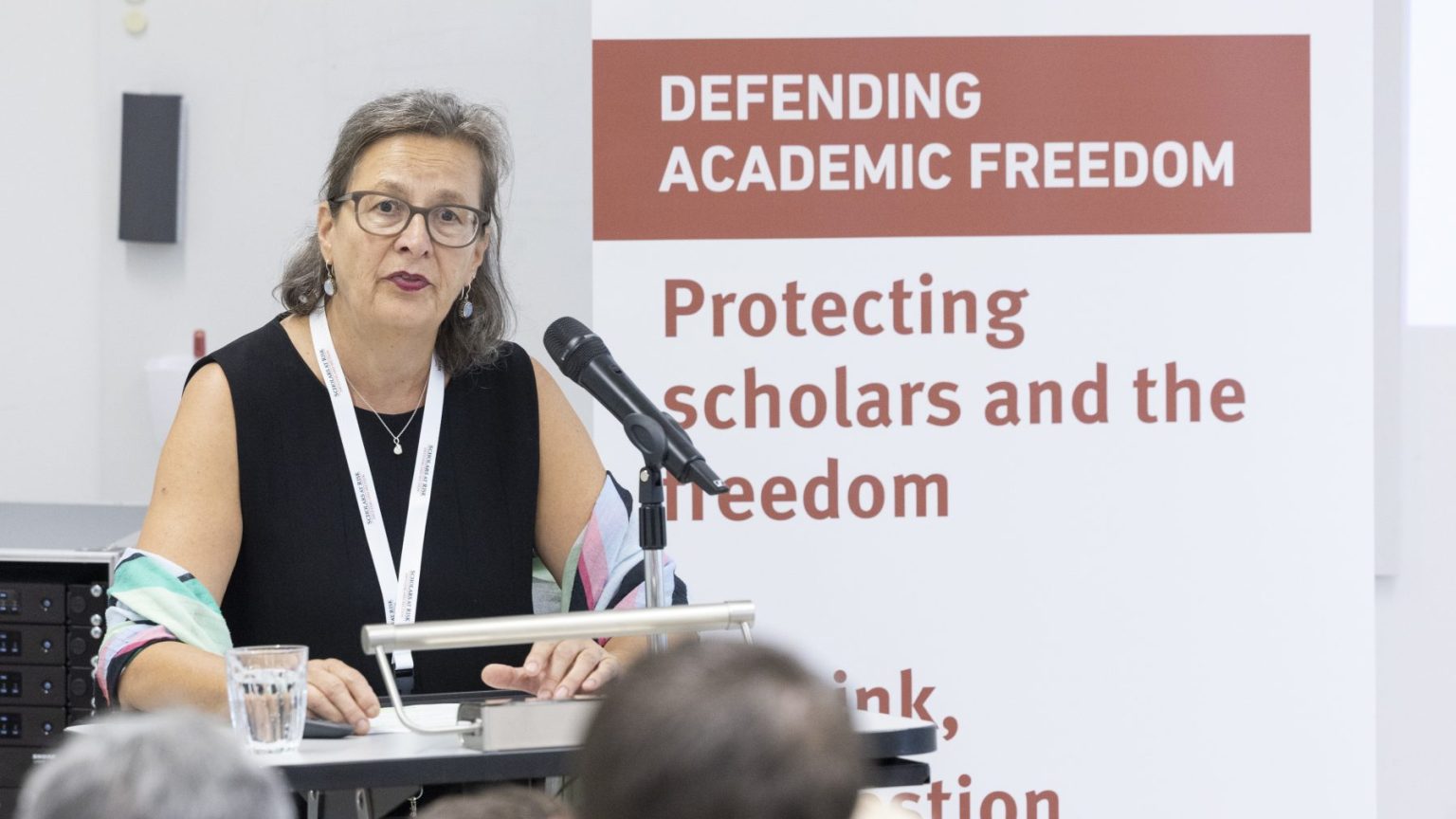
Regula Mader, Vice Director of the Immigration and Integration Directorate at the Swiss State Secretariat for Migration, adresses the attendees of the Anniversary of the swiss section of Scholars at Risk at Universität Bern, June 26th 2026. Photo: Monika Flueckiger
Gathered on 26 June 2026 at the University of Bern, representatives from academia, the Swiss Commission for UNESCO, the State Secretariat for Migration and the international Scholars at Risk network celebrated the tenth anniversary of the Swiss section. The event was held under the patronage of the Swiss Commission for UNESCO. EPFL was represented by Professor Annalisa Buffa, who moderated a discussion with scholars at risk, and by Dr Gabriela Tejada, a member of SAR Switzerland’s Steering Committee. The event recalled the importance of defending academic freedom and providing concrete support to scholars at risk.
In an international context where academic freedom is declining in many countries, Scholars at Risk Switzerland plays an essential role in hosting and supporting researchers in Switzerland whose safety, freedom or ability to carry out their work is compromised. Supported in particular by the Swiss National Science Foundation, this national section helps provide temporary placements in higher education institutions and sustain scientific careers weakened by political crises, conflicts or restrictions on freedom.
To date, the Swiss section has supported well over 100 scholars, with around 25 currently hosted at higher education institutions across Switzerland. The event brought together scholars from diverse contexts and career paths, moving beyond individual experiences to explore the forces driving this humanitarian action in the swiss academic environment as well as its challenges. Among the 4 scholars that were hosted by EPFL labs since 2021, 2 contributed to the panel discussions with their experiences
The discussions showed that hosting scholars at risk is not merely an emergency response. Scholars face complex administrative procedures, highly diverse personal situations and considerable uncertainty about their professional future. Host institutions therefore have a decisive role to play, not only by providing a safe working environment, but also by fostering integration, access to academic networks and the development of sustainable prospects.
The discussions also addressed sensitive issues such as the risk of a brain drain from conflict zones, the need to protect scientists in danger while preserving their links with their countries of origin and, where possible, to support the rebuilding of local academic capacity. Defending academic freedom therefore means acting simultaneously for threatened individuals, for the institutions that nurtured them and for the free circulation of knowledge.
After ten years of existence, Scholars at Risk Switzerland stands out as an essential solidarity network. The discussions held on 26 June highlighted the existence of a strong and committed community, as well as the challenges its actions are facing to foster academic freedom as an intrinsic condition for high-quality research, teaching and democratic debate.