
Background
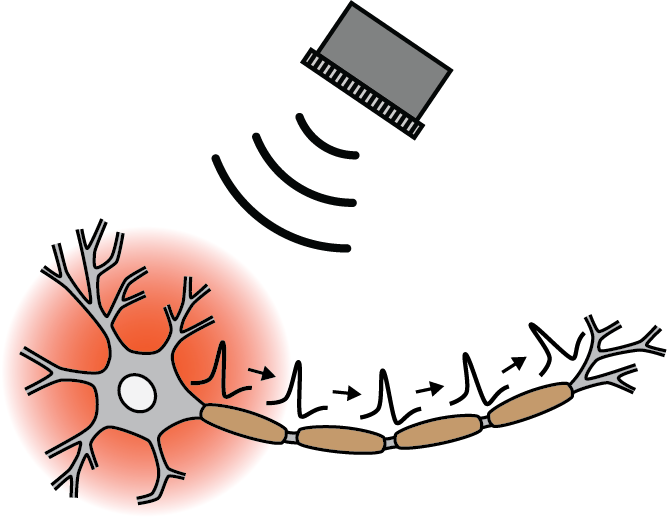
Focused Ultrasound Stimulation (FUS) is a non-invasive therapeutic tool with great potential, widely used in humans for ablation therapies and diagnostic imaging. It has recently emerged as a promising technology to achieve reliable, selective and non-invasive neuromodulation of various targets of the central nervous system of rodents, non-human primates and humans (King et al., 2013; Legon et al., 2014). A wide range of applications can therefore be envisaged in which US would replace the standard and invasive electrical stimulation. However, in order for FUS to become a reliable neuromodulation technology, we need a deeper understanding of the fundamental mechanism(s) by which ultrasonic waves can modulate neural activity.
Moreover, while this technique is increasingly adopted as a non-invasive neuromodulation modality for brain circuits, its impact on axons, crucial for applications involving peripheral neuropathies and long-range brain connectivity, remains poorly characterized. In particular, current evidence of direct neural effects is inconsistent, with both excitatory and inhibitory outcomes observed under comparable stimulation conditions (Downs et al., 2018; Guo et al., 2022), limiting both mechanistic interpretability and translation to clinical application.
Our Focus
Our goal is to assess whether and how FUS can be applied for neuromodulation of axonal pathways and to build the foundations for the translation of this technique to clinical practice. To do so, we employed both computational and experimental models across increasing levels of biological complexity.
First, we have developed a multi-Scale Optimized Neuronal Intramembrane Cavitation (SONIC) model (Lemaire et al., 2019) based on the neuronal intramembrane cavitation excitation (NICE) theory (Plaksin et al., 2014). This allowed us to simulate the responses of various point-neuron models to ultrasound stimulation in a computationally efficient and interpretable manner. We developed a new web App which you can find below.

Building on this novel paradigm, we have developed a computational framework allowing to simulate intramembrane cavitation in multi-compartmental neuronal representations, thereby expanding model predictions to the morphological scale. With this framework, called morphoSONIC, we investigated the responses myelinated and unmyelinated peripheral axons to various acoustic pressure fields and found that FUS stimuli could be fine-tuned to selectively recruit myelinated and/or unmyelinated nerve fibers (Lemaire et al., 2021). These predictions are in qualitative agreement with recent empirical observations and suggest that FUS can preferentially target nociceptive and sensory fibers, opening up new opportunities for peripheral therapeutic applications currently not addressable by electric stimulation. We now plan to integrate this model into a comprehensive computational pipeline hosted on an open cloud environment designed to enable end-to-end simulations of focused ultrasound neuromodulation in peripheral nerves within realistic environments.
A rigorous investigation of ultrasound-induced axonal activity requires experimental models that provide controlled access to neural tissue and well-defined stimulation and recording conditions. To address these requirements, we employ an ex vivo nerve-on-a-chip platform (Gribi et al., 2019) adapted to enable controlled ultrasound stimulation of isolated peripheral nerve fascicles combined with direct multi-site electrophysiological recordings, allowing systematic and quantitative analyses of axonal recruitment and firing dynamics under well-defined conditions. We then extended these investigations to in vivo rodent models, in which focused ultrasound stimulation is applied to motor spinal roots and US-evoked neural and muscular responses are recorded, enabling assessment of the functional effects of ultrasound stimulation. We now plan to extend these studies to stimulation of cutaneous targets in human participants to explore the potential of FUS for sensory feedback restoration.
References:
- Lemaire, T., Neufeld, E., Kuster, N., and Micera, S. (2019). Understanding ultrasound neuromodulation using a computationally efficient and interpretable model of intramembrane cavitation. J. Neural Eng.
- Lemaire, T., Vicari, E., Neufeld, E., Kuster, N., and Micera, S. (2021). MorphoSONIC: A morphologically structured intramembrane cavitation model reveals fiber-specific neuromodulation by ultrasound. iScience, 24 (9), 103085.
- Dedola, F., Severino, F. P. U., Meneghetti, N., Lemaire, T., Cafarelli, A., Ricotti, L., Menciassi, A., Cutrone, A., Mazzoni, A., Micera, S. (2020) Ultrasound Stimulations Induce Prolonged Depolarization and Fast Action Potentials in Leech Neurons. IEEE Open Journal of Engineering in Medicine and Biology 1, 23–32.
- King, R.L., Brown, J.R., Newsome, W.T., and Pauly, K.B. (2013). Effective parameters for ultrasound-induced in vivo neurostimulation. Ultrasound Med Biol 39, 312–331.
- Legon, W., Sato, T.F., Opitz, A., Mueller, J., Barbour, A., Williams, A., and Tyler, W.J. (2014). Transcranial focused ultrasound modulates the activity of primary somatosensory cortex in humans. Nat. Neurosci. 17, 322–329.
- Downs, M. E., Lee, S. A., Yang, G., Kim, S., Wang, Q., Konofagou, E. (2018) Non-Invasive Peripheral Nerve Stimulation via Focused Ultrasound in Vivo. Phys Med Biol 63 (3), 035011.
- Guo, H., Offutt, S. J., Hamilton II, M., Kim, Y., Gloeckner, C. D., Zachs, D. P., Alford, J. K., Lim, H. H. (2022) Ultrasound Does Not Activate but Can Inhibit in Vivo Mammalian Nerves across a Wide Range of Parameters. Sci Rep 12 (1), 2182
- Plaksin, M., Shoham, S., and Kimmel, E. (2014). Intramembrane Cavitation as a Predictive Bio-Piezoelectric Mechanism for Ultrasonic Brain Stimulation. Physical Review X 4.
- Gribi, S., du Bois de Dunilac, S., Ghezzi, D., Lacour, S. P. (2018) A Microfabricated Nerve-on-a-Chip Platform for Rapid Assessment of Neural Conduction in Explanted Peripheral Nerve Fibers. Nat Commun 9 (1), 4403.