
Background
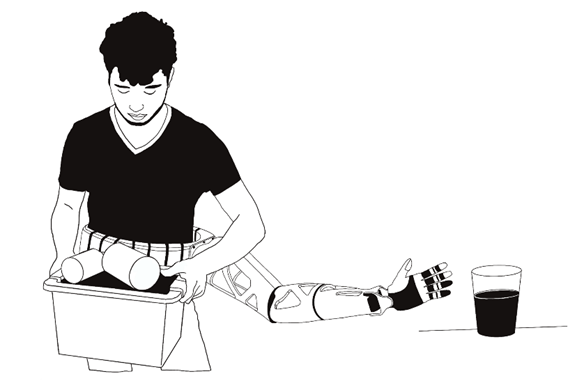
Motor augmentation, which seeks to enhance or extend natural motor capabilities, is emerging as a transformative field with the potential to revolutionize human-machine interaction and rehabilitative practices [1,2]. At the forefront of this innovation are extra robotic limbs (XRL)—wearable robotic devices designed to augment an individual’s motor functions by providing additional effector systems. These devices can be attached to various body parts, such as limbs or the torso, to complement and enhance a person’s physical abilities. XRLs have generated significant interest for their potential not only to restore lost motor function in individuals with disabilities but also to enhance the motor skills of healthy individuals.
One of the most critical aspects of this research is the development of human-machine interfaces (HMIs) that can augment motor functions without hindering existing ones. This challenge is defined as the neural resource allocation problem, where the goal is to find redundant physiological pathways that do not interfere with primary tasks as control sources. Current research has explored several HMIs to tap into these spaces, such as utilizing foot movements to control extra digits [3], diaphragmatic modulation for reaching tasks [4], modulation of specific muscle activity and vestigial muscles [5,6] for de control of these extra degrees of freedom (xDoF).
Furthermore, research into motor augmentation with XRLs offers valuable insights into motor learning and motor representation7. While traditional motor learning research primarily focuses on skill acquisition using existing limbs, the integration of XRLs introduces a new frontier. It challenges our understanding of motor representation, prompting new questions about how the brain adapts its internal motor maps and “body schema” to incorporate these augmented effector systems. By studying how the brain manages these additional degrees of freedom, we seek to understand the extent of neural plasticity and whether a robotic limb can be truly embodied as a part of the biological self.
Goal
Our research explores the fundamental building blocks of motor functional augmentation, ranging from the development of control HMIs, robotic interfaces to the design of behavioural experiments, motor learning assessment and the neurocognitive implications of XRL use. To guide our investigation, we have some core questions: Can we effectively augment human motor functions by providing xDoFs that operate independently of the biological limbs? What are the trade-offs between HMIs inherent intuitive versus the need for intensive training to master control? Beyond the control, how can we explore effective augmentation gain in different tasks scenarios? Does the brain eventually treat the extra limb as a cooperative partner? Our research ultimately aims to determine the extent to which XRLs can be integrated into the user’s internal models, characterizing the fundamental behavioral and neural adaptations that underpin this human-machine interaction.
References
- Dominijanni, G. et al. The neural resource allocation problem when enhancing human bodies with extra robotic limbs. Nat. Mach. Intell. 3, 850–860 (2021).
- Eden, J. et al. Principles of human movement augmentation and the challenges in making it a reality. Nat. Commun. 13, 1345 (2022).
- Kieliba, P., Clode, D., Maimon-Mor, R. O. & Makin, T. R. Robotic hand augmentation drives changes in neural body representation. Sci. Robot. 6, eabd7935 (2021).
- Dominijanni, G. et al. Human motor augmentation with an extra robotic arm without functional interference. Sci. Robot. 8, eadh1438 (2023).
- Pinheiro, D. J. L. L., Faber, J., Micera, S. & Shokur, S. Human-machine interface for two-dimensional steering control with the auricular muscles. Front. Neurorobotics 17, (2023).
- Leal Pinheiro, D., Faber, J., Micera, S. & Shokur, S. Neuromuscular learning and control of auricular muscles for human–machine interfaces. Int. J. Robot. Res. 02783649251390578 (2025) doi:10.1177/02783649251390578.
- Makin, T. R., Micera, S. & Miller, L. E. Neurocognitive and motor-control challenges for the realization of bionic augmentation. Nat. Biomed. Eng. 1–5 (2022) doi:10.1038/s41551-022-00930-1.