
Doctoral Project: Eva Ruof
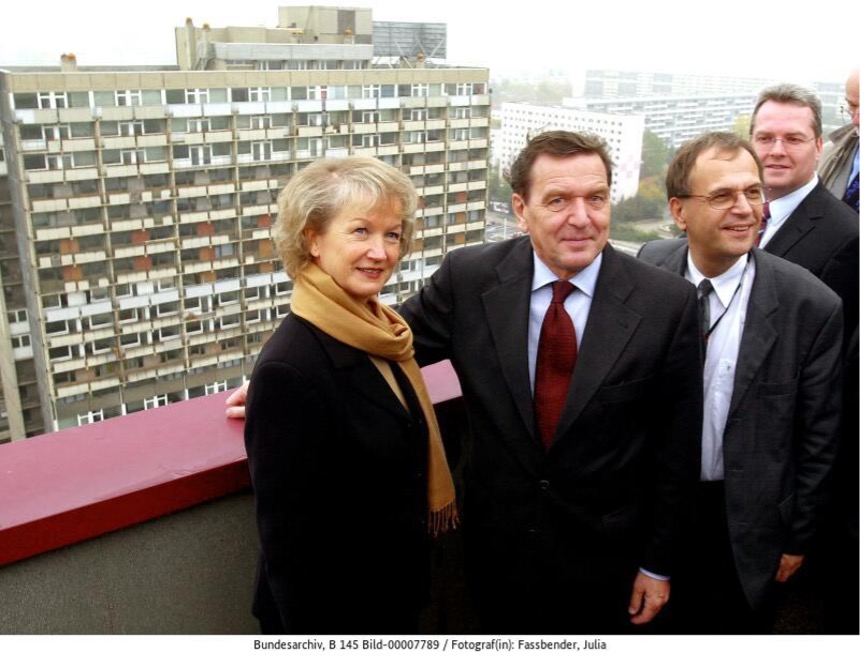
This dissertation studies Stadtumbau (Urban Restructuring), a large-scale, state-funded yet market-driven urban governance program implemented in 2002 as a delayed response to the uneven territorial impact of German reunification in 1989 and the seismic demographic and economic shifts that followed. Federal means amounting to over 2.5 billion euros were put forth to finance, among other measures, the demolition of more than 300.000 housing units in East Germany alone. By looking at the program’s origin, process, and aftermath, this project explores an urban development of removal that remains tied to the imperative of growth.
East Germany’s transition from a distinct socialist nation to a drained region within a booming free-market economy was driven by the controversial decommissioning of major eastern industries and significant internal westward migration. Despite this, tax incentives and subsidies fueled a building boom in the former East that funneled residents into new, mostly suburban, buildings and led to substantial vacancies in the existing building stock. At the urging of major housing companies and their banks, the program Stadtumbau Ost was established in 2002 to foster demolitions that could purportedly “right-size” the existing housing stock. A western counterpart, Stadtumbau West, followed in 2004, but operated through an inverse logic of preventive measures, such as upgrading city centers and public infrastructure to incentivize private investment, paired with a reinforced narrative of sustainable development. In both incarnations, Stadtumbau was a novelty in urban planning, operating through large-scale erasure as a primary means of ordering urban retreat and thereby clearing the ground for a new state. Today, regional disparities still grow, only slowly beginning to dissolve the East-West divide, while migration increasingly crosses national borders altogether. Revisiting Stadtumbau twenty years after its start offers a relevant case to study citymaking beyond new construction.
This project works through the material remnants, or their absence, of a past that continues to condition the present. By crossing federal records, municipal planning documents, demolition and disposal records, and popular media with site observations, interviews, and visual documentation, this dissertation will track the multilayered and knotted material flows that emerge as buildings are taken down and the landscapes these flows produce. The “sober” and calculating rationale for restructuring the built environment, as set by the program’s founding figures, is confronted with its actual spatial, social and political consequences.