
Below is a list of available projects that can be pursued as either Semester Projects or Master’s Projects (PDM). These projects require familiarity with data analysis and scientific computing (e.g., MATLAB, Python, or R).
We also welcome student-initiated ideas. Interested students are encouraged to contact Prof. Mirko Musa directly at [email protected].
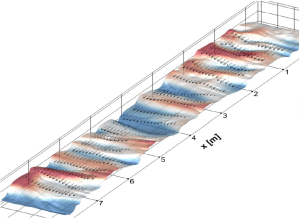
Ripples and dunes are ubiquitous features that can be found on the bottom of sandy rivers and costal seas. Often generally referred to as bedforms, they originate and migrate under the constant shear of the moving flow. In river hydraulics, characterizing bedforms is of extreme importance as local hydrodynamics and sediment transport conditions depend on their size, geometry, and migration speed. On the one hand they are the manifestation of sediment bedload as they move sediments downstream and could then be used to infer sediment transport. On the other hand, they represent form drag elements at the bed responsible for the majority of the roughness which dictates the hydraulic conditions (e.g., water depth). In this project, the student will analyze a dataset of migrating dunes and ripples measured in a laboratory setting to estimate they migrating speed and bidimensional shape. The first step is to apply algorithms inspired by Particle Image Processing (PIV) where pairs of subsequent images are compared to extract the moving direction and speed of trackers in the flow (i.e., in this case the bedforms themselves. Students should be comfortable with Matlab (or Python) and willing to develop and learn methods for data analysis and image processing.
Supervisors: Antonio Magherini ([email protected]) and Mirko Musa ([email protected])
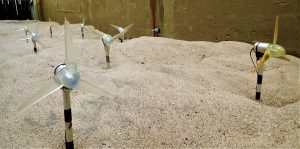
Hydrokinetic turbines are an emerging renewable energy technology that generate electricity directly from naturally flowing water. Unlike conventional hydropower, they harness the kinetic energy of the current without requiring dams, much like wind turbines extract energy from moving air. Their geometry and operating principles are, in fact, closely analogous to those of wind turbines. This technology holds promise for providing localized and continuous power, particularly in remote or underserved regions. Rivers and artificial canals represent distributed energy resources that could support rural communities, microgrids, and small-scale applications. At present, however, there is no clear consensus on how to quantify hydrokinetic potential at large scales. The first step of this project is to develop a robust methodology—whether analytical or data-driven—to estimate available hydrokinetic resources in rivers and engineered channels. In the longer term, this effort could evolve into a comprehensive assessment of hydrokinetic potential across rural Switzerland and Europe.
Supervisor: Mirko Musa ([email protected])
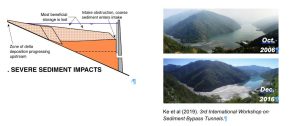
Dams interrupt the natural flow of water and sediments in rivers, causing these latter to settle once they reach the reservoir. Sedimentation poses a serious threat to hydropower development and sustainability by progressively reducing storage capacity. With increasing development of intermittent renewable resources on the grid, there is a need for energy storage which can be addressed by hydropower reservoirs. Sedimentation represents also a serious environmental issue as it precludes the natural continuity of sediment transport in rivers. But how significant is this problem in Europe and in other parts of the planet? What mitigations are currently in place and how effective they are, both technically and economically? This project aims to synthesize and expand existing datasets on reservoir sedimentation, with a particular focus on mitigation strategies employed at operational dams. The goal is to create a synthesized dataset of reservoir sedimentation, incorporating mitigation strategies, and analyze it to identify patterns and correlations between dam characteristics, system watersheds, and the effectiveness of sedimentation mitigation measures. This project will provide valuable insights into the sustainability of reservoir operations while developing a structured database that can support future research on sediment management in regulated rivers.
The project is in collaboration with Oak Ridge National Laboratory of the US Department of Energy.
Supervisors: Mirko Musa ([email protected]) and Giovanni De Cesare (Giovanni De Cesare [email protected])
Sediment transport is a fundamental component of river dynamics because it governs bed evolution, channel stability and the ability of fluvial systems to recover or maintain their natural form. As river restoration becomes an increasingly important objective in environmental management, it is essential to understand how sediment moves through channels in order to predict how rivers evolve once human interventions are reduced or removed. Laboratory and field studies provide valuable insight into these processes, yet numerical modeling is necessary to investigate long term behaviour under natural conditions and to assess how rivers respond to variations in discharge, sediment supply and channel geometry.
This project aims to evaluate the capability of current numerical tools, with particular focus on BASEMENT, a Swiss hydro morphodynamic modeling software developed at ETH Zurich, to simulate sediment transport and bed evolution in simplified natural and laboratory configurations. The goal is to examine how the sediment transport module behaves in realistic settings and to identify the challenges involved in applying these tools to natural river environments. Through a series of controlled numerical experiments, students will learn how to set up, run and critically interpret sediment transport simulations, gaining practical experience and a deeper understanding of the strengths and limitations of existing hydraulic software.
More details can be found here.
Supervisors: Clemente Gotelli ([email protected]) and Mirko Musa ([email protected])
The STREEM Lab’s AI for River Morphology project explores how deep-learning models can predict the long-term evolution of complex river systems—especially braided rivers, where conventional models face challenges. Leveraging globally available satellite imagery and existing open-source datasets, the project invites students to advance state-of-the-art methods for forecasting river planform changes. Possible research directions include improving temporal pattern recognition, testing new architectures and loss functions, integrating hydrologic data, developing new datasets, and evaluating model performance. The ultimate goal is to better understand the capabilities and limitations of AI for modeling natural river dynamics and to propose pathways for future innovation.
More details can be found here.
Supervisors: Antonio Magherini ([email protected]) and Mirko Musa ([email protected])