
Elastomers Combining Damping Efficiency with Rapid Recovery
Damping materials are essential for protecting sensitive components in applications such as wearable electronics. Elastomers are widely used for this purpose, but their viscoelastic nature imposes a fundamental trade-off between energy dissipation and shape recovery speed, limiting their performance. This paper presents 3D-printable double network granular elastomers that overcome the usual trade-off between damping efficiency and shape recovery in conventional elastomers. The material consists of stiff elastomeric microparticles embedded in and connected by a softer percolating elastomer network, enabling high energy dissipation under cyclic compression while maintaining rapid elastic recovery and resistance to repeated loading. By exploiting the printability of these granular inks, we fabricate anisotropic and multi-material architectures, including honeycomb-based composites, that further improve compressibility, cyclic durability, and impact protection. By incorporating dynamic disulfide crosslinks into the percolating elastomer network, we render the double network granular elastomer recyclable. The mechanical properties of recycled double network granular elastomers are similar to those of the virgin counterparts. These results indicate the potential of this material as a versatile platform for durable, tunable, and recyclable dampers suitable for wearable devices, soft robotics, and protective sports equipment. This work is now published in Advanced Materials Technologies.

3D Printing of Double Network Granular Elastomers with Locally Varying Mechanical Properties
Elastomers are hydrophobic polymeric networks. Due to their high polymer content, elastomers can attain a wide range of ultimate tensile strains and stiffnesses. Moreover, compared to hydrogels, their mechanical properties are less sensitive to moisture, such that elastomers can also be readily used in air. Unfortunately, the processing of elastomer that combine stiffness and toughness is limited to casting. Inspired by the superior mechanical properties of our double network granular hydrogel (DNGH) systems, we introduce double network granular elastomers (DNGEs) that can be 3D printed through direct ink writing. By tuning the composition of the elastomer microparticles and the 2nd percolating network, DNGEs can attain a wide range of mechanical properties. We take advantage of the adjustable mechanical properties to produce an elastomeric finger that possesses locally varying mechanical properties such that it deforms in a pre-defined fashion.
This work is published in Advanced Materials and featured as a frontispiece.
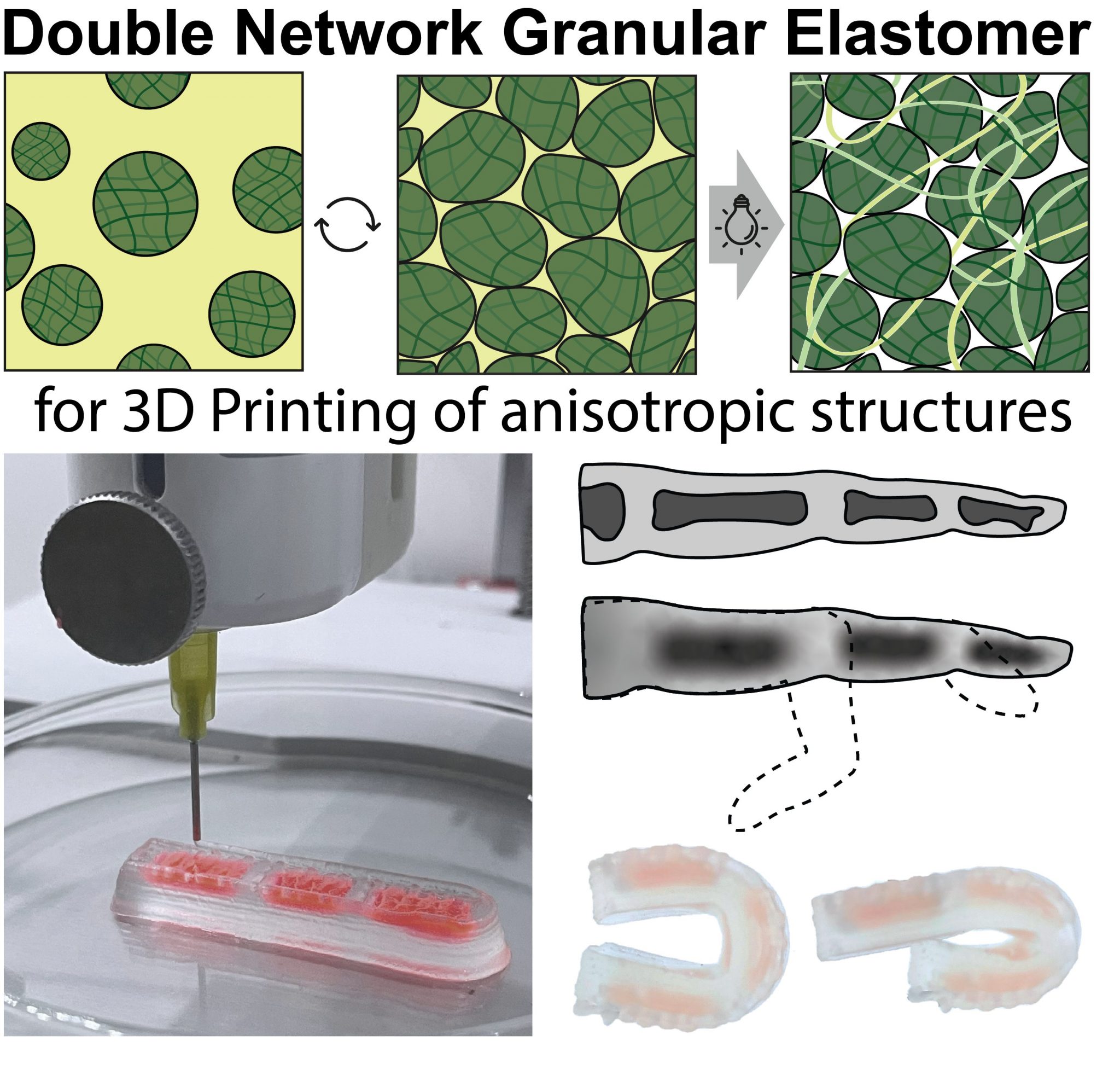
Elastomers Combining Damping Efficiency With Rapid Recovery
Advanced Materials Technologies. 2026. DOI : 10.1002/admt.202501988.Direct laser writing of electronically conductive microstructures within soft hydrogel substrates
Materials Today Bio. 2025. Vol. 34, p. 102140. DOI : 10.1016/j.mtbio.2025.102140.Programmable somatosensory soft robots
2025
Mechanoreceptive soft robotic molluscoids made of granular hydrogel-based organoelectronics
Materials and Design. 2025. Vol. 256, p. 114297. DOI : 10.1016/j.matdes.2025.114297.Electrostatically Reinforced Double Network Granular Hydrogels
ADVANCED SCIENCE. 2025. DOI : 10.1002/advs.202412566.Engineering the Mechanics of Microstructured Hydrogels
Lausanne, EPFL, 2025.From the design to the characterization of granular elastomers for 3D printing applications
Lausanne, EPFL, 2025.Bioprinting of piezoresistive organohydrogel networks for advanced real-time mechanosensing in engineered tissue models
Trends in Biotechnology. 2025. DOI : 10.1016/j.tibtech.2025.05.026.Fatigue-Resistant and Tough Double Network Granular Elastomers
2025