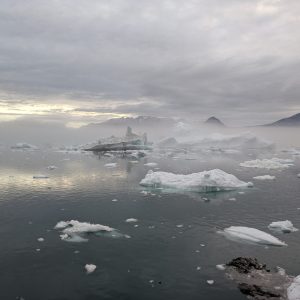
From July 9 to August 4, 2025, our R&D engineer Sébastien Lavanchy joined an international expedition to Greenland, part of a global effort to better understand glacier dynamics and climate-driven change in the Arctic. Aboard the research vessel Forel, the SENSE team deployed the SubOcean instrument, collected samples, and collaborated with scientists from partner institutions to track ice melt, ocean conditions, and their impact on coastal ecosystems and communities.
Our participation focused on the leg from Disko Bay to the Uummannaq Fjord and Kangerlussuaq region, navigating through glacial fronts and fjords to measure methane and other greenhouse gas fluxes, map meltwater plumes, and support multidisciplinary sampling along the west Greenland coast.
Recent studies have suggested that methane may travel through subglacial waters and be released directly into Arctic fjords. Our hypothesis is that if we can measure this methane upstream, close to the glacier, and then along the fjord, it would allow us to verify whether this is actually happening.
Date : July 9 – August 4, 2025
Location : Western Greenland (Ilulissat – Uummannaq – Karrat Fjord – Kangerlussuaq); 67°–71°N, 50°–53°W, altitude 0–500 m
Ilulissat (Greenland) ; 69°13′N, 51°06′W, altitude ~0 m
Karrat Fjord (Greenland) ; 71°20′N, 53°30′W, altitude ~0 m
Uummannaq (Greenland) ; 70°40′N, 52°07′W, altitude ~0 m
Kangerlussuaq (Greenland) ; 67°01′N, 50°41′W, altitude ~50 m
Team members : Researchers from EPFL, UNIL, ETHZ, UQAC, Université Laval will join the expedition. From SENSE team, R&D engineer Sebastien Lavanchy.
Activities: Emissions and fate of methane from subglacial waters