
Building integrated photovoltaics

Colored photovoltaic modules with high conversion efficiency
Hard nanocomposite metal oxide films are used in novel multilayered coatings on solar glazing. Such coatings combine a colored reflection with a high solar transmittance and open new possibilities for the architectural integration of photovoltaic in building facades (Building Integrated Photovoltaics, BIPV). Our research has led to the foundation of the spin-off company KROMATIX.

Quantum dot photoluminescent concentrators
Quantum dot photoluminescent concentrators for photovoltaic solar energy conversion allow to concentrate not only direct but also diffuse solar radiation to a considerable extend. Hereby the energy collected on a large surface can be concentrated on a relatively small area of photovoltaic cells located at the edge of a fluorescent glass pane.

Metal meshes as transparent conducting electrodes in perovskite solar cells
As the demand for photovoltaic technologies continues to grow, the quest for efficient and sustainable transparent conducting electrodes (TCEs) rapidly rises. Traditional solutions, such as indium tin oxide (ITO), face challenges related to indium scarcity and environmental impact. To tackle these issues, we develop a novel metal mesh rear TCE consisting of gold micro-meshes as ITO replacement in perovskite solar cells (PSCs). this work highlights remarkable features of metal meshes, making them promising alternatives to commonly used TCEs in optoelectronic applications.
Solar Thermal
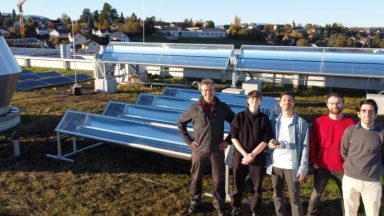
Highly durable selective solar absorber coatings for industrial process heat
Advanced nanocomposite coatings are developed for glazed collectors aiming at high optical performance and superior aging stability. Promising novel highly durable materials are nanocomposite ceramic coatings of the spinel type produced by low-cost sol gel dip-coating process. Our research has led to the foundation of the spin-off company SUNAXER.

Smart selective solar absorber coatings based on reversible semiconductor-to-metal transition
Thermochromic vanadium dioxide films exhibit a reversible first-order phase transition from the semiconducting monoclinic to the tetragonal metallic phase at a temperature of 68°C. This thermochromic property makes these coatings useful for the overheating protection of solar thermal collectors.

Solar cooking
A basket-based solar cooker has been designed for Uganda, an equatorial country. The solar cooker is designed to be easily constructed and based on recycled and locally available materials. Its performance in terms of cooking potential, power, and energy efficiency is evaluated. Solar thermal cookers offer substantial advantages, including fuel independence, financial savings, and reduced environmental impact. Widespread solar cooker use has the potential to mitigate deforestation, improve health, and enhance education.
Passive Solar: Innovative Glazing Technology

Frequency-selective surfaces by nanosecond laser-ablation
Nanosecond laser ablation can be used to create a millimetric slit-pattern in a transparent conductive low-e coating, achieving likewise a polyvalent effect of wavelength-selectivity: solar radiation in the UV-VIS-NIR spectral range is transmitted, heat radiation in the MIR range is reflected – keeping the thermal emissivity at low values – and the centimetre waves of mobile communication are transmitted. Our research has led to the foundation of the spin-off company NU.GLASS .

Solid-ion-conductors for durable electrochromic windows
The use of windows with switchable solar heat gains limits the cooling needs in summer, and decreases the heating needs in winter. The use of inorganic solid-state ion conductors such as LiPON, LLTO and Ta2O5 open the pathway to more durable devices, which can be built-up as multilayered film stacks on one glass substrate.
Metallic micro-/nanomeshes for transparent conductive layers
Conventional selective low-e coatings for windows of residential buildings have a cut-off frequency in the near infrared spectral region NIR, limiting the resulting solar heat gain coefficient to g ≈ 0.5. By structuring the coating into micro-/nanomeshes, the selectivity shall be enhanced and higher solar heat gains shall be achieved. The resulting increase in solar heat gains will lead to energy savings in heating in the residential sector.
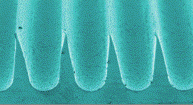
Optical Microstructures for advanced architectural glazing
The novel advanced glazing system combines several functions and can contribute to significantly reduce the energy consumption in buildings with favourably oriented glass façades. In winter, solar gains are used to reduce heating energy requirements; in summer, the proposed device blocks direct radiation and thus limits air conditioning load as well as overheating risks. Judicious use of daylighting furthermore reduces energy needs for artificial lighting and improves the wellbeing of occupants. Our system is based on optical microstructures, and ensures transparency.
Angular dependent optical and thermal properties of advanced architectural glazing
For novel types of innovative architectural glazing, the thermo-optical properties of the glazing play an important role in energy management of the building. The investigated advanced architectural glazing include innovative sun protection coatings with improved ratio of visible and energetic transmittance, as well as glazing integrated transparent and translucent photovoltaic modules based on dye-sensitized solar cells.
Building Integration and Energy Efficiency

Building integration of our novel solar technologies
The building integration of our novel technologies are studied in the SolAce unit of the NEST demonstration platform on EMPA campus in Dübendorf: multi-functional facade technologies are implemented to achieve an Energy-Plus and Low Carbon combined working/living space. The unit SolAce @ NEST features the following technologies which have been developed in our research group: light redirecting optical microstructures, laser-treated selective glazing, and colored glazing for PV & solar thermal collectors.

Energy efficiency in public transport
To reduce electricity consumption in rail transport, the focus of research and development today needs to extend beyond traction systems efficiency to the electricity consumption of comfort systems such as heating, ventilation and cooling (HVAC), which are responsible for an increasingly large part of total energy consumption. The construction of an entire vehicle envelope including glazing and the efficiency and control of HVAC components are naturally factors that influence the energy consumption of comfort installations. In addition to aspects purely related to energy consumption, daylight availability and visual comfort of the travelers are of central importance in this work. So far, our studies on the topic have already inspired novel ideas for improved glazing and smart thermal insulation materials for trains and trolleybuses.