We are the NeuroAI research group at the EPFL Neuro-X Institute, jointly between the School of Life Sciences, and the School of Computer and Communication Sciences.
Our research focuses on a computational understanding of the neural mechanisms underlying human natural intelligence. To achieve this goal, we bridge Deep Learning, Neuroscience, and Cognitive Science, building artificial neural network models that match the brain’s neural representations in their internal processing and are aligned to human behavior in their outputs.
We primarily engage on three synergistic research directions:
TEST: Alignment to Brain and Behavior
We thoroughly test the alignment of computational models to brain and behavioral data to uncover how brain-like representations are shaped.
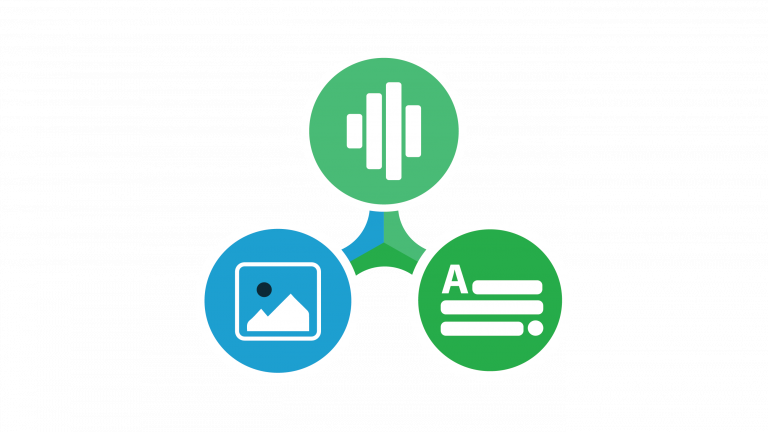
BUILD: State-of-the-art Brain Models
We build brain-like models using task and data optimization. Our focus is on pathways from multimodal sensory input through language to cognitive behaviors.
APPLY: Clinical Translation
We want our research to positively impact people’s lives. Towards this we are developing model-guided open- and closed-loop translational applications (e.g., visual prosthetics, dyslexia, depression).
Selected Publications
Please see Google Scholar for a full list of publications.

Model-Guided Microstimulation Steers Primate Visual Behavior.
Mehrer, Lonnqvist, Mitola, Gokce, Papale, Schrimpf.
ICLR 2026.
[paper]

Inducing Dyslexia in Vision Language Models
Honarmand, Sharma, AlKhamissi, Mehrer, Schrimpf.
ICLR 2026.
[paper]
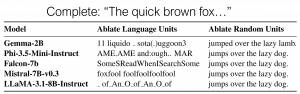
The LLM Language Network: A Neuroscientific Approach for Identifying Causally Task-Relevant Units
AlKhamissi, Tuckute, Bosselut**, Schrimpf**.
Oral @ NA ACL 2025.
[paper] [project page] [press 1 2 3 4 5 6]
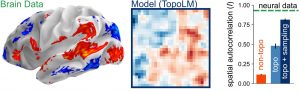
TopoLM: brain-like spatio-functional organization in a topographic language model
Rathi*, Mehrer*, AlKhamissi, Binhuraib, Blauch, Schrimpf.
Oral @ ICLR 2025.
[paper] [project page] [code] [press 1 2 3 4 5 6 7 8 9]

Scaling Laws for Task-Optimized Models of the Primate Visual Ventral Stream
Gokce & Schrimpf.
Spotlight @ ICML 2025.
[paper] [project page] [code]

Driving and Suppressing the Human Language Network Using Large Language Models
Tuckute, Sathe, Srikant, Taliaferro, Wang, Schrimpf, Kay, Fedorenko.
Nature Human Behavior 2024.
[paper] [code] [press 1 2 3 4 5 6 7 8 9]

The Neural Architecture of Language: Integrative Modeling Converges on Predictive Processing
Schrimpf, Blank, Tuckute, Kauf, Hosseini, Kanwisher, Tenenbaum, Fedorenko.
PNAS 2021.
[paper] [code, now also in Brain-Score] [press 1 2 3 4 5 6 7 8 9 10 11 12 13]

Brain-Score platform
ongoing community effort; first released in 2018.
[website] [perspective Neuron 2020] [technical paper 2018] [code] [press 1 2 3]
Team
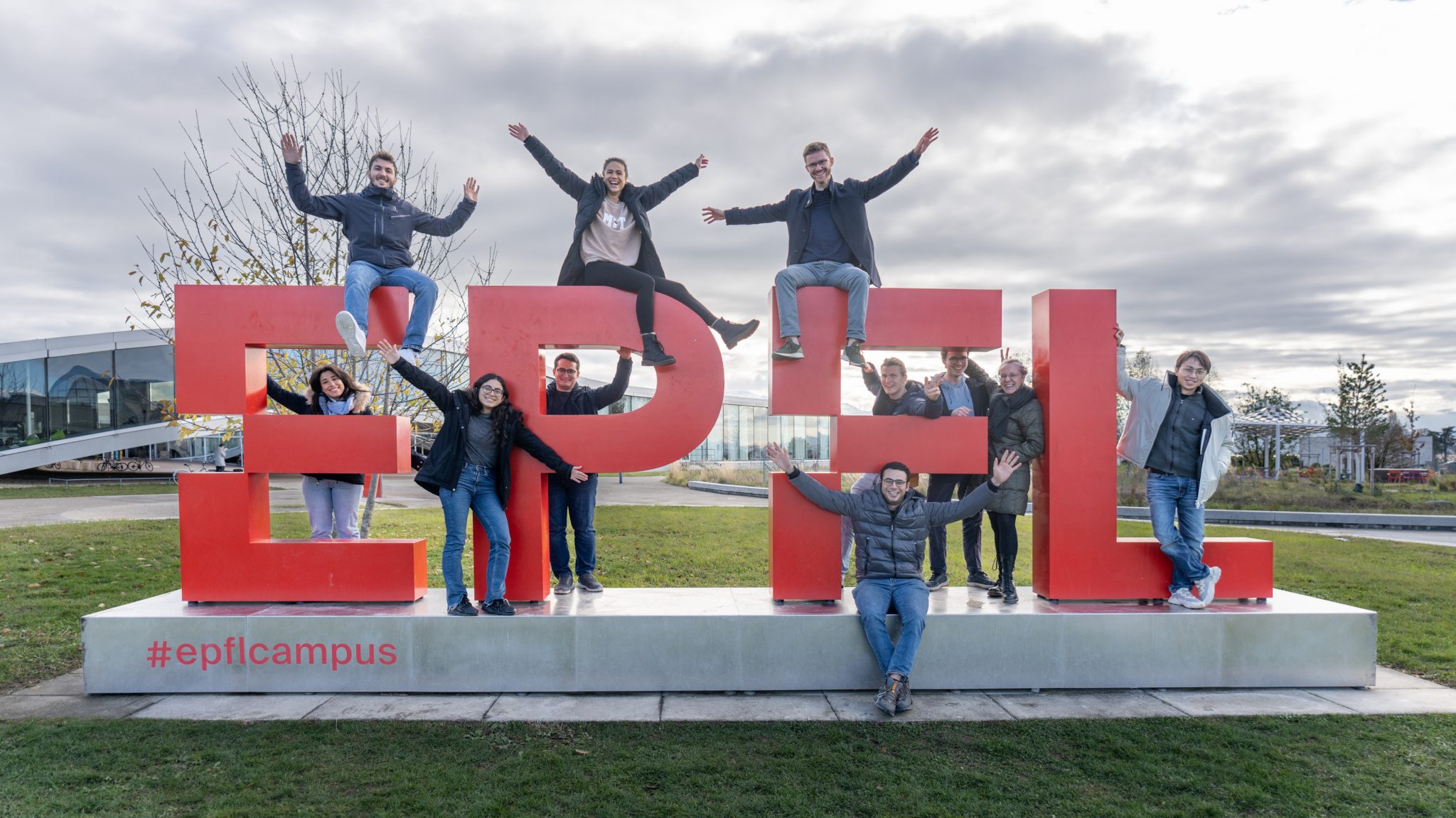





Former members and their next steps.
Prospective Members
- BS/MS interns and project students: *Note our lab is full until fall 2026* If you are an EPFL student or if you are considering a longer-term visit (6-12 months full-time), please submit your application via this form. We strongly prefer students who can commit to at least 2 full days per week. If you are not an EPFL student, please consider the SRP and Summer@EPFL programs — please do not email us. We generally only support ThinkSwiss applications for previous interns/collaborators. Please check the (non-comprehensive) list of projects and consider contacting group members whose research you are most excited about.
- PhD Applicants: We are always looking for highly talented and motivated students. At EPFL you apply to central PhD programs rather than an individual lab directly. Specifically, we hire from the EDIC and EDNE programs. Prospective ELLIS students have to first be admitted through these programs as well. To keep things fair for all applicants, we typically do not hold meetings before the initial screening. You do not need to send an email to us.
- Postdocs: Please email Martin Schrimpf directly with your CV, cc’ing Stéphanie Debayle. We expect a strong background in ML and/or neuroscience, demonstrated e.g. by publications. Consider applying to postdoctoral fellowships from SNSF, Marie Curie, NeuroX, the EPFL AI Center (and EPFLeader4impact when it reopens), and an SNSF Starting Grant.
- Other positions:
Research Engineer, NeuroAI
Teaching
-
BIOENG-310 Neuroscience foundations for engineers (Bachelor)
This overview course bridges computational expertise with neuroscience fundamentals, aimed at fostering interdisciplinary communication and collaboration for engineering-based neuroscience programs. - NX-414 Brain-like computation and intelligence (Master)
Recent advances in machine learning have contributed to the emergence of powerful models of animal perception and behavior. In this course we will compare the behavior and underlying mechanisms in these models as well as brains.
Contact us
Contact
Offices:
BC 206 (Main Campus Lausanne)
B1 0 261.050 (Campus Biotech Geneva)
Administrative Assistant: Stéphanie Debayle
Office: SV 2513
Phone: +41 21 693 5148
Email: [email protected]
Mailing address:
EPFL, INX-SV, SV UPSCHRIMPF1, SV 2513 (Bâtiment SV), Station 19, CH-1015 Lausanne
Access map
Funding
Many thanks to the following funding bodies for supporting our research: