
PV modules: reliability and performance prediction
|
Group members:
|
Dr. A. Virtuani, E. Annigoni, A. Martins, X. Niquille, L. Gnocchi
|
|
Running projects:
|
EOS Holding, PNR 70: ACTIVE INTERFACES, H2020-GoPV
|
Keywords: PV modules, reliability, performance prediction, building integration
Background
This group focuses on the long-term reliability of photovoltaic (PV) modules, which is influenced by the properties of the different materials and interfaces composing the module as well as by the external stresses operating on the module in real conditions. In the past years, the laboratory has also developed novel products for a better integration to buildings, such as the colored -terra-cotta-like – thin-film silicon module, as well as innovative characterization set-ups. Since the creation of the PV Center at CSEM, a close collaboration has been taking place on most of the subjects with both entities complementary equipped for the design and manufacturing of modules, from the PV cell fabrication up to full-size modules. The major focus at PV-Lab is now on the more fundamental aspects of reliability, be it for standard modules or prototypes.
Research highlights
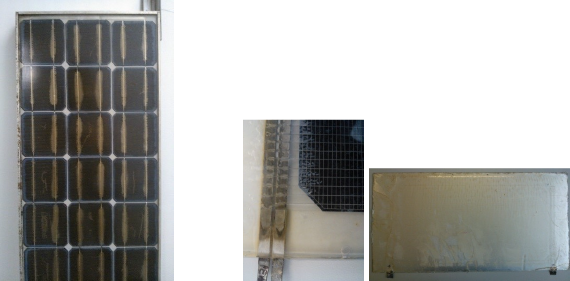
Predicting lifetime and power delivery over time of PV modules in real outdoor conditions is of major interest for all stakeholders (investors, utility companies…), as it presents a key factor in terms of investments. Presently, PV module manufacturers typically guarantee 80% of the nominal power for 25 years, but the performance evolution with time is not clearly defined. Indeed, during outdoor operation, a PV module can be affected by a large number of failures and related performance loss (see an example in Fig.1). All these failures do not occur at the same frequency and with the same impact on module performance, and are clearly dependent on the module technology and its geographical localization.
Presently, PV modules are only going through qualification tests (such as performed according to the IEC 61215 for crystalline silicon based modules) which provide limited information as (i) they do not provide information on the maximum lifetime that can be expected, (ii) they do not consider climate specificities.
One of our aim is thus to develop a predictive model to evaluate the lifetime of PV modules, taking into account their specific technology and the external stresses they encounter based on their operating location. To this purpose, a study of most common failures modes is performed with a deep analysis of the major ones, and accelerated tests sequences are defined to reproduce these failures. This work requires both a deep understanding of the fundamental mechanisms at the basis of the failures, and the assessment of a clear correlation between accelerated tests results and outdoor degradation observations and reports.
|
Figure 1 – A PV module after 22 years of outdoor exposure in Switzerland (power loss 15%). Corrosion is due to water ingress, high temperatures and UV radiation.
|
Figure 2 – Example of modules degradation reproduced at PV-Lab: delamination of materials due to water ingress.
|
||||||||||||||||||||
For example, one particular mechanism that we are studying is water ingress into PV modules. Figure 2 shows results of an accelerated test that replicated the consequences of long-term exposure to very high relative humidity and temperature levels. Mathematical simulations are also employed, where diffusion equations are applied to a PV module geometrical model. Such simulations allow analyzing the impact of climate characteristics by using weather data of different climatic regions as inputs. Some results are reported in Fig.3: the climate influence is evident in the higher water concentration for the two locations featuring a humid climate, as well as in the seasonal variations, particularly visible at the edge.

Figure 3 – On the top: Some results of water ingress simulations: the water concentration in three points inside the PV module (the edge, the back of the first cell and the back of the second cell, see picture on the left) is plotted against time for three different climates. Modules with a glass/glass (G/G) encapsulation scheme are considered.
Accelerated tests and mathematical simulations are then used to develop models for the prediction of PV modules electrical performance as a consequence of the degradation mechanisms. Some models are available in the literature for specific degradation modes, and are typically based on empirical relations widely used for reliability prediction such as Arrhenius law for temperature-driven processes or Peck law for phenomena driven by temperature and relative humidity. For example, the equation hereunder, based on Peck’s model, was proposed by Peter Hacke (NREL, 2015) to describe the modules power degradation in time due to high voltage , temperature and relative humidity exposure ( is the thermal activation energy of the degradation process, the Boltzmann constant, and parameters that can be empirically determined from the accelerated tests).

Even though the majority of PV installations are roof- or rack-mounted, solutions for an aesthetic integration to buildings are also offered on the market. However, such BIPV (Building Integrated Photovoltaic) elements have not been implemented to a large extent yet due to some barriers among which the two most cited ones are the higher costs and the lack of knowledge from building actors. In this frame, the PNR 70 – ACTIVE INTERFACES project aims at providing a better understanding of the failures and success of past and present BIPV solutions, in terms of technological choice, cost potential and acceptance. In parallel, we are working on the development of the next generation of BIPV products that satisfy manufacturability and low ecological footprint. In particular, various types of materials and configurations are being tested, including analysis of BIPV modules available on the market. We are also working on the development of lightweight modules, as most of the building structures have not been designed to support the additional weight of the BIPV modules. A standard PV module can weight around 13-20 kg/m2 while with our developments we aim to achieve 5-8 kg/m2. In order to reach this goal, we have been using for instance an innovative composite backsheet for PV market based on a composite structure. Composites are especially attractive for such applications where the request for weight saving are as important as mechanical or fire safety properties. Fiber reinforced composites are well-known in high-tech applications such as in railway and aeronautical transportation industries due to their high stiffness and strength with minimal weight required. An even higher stiffness-to-weight ratio may be achieved by employing the sandwich construction principal: separating two thin composite face sheets by a cellular core results in considerably higher bending stiffness compared to a monolithic structure of the same weight. One of the possible configuration is described here: glass fiber reinforced plastics (GFRP) for the skins of the backsheet, nomex honeycomb as core structure, Ethylene Tetrafluoroethylene (ETFE) as frontsheet and ethylene vinyl acetate (EVA) as encapsulant. In Fig.4 an example of a mini-module with such configuration is sketched. These mini-modules modules are now being tested under different accelerated lifetime tests (ALTs) to evaluate their reliability.
This work would improve the potential for BIPV to reach sufficient acceptance (aesthetic, reliability, easy installation and cost).

Fig. 4 – Prototype layout (left) and two cells mini-module (right) developed with sandwich structure.
| [4] | C. Ballif, H.-Y. Li, E. Annigoni, F. Galliano, J. Escarré, F. Meillaud, L.-E. Perret, Impact of moisture ingress in PV modules on long-term performance: the role of EVA formulation, module design and climate, 11th Workshop of PV Module Technology, TUV Rheinland, Cologne (Germany), 2014 |
| [3] | H. Li, Open the Black Box: Understanding the Encapsulation Process of Photovoltaic Modules, PhD thesis at École Polytechnique Fédérale de Lausanne (EPFL), 2013 |
| [2] | P. Heinstein, C. Ballif and L.-E. Perret-Aebi, Building integrated photovoltaics (BIPV): review, potentials, barrier and myths, in Green, vol. 3, num. 2, 2013 |
| [1] | S. Heimbs, S. Schmeer, P. Middendorf, M. Maier, Strain rate effects in phenolic composites and phenolic impregnated honeycomb structures, Composites Science and Technology 67 (13), pp. 2827-2837, 2007 |