
Keywords: silane consumption efficiency, powder, secondary-gas phase reactions, plasma transients
Background
Several diagnostic tools have been applied in the past to detect a wide range of chemical species in laboratory-scale plasma-enhanced chemical vapor deposition systems (PECVD). While a considerable amount of effort has been undertaken to better understand the plasma chemistry, the focus of our research is rather to establish correlations between the plasma composition and the properties of thin films deposited in an industrial PECVD. To comply with our stringent industrial requirements, the following compact and non-intrusive plasma diagnostic tools have been mounted on an industrial parallel-plate KAI-MTM system:
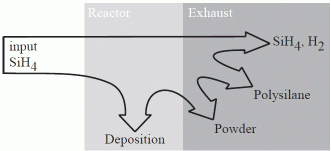
– A homebuilt high-resolution quantum cascade infrared laser-based absorption spectrometer. The spectrometer is designed to monitor the silane precursor gas in the PECVD exhaust, in the PECVD reactor and in the surrounding chamber of the PECVD reactor. It has been applied to measure the silane consumption efficiency (utilization efficiency) (see Fig. 2), or the fraction of silane lost in polysilane and powder (see Fig. 1).
– A homebuilt laser light scattering device designed to detect the formation of powder particles at the exhaust of the PECVD reactor. Powder refers here to rather large (> 50nm) negatively-charged particles that are expulsed from the reactor.
– An optical emission spectrometer to monitor the plasma emission.
|
|
|
| Figure. 1. Silane pathways in a PECVD reactor. Silane may be dissociated in the reactor, react with silane radicals to form polysilane molecules (secondary-gas phase reactions), or be pumped through the exhaust line. Silane molecules that have reacted or been dissociated may contribute to the film growth or be expelled from the reactor in the form of silane, hydrogen, polysilane or powder particles. | Fig. 2. Measurement of the silane consumption efficiency η in the exhaust of an industrial PECVD system
|

Research highlights
The role of secondary gas-phase reactions during deposition of microcrystalline silicon is a controversial subject. Secondary gas-phase reactions trigger the formation of powder, which have been simultaneously detected with our three diagnostic tools. We isolated the effect of secondary gas-phase reactions from other effects by performing deposition series at a constant deposition rate, with a constant ion bombardment rate, and with similar Raman crystalline factions of the deposited films. We unambiguously confirmed the beneficial impact of powder regimes. Based on this finding we have now adopted a refined view of powder. On the one hand, powder is considered as (i) a limiting factor to the maximum achievable deposition rate and (ii) a potential source of inhomogeneous and instable plasma conditions. On the other hand, the formation of powder is seen as (iii) an indicator of favorable process conditions.
With the help of our plasma diagnostic tools, further results, listed below, were obtained:
. The plasma ignition as been optimized such as to reach steady state conditions in less than a second.
. Tailored processes were established to reduce plasma transients at the front contact/p-layer interface and at the p/i layer interface.
. In light of silane concentration measurements in the plasma, we identified an amorphous-to-microcrystalline silicon transition regime, where device-grade material is grown.
. Based on all previous findings, the efficiency of the reference microcrystalline cell deposited at a high rate of 10 Å/s could thus be improved from 7.1 to 7.9 %.
Key publications
| [1] | G. Parascandolo, R. Bartlome, G. Bugnon, T. Söderström, B. Strahm, A. Feltrin, and C. Ballif, Impact of secondary gas-phase reactions on microcrystalline silicon solar cells deposited at high rate, Applied Physics Letters, 2010, vol. 96, 233508, 2010 |
| [2] | R. Bartlome, A. Feltrin, and C. Ballif, Infrared laser-based monitoring of the silane dissociation during deposition of silicon thin films, Applied Physics Letters, vol. 94, art. 201501, 2009 |
| [3] | A. Descoeudres, L. Barraud, R. Bartlome, G. Choong, Stefaan De Wolf, F. Zicarelli, and C. Ballif, The silane depletion fraction as an indicator for the amorphous/crystalline silicon interface passivation quality, Appl. Phys. Lett., Vol 97, pp. 183505-, November, 2010 |