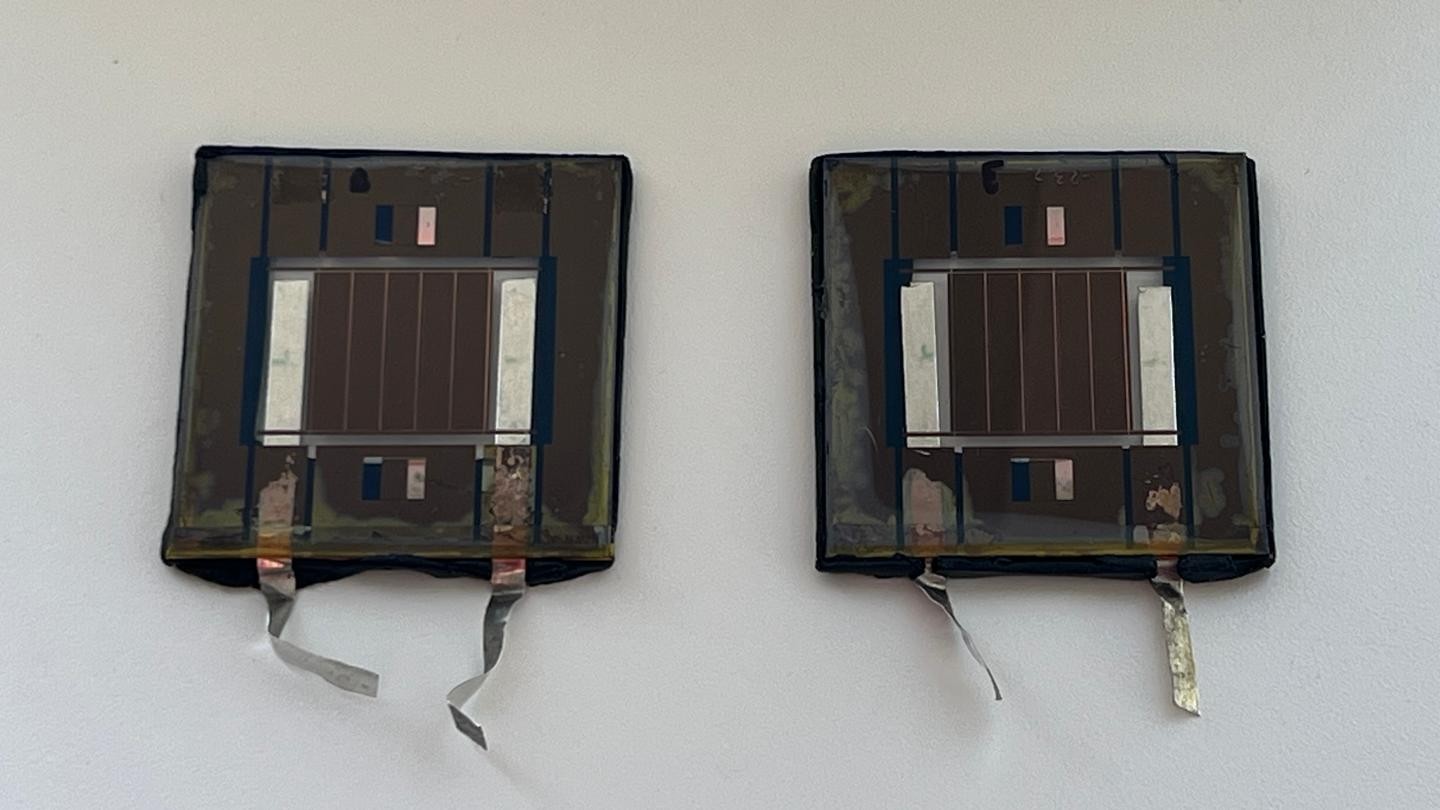
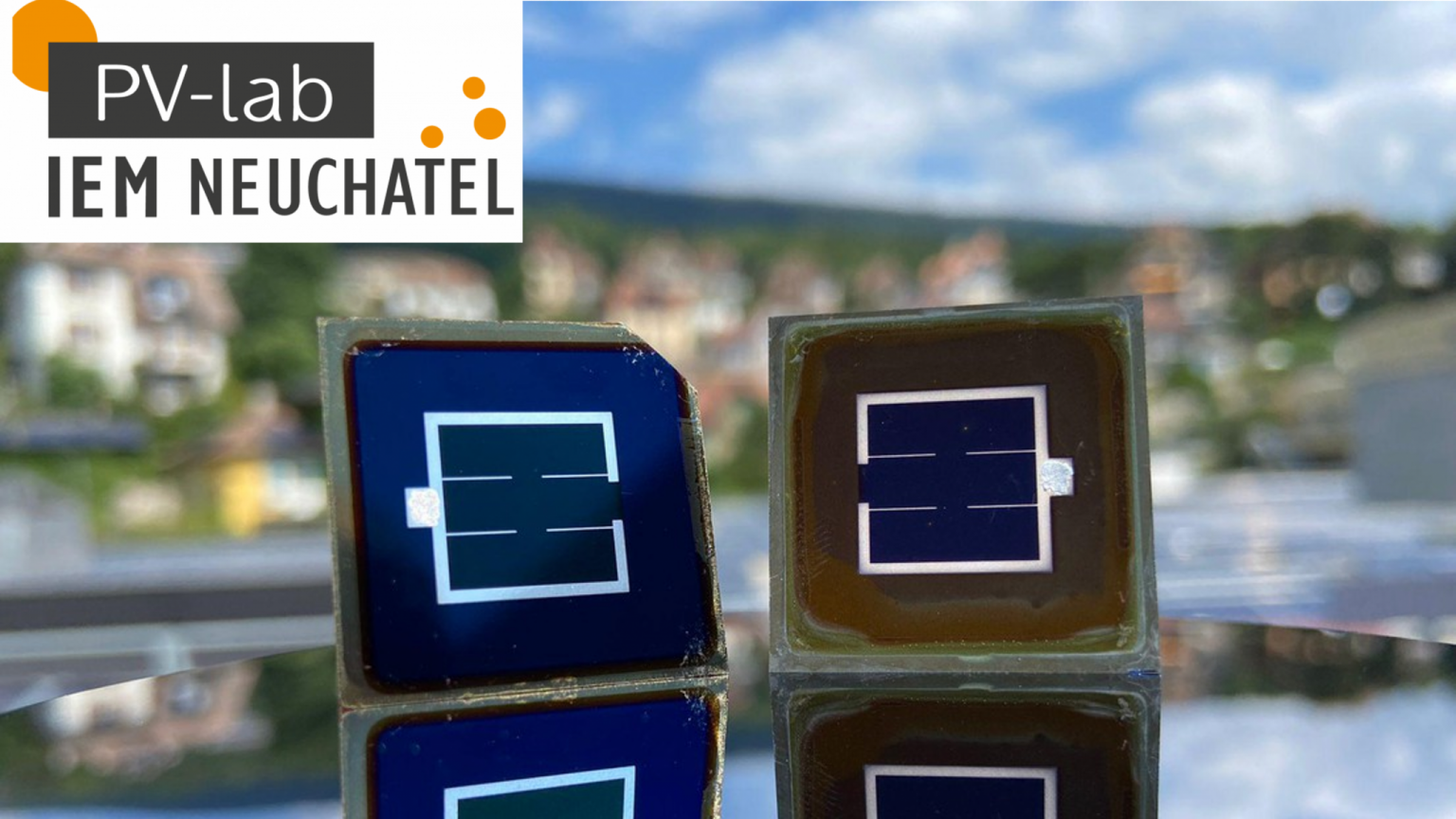
The laboratory of photovoltaics and thin-films electronics (PV-lab) of IEM, founded in 1984 by Prof. Arvind Shah and headed by Prof. Christophe Ballif since 2004, has pioneered several new processes for the preparation of thin-film silicon, such as the introduction of very high frequency (VHF) plasma deposition and microcrystalline silicon as an efficient photovoltaic material, and simple processing of heterojunction crystalline cells. Current activities of the laboratory cover a broad spectrum, ranging from fundamental research to industrial technology transfer. The lab masters processes of device fabrication for a wide variety of transparent conductive oxides, thin-film solar cells and high-efficiency crystalline silicon solar cells. It also has expertise for specialty detectors. It has full facilities for packaging of PV products. It has been designated as a center of national importance by the Swiss Federal Office for Energy.

PV-lab is a founding partner of the CSEM PV-center, which started operation in 2013 with a focus on technology transfer, and industrialisation of technologies.
LATEST NEWS

© 2025 EPFL

Christophe Ballif wins ERC Synergy Grants for Ultimate PV

— On 6th of November, the European Research council announced the selection of 66 ERC Synergy Grants for a total 684 m€ ! Fantastic news: our "Ultimate PV project", with EPFL PV-lab (Christophe Ballif) , Stefan Glunz at University of Freiburg, and StĂ©phane Collin at CNRS has been selected as one of the winning project 

Pierre Vandergheynst and Christophe Ballif. 2025 EPFL CC BY SA

Pierre Vandergheynst and Christophe Ballif win ERC Synergy Grants

— The European Research Council announced on Thursday that School of Engineering professors Pierre Vandergheynst and Christophe Ballif have been awarded ERC Synergy Grants to tackle major scientific challenges.

© 2025 EPFL

La Doctorale – 10 Research Prizes reward EPFL Researchers

— 10 young EPFL researchers have been rewarded for their research projects this year again. These prizes are offered by Foundations and EPFL.

© 2025 EPFL

Zeno Karl Schindler Award 2025 goes to Dr. Christian Wolff of PV-Lab

— Congratulation to Christian for getting the prestigious Zeno-Karl Schindler Award 2025 (20’000 CHF) ZKS-EPFL – Zeno Karl Schindler Fondation during the “Doctorale 2025”, at the Forum Rolex on Oct. 27th Christian receives the award “For his multiple contributions to the field of perovskite and perovskite-silicon solar cells, allowing among others the first worldwide demonstration of tandem perovskite-silicon solar cells with over 30% efficiency, world record triple junction solar cells, as well as perovskite solar cells with remarkable stability. His achievements open key pathways for providing low-cost clean electricity beyond standard silicon solar cells”. Prix Zeno Karl Schindler – 2025 – Christian Wolff – EPFL

© 2025 EUPVSEC

Best poster award in EU PVSEC 2025 Bilbao!

— Big congratulations to Umang Desai from EPFL PV-lab for winning a Best Poster Award at #EUPVSEC2025 in Bilbao for his work on "Façade Application of Light-Weight Glass-Free Colored PV Modules: Reliability Testing of the Large-Format Modules and Monitoring of the Demonstration Site''. Moreover, the presentations of recently graduated Ph.D. students from EPFL, Hugo Quest and Kerem Artuk, were featured among the highlights of the conference. We are delighted that PV-Lab posters and presentations received recognition.

© 2025 EES Solar

Perovskite-TOPCon tandems are catching up!

— Our article “Over 31%-efficient perovskite–TOPCon solar cells enabled by AlOx-based hydrogenation and front sub-micron texturing” is now published in EES Solar. In this work, we demonstrate high-efficiency perovskite–silicon tandem solar cells using double-sided tunnel oxide passivated contacts (TOPCon2) bottom cells, achieving 30.2% efficiency on both sides flat and 31.3% on front-textured devices. The former is enabled by high passivation quality on flat surfaces and the latter by enhanced optical performance. These results highlight that TOPCon2 is a promising platform for scalable tandem integration beyond silicon heterojunction-based bottom cells.'

© 2025, Digital Discovery, Hilal Aybike Can

Paper alert: accelerating optimization of halide perovskites!

— Our article “Accelerating optimization of halide perovskites: two blueprints for automation” is now published in Digital Discovery. We present HITSTA, an accelerated aging setup that not only speeds up stability testing but also provides insight into degradation mechanisms, and ROSIE, a robotic ink-mixing platform that standardizes and automates solution preparation for systematic, high-throughput studies. Together, these open-source and affordable tools pave the way for faster, more reproducible perovskite research. 

© 2025, SOLMAT

Check out our new article on leaner TOPCon solar cell fabrication !

— Happy to share our new article 'Co-annealing of PECVD boron emitters and poly-Si passivating contacts for leaner TOPCon solar cell fabrication' is published in SOLMAT and also featured in PV Magazine. 

© 2025 EPFL

Light-Weight Colored Photovoltaic Modules Based on Composite Polymer

— Can PV modules be LIGHTWEIGHT, GLASS-FREE, COLORED, and still survive hailstorms and accelerated environmental ageing? Happy to share our new article 'Novel Mechanically Robust and Environmentally Stable Light-Weight Colored Photovoltaic Modules Based on Composite Polymer Backsheets' is published in Solar RRL. 

© 2025, Nature Review Clean Technology

Fantastic overview paper about BIPV in Nature Reviews Clean Tech !

— Integrating photovoltaics into Building check the fantastic latest overview paper in Nature Clean Energy Reviews!

All news

NEXT EVENTS

No scheduled events

See all events

RECENT PUBLICATIONS

Improving the operational stability of perovskite solar cells with cesium-doped graphene oxide interlayer

M. Almalki; K. Anagnostou; K. Rogdakis; F. T. Eickemeyer; M. Othman et al. 

Journal Of Energy Chemistry. 2024-09-01. Vol. 96, p. 483-490. DOI : 10.1016/j.jechem.2024.04.037.

Correlating long-term performance and aging behaviour of building integrated PV modules

E. Ozkalay; A. Virtuani; G. Eder; Y. Voronko; P. Bonomo et al. 

Energy And Buildings. 2024-08-01. Vol. 316, p. 114252. DOI : 10.1016/j.enbuild.2024.114252.

From PV to EV: Mapping the Potential for Electric Vehicle Charging with Solar Energy in Europe

N. Jeannin; A. Pena Bello; J. Dumoulin; D. Wannier; C. Ballif et al. 

International Journal of Sustainable Energy Planning and Management. 2024-06-19. Vol. 41, p. 45-57. DOI : 10.54337/ijsepm.8151.

Intrinsic performance loss rate: Decoupling reversible and irreversible losses for an improved assessment of photovoltaic system performance

H. Quest; C. Ballif; A. Virtuani 

Progress In Photovoltaics. 2024-06-17. DOI : 10.1002/pip.3829.

Alleviating nanostructural phase impurities enhances the optoelectronic properties, device performance and stability of cesium-formamidinium metal-halide perovskites

M. Othman; Q. Jeangros; D. A. Jacobs; M. H. Futscher; S. Zeiske et al. 

Energy & Environmental Science. 2024-05-09. DOI : 10.1039/d4ee00901k.

Stress tolerance of lightweight glass-free PV modules for vehicle integration

U. B. Desai; K. Nicolet; S. Prabhudesai; G. Cattaneo; J. Robin et al. 

Epj Photovoltaics. 2024-04-01. Vol. 15, p. 10. DOI : 10.1051/epjpv/2024003.

Nanostructure and Optical Property Tailoring of Zinc Tin Nitride Thin Films through Phenomenological Decoupling: A Pathway to Enhanced Control

C. Hain; K. Wieczerzak; D. Casari; A. Sharma; A. Xomalis et al. 

Acs Applied Nano Materials. 2024-03-11. Vol. 7, num. 6, p. 6242–6252. DOI : 10.1021/acsanm.3c06178.

Characterization of a flexible a-Si:H detector for in vivo dosimetry in therapeutic x-ray beams

M. J. Large; A. Bashiri; Y. Dookie; J. McNamara; L. Antognini et al. 

Medical Physics. 2024-03-03. DOI : 10.1002/mp.17013.

The effect of partial shading on the reliability of photovoltaic modules in the built-environment

E. Ozkalay; F. Valoti; M. Caccivio; A. Virtuani; G. Friesen et al. 

Epj Photovoltaics. 2024-02-28. Vol. 15, p. 7. DOI : 10.1051/epjpv/2024001.

A Universal Perovskite/C60 Interface Modification via Atomic Layer Deposited Aluminum Oxide for Perovskite Solar Cells and Perovskite-Silicon Tandems

K. Artuk; D. Turkay; M. D. Mensi; J. A. Steele; D. A. Jacobs et al. 

Advanced Materials. 2024-02-19. DOI : 10.1002/adma.202311745.