(Page under construction)
Introduction
Loudspeakers with membranes – like those found in cars or home audio systems – are among the most studied solutions for active noise reduction. With a control feedback, a loudspeaker can absorb sound, just as it can produce it.
However, conventional loudspeakers face a major limitation as sound absorbers. Depending on their membranes’ mechanical properties, they follow certain dynamic behaviours that limit their frequency range of operation. In mechanics terminology, this means that the combination of inertial, stiffness and damping parameters in loudspeakers makes them more efficient in the vicinity of their resonance but less effective otherwise. There is also another issue directly attributed to the mass of the membrane: the inertia prevents it from responding efficiently to rapidly changing sounds and limits the performance at high frequencies.
Plasma-based transducers on the other hand offer an intriguing alternative for noise control applications by eliminating this key limitation of conventional loudspeakers: the need for a membrane.
How it works
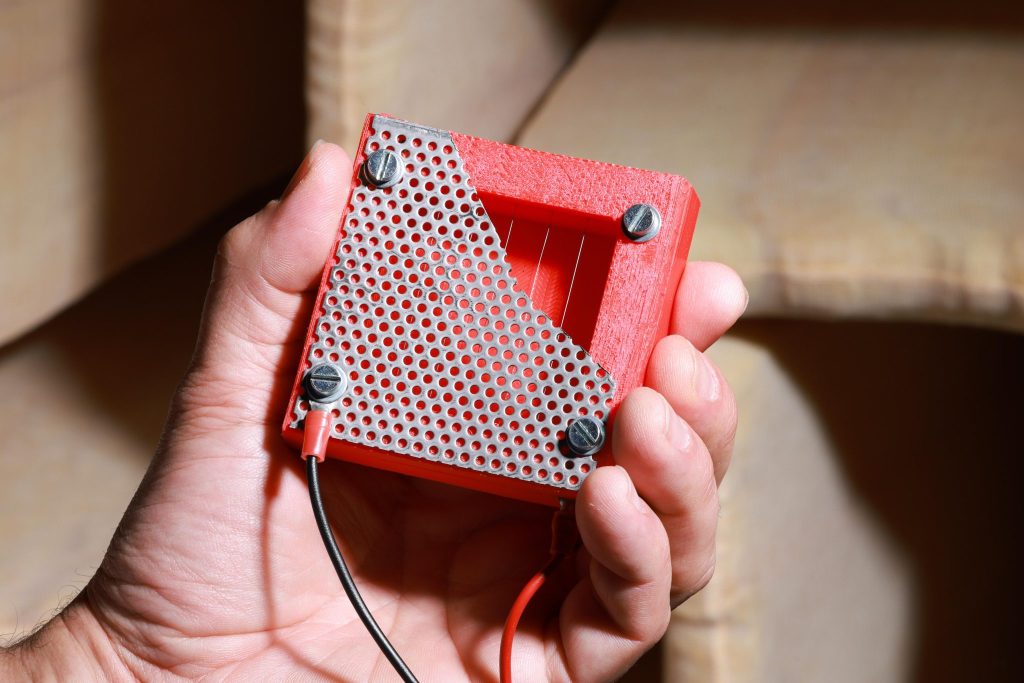
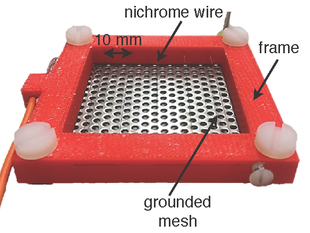
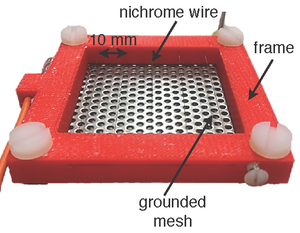
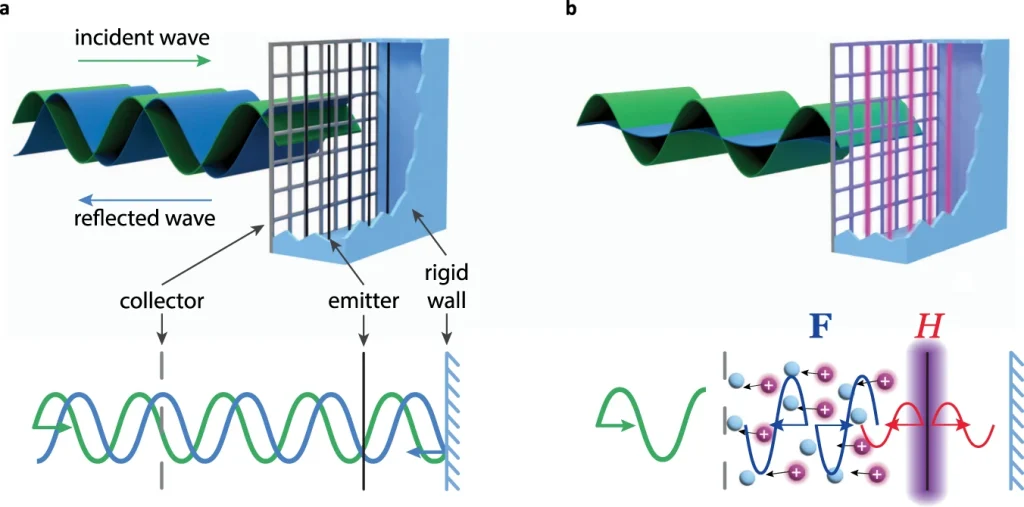
Instead of relying on a heavy membrane to cancel out noise, plasmacoustic metalayers take a completely different approach by using air itself as the active sound-absorbing medium. The plasma transducer consists of two metallic electrodes (see here a more detailed description of the plasma speaker) with a thin layer of air between them. This air layer is known as the plasmacoustic metalayer.
As indicated by its name, the underlying sound generation mechanism of a plasmacoustic transducer is rooted in plasma physics. By applying a high voltage to the electrodes, the air molecules in between them get ionised. With a negligible mass compared to a solid membrane, these charged particles respond to changes in the electrical field surrounding them almost instantaneously. This fast response allows the ionised air to effectively interact with incoming sound waves and absorb them. The direct interaction between the electrical control system of the plasma metalayer and the sound waves enables much faster communication with the acoustic environment than conventional membranes.
The dynamics of thin layers of air plasma can be controlled to interact with sound over deep-subwavelength distances, for example efficient sound absorption over a few millimeters of plasma metalayer – much smaller than the incoming sounds’ wavelength. In summary, by replacing heavy membranes with an ultrathin controllable plasmacoustic metalayer, plasma-based transducers promise high efficiency beside compactness.
What are the applications
Plasmacoustic metalayers are suitable for a wide range of applications—especially where space and weight are critical constraints. They are capable of delivering perfect sound absorption – absorbing the incoming sound energy with minimal, if any, reflection. This is achieved across a wide range of frequencies, from just a few hertz to several kilohertz.
To illustrate their efficiency, it is worth noting that to effectively absorb the sound at 20 Hz (with a wavelength of about 17 meters) using conventional soundproofing materials, a sound-absorbing wedge of approximately 4 meters thick would be required. Nevertheless, a plasmacoustic metalayer can achieve the performance with a active layer of just 5 millimeters thick — with a size reduction by a factor of over 800.
The plasmacoustic metalayers’ compactness, customisability and transparency enables it to have great potential to transform the acoustics of various enclosed spaces, including aircraft and vehicle cabins, apartments, recording studios, and home theatres, for example.
What we are working on
Ongoing research to be detailed later.
List of projects associated with this topic
| Funding body | Project | Period |
| PlasmAcoustic metaLayer for Active aCoustic WIndOws (PALACIO) | 2025- |
To learn more