(Page under construction)
Introduction
Conventional loudspeakers rely on a vibrating diaphragm and a voice coil to push air at audio frequencies and make sound. While this method works well for sound generation, it has an inherent limitation in sound control applications. Moving parts have mass, and mass comes with inertia. This prevents the conventional loudspeakers from responding instantly to rapid changes in the input signal, leading to a loss in detail and precision especially at high frequencies.
What if the constraints imposed by mechanical inertia could be completely eliminated? Imagine producing sound by directly converting electrical signals into acoustic waves, thereby bypassing any need for a moving solid interface.
Plasmacoustic transducers take a completely different approach to generating sound. Instead of a moving diaphragm, they rely on local ionisation of air molecules in a controllable, intense electric field within a very thin plasma layer to provoke acoustic particle velocity. With no mass to slow them down, these “inertialess” loudspeakers can react instantly to electrical signals, enabling exceptionally precise control on high-frequency audio.
How it works
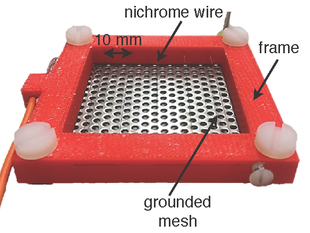
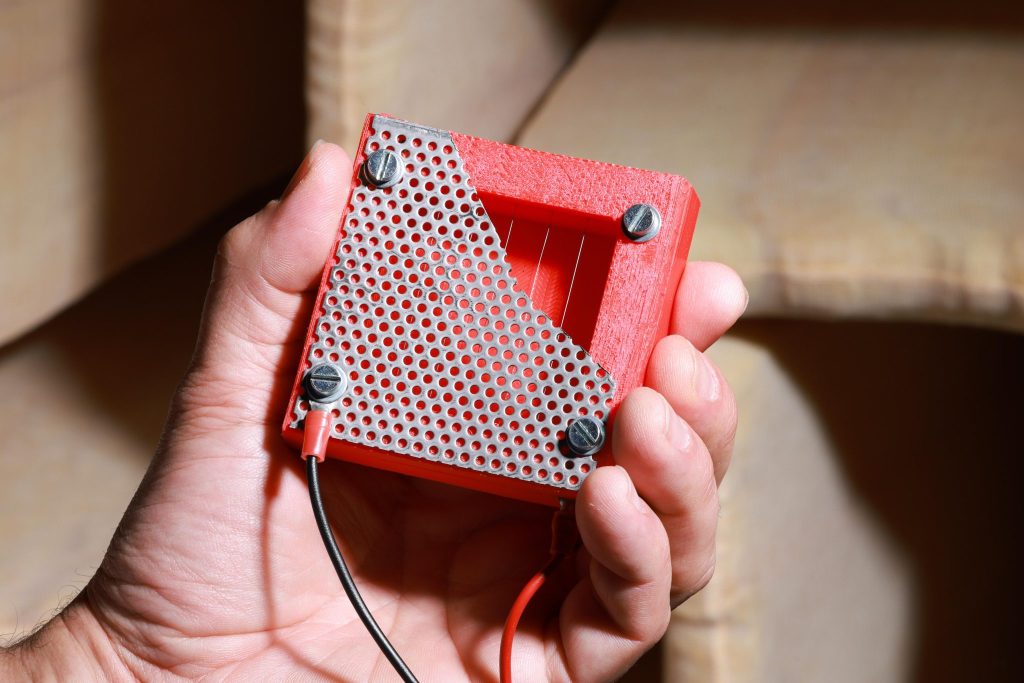
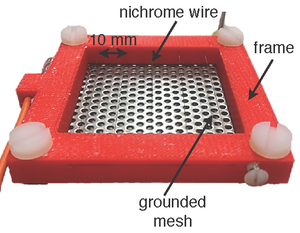
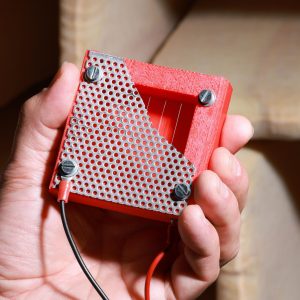
A plasmacoustic transducer like the one pictured below consists of two metallic electrodes: a perforated plate (collector electrode) and an array of thin wires (emitter electrode). These electrodes are fixed onto a plastic frame and separated by a 5 mm gap of air.

While the collector is grounded, a high positive DC voltage is applied to the emitter wires that introduces a strong electric field around the wires. Once the intensity of this field exceeds the electric breakdown threshold, a corona discharge initiates that leads to local ionisation of the air molecules within a small region surrounding the wires.
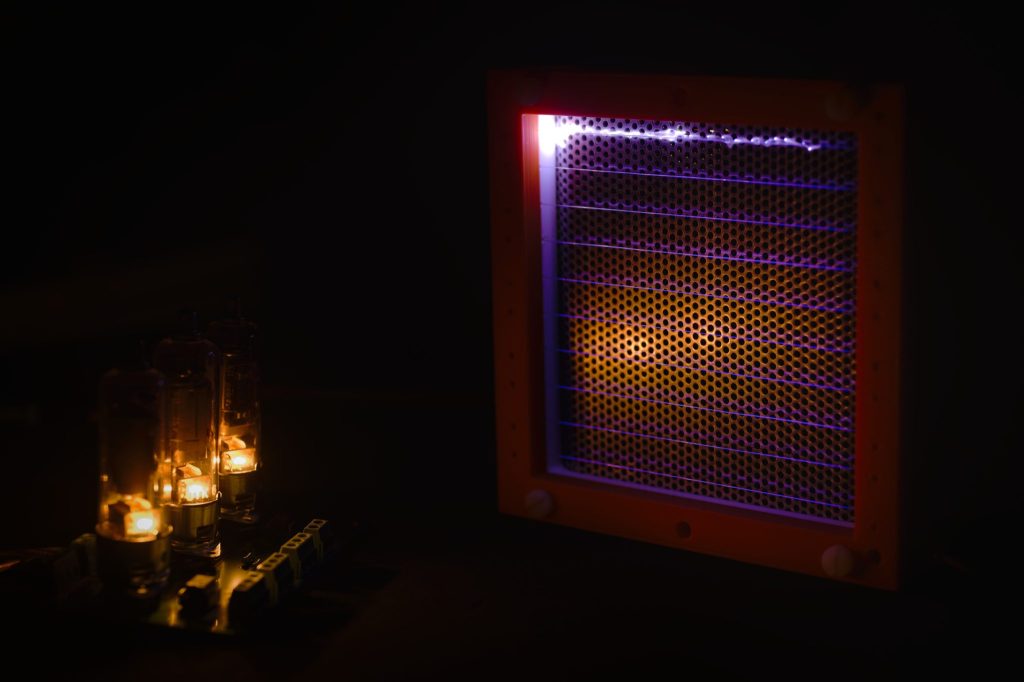
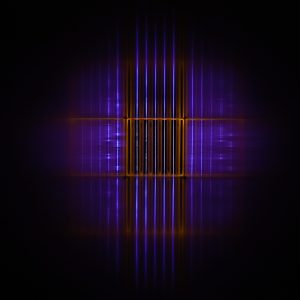
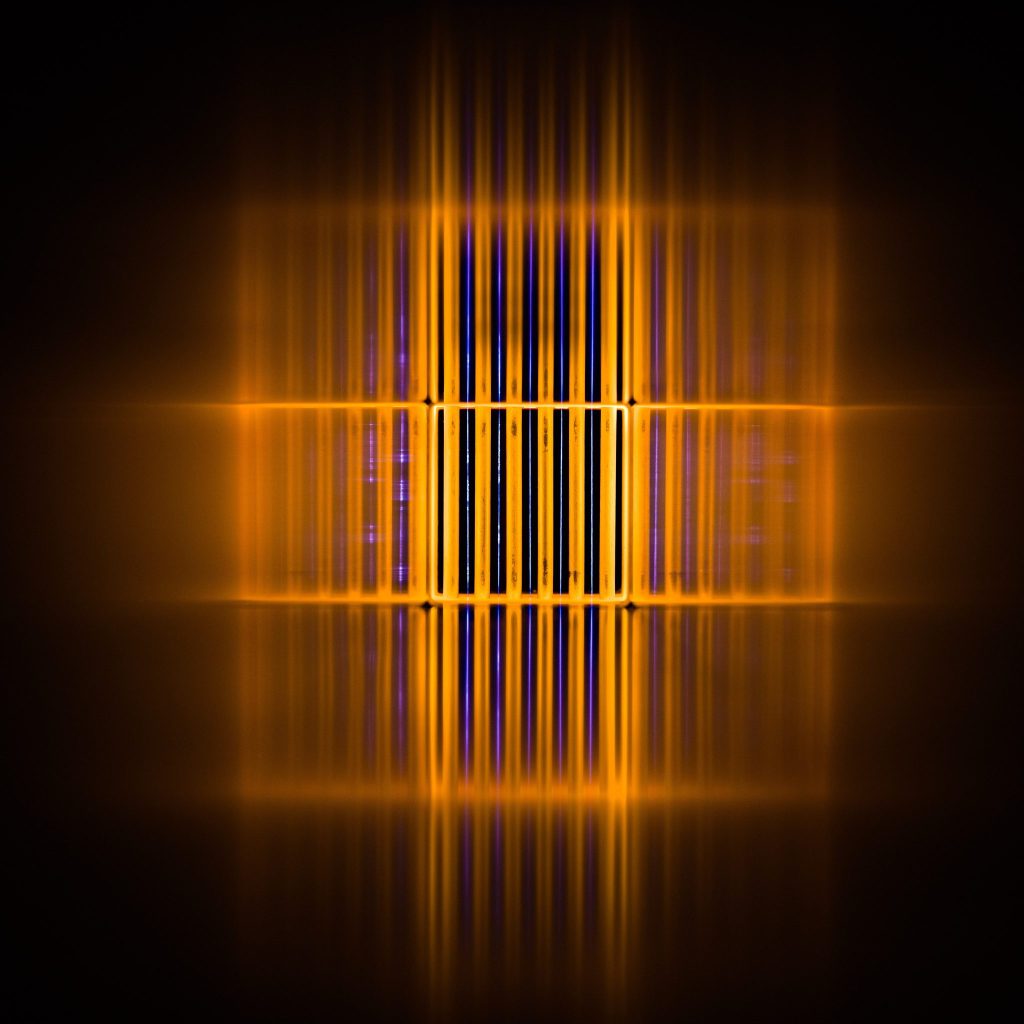
This discharge glows in the dark, leading to the beautiful pictures below. The ions then drift in the electrical fields towards the collector. While moving, they collide with neutral air particles present in the gap between the electrodes and transfer momentum to them. This accelerates a volume of air between the electrodes. The perforated plate collects the ions but the air moves through. Thus, in a constant voltage regime, the actuator can actually work like a ionic fan with a velocity proportional to the voltage we apply. When a sufficiently strong AC voltage is superimposed on the constant DC bias, it causes the ionised air to compress and generate sound.
What are the applications
These plasmacoustic transducers present multiple intrinsic advantages that make them well-suited for a wide range of applications. With an active area less than 1cm wide, their compact design makes them ideal for broadband sound absorption. Without any moving parts, these transducers exhibit non-resonant behaviour. A characteristic that, when coupled with their ultra-fast response time, makes them particularly well-suited for active sound control applications. Moreover, their permeability to air enables sound regulation by preserving fluid flow.
List of projects associated with this topic
| Funding body | Project | Period |
| Horizon H2020 | Aircraft noise Reduction Technologies and related Environmental iMpact (ARTEM) | 2017-2021 |
To learn more