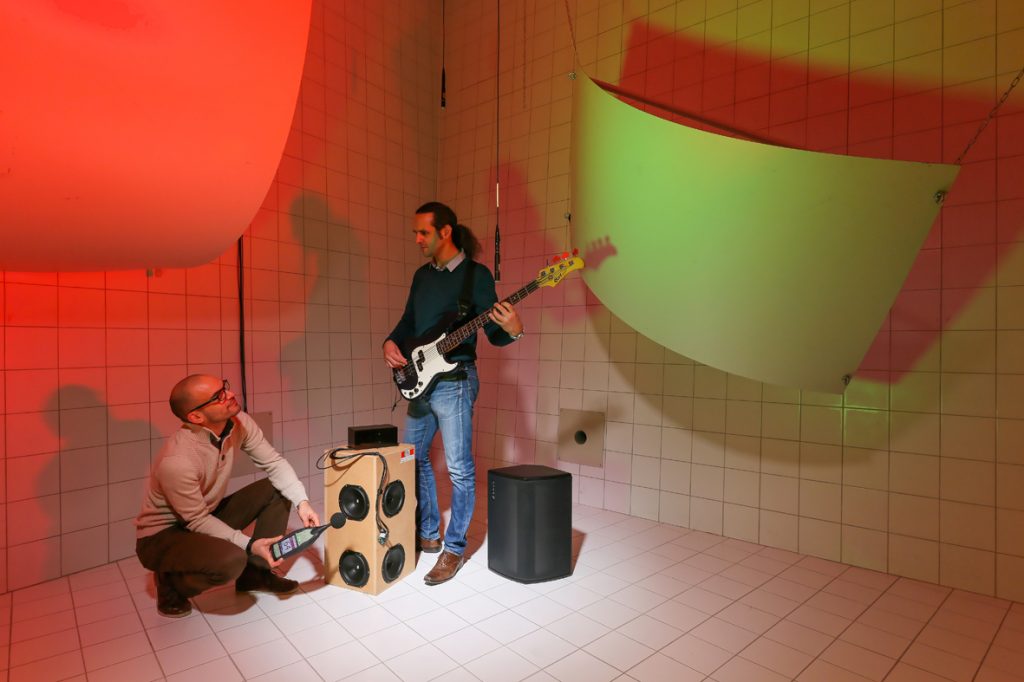
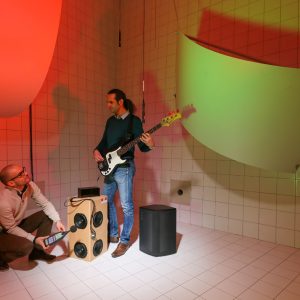
Electroacoustic absorbers are used to damp room modes at low frequencies. Here the laboratory prototype of the Acoustic Group, side by side with the AVAA C20 model of PSI Audio.
Introduction
Loudspeakers are well known as sound sources, being the only means to render music and movie sounds in your living room for example. But they can also be used as membrane absorbers, capable to damp sound energy in the low frequency range, where no state-of-the-art soundproofing material can actually work.
How it works
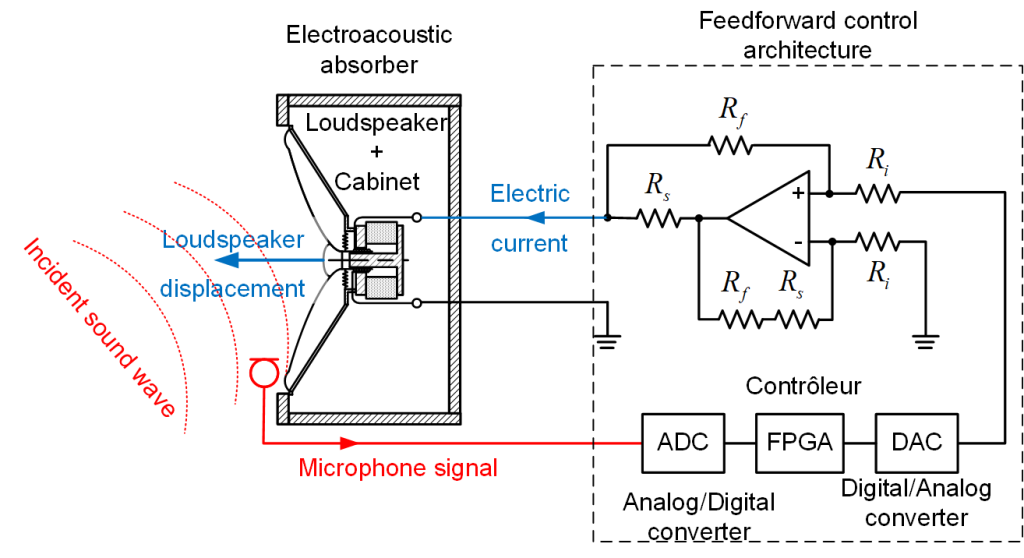
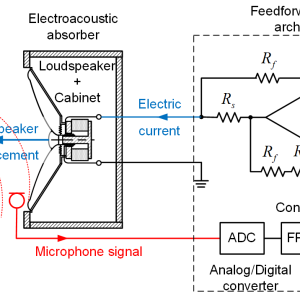
The baseline electroacoustic resonator configuration consists of a loudspeaker enclosed in an air-filled cabinet, a microphone mounted on the front side of the cabinet to estimate the sound pressure applied on the diaphragm, the whole being connected by a control hardware, consisting of a digital signal processing unit (DSP, u-controller, FPGA, etc.) and a power amplifier (preferably a current-driven amplifier).
Schematics of the baseline Electroacoustic resonator
The microphone senses the pressure applied over the loudspeaker membrane, likely to make it vibrate, and feeds the digital signal processing unit. This, in turn, drives the loudspeaker’s electrical terminals in the form of a current, in order to create an opposite force that moves it according to a target response. For example, if we want to absorb the sound energy coming from the incident sound field, we need to impose the membrane vibration velocity be in phase with sound pressure, with a given amplitude. If the ratio between sound pressure and membrane velocity is equal to the so-called characteristic acoustic impedance of the air, the membrane becomes ideally absorbent to sound.
This control strategy is interesting in terms of noise reduction as it is effective particularly at low frequencies (in the range of a few tens of Hertz) where conventional sound absorbing materials are known to be ineffective. This makes the concept particularly attractive, for example, to damp the low-frequency resonances occurring in rooms dedicated to music reproduction (eg. sound recording studios).
Besides room modes damping at low-frequency, the same concept can be adapted to other frequency ranges by scaling the components (especially the loudspeaker). Although conventional passive materials, such as glass wool (porous materials) or perforated panels (Helmholtz resonators), can be more interesting cost-wise, the electroacoustic resonators’ main asset lies in the capacity to adapt to the frequency of the noise. Also, their small size relative to the acoustic wavelength (of the order of 1 m at 500 Hz) makes it an extraordinary asset for noise reduction in environments where size matters.
This is especially the case of aircraft engine noise reduction, where the engine noise comprises a certain number of tonal frequencies (associated to the fan rotation speed), that vary with time and are not addressable with a single acoustic treatment (called acoustic liners in the aircraft industry). With the electroacoustic resonator concept, we have been able to develop a new concept of Active electroacoustic liner in the frame of the H2020-SALUTE project, capable to reduce noise by about 5 dB of individual tonal noises ranging over one frequency octave for different rotation speeds, up to 4 dB on broadband noise, and more impressively up to 25 dB on the low-frequency buzz-saw noise, surpassing any existing passive treatment.
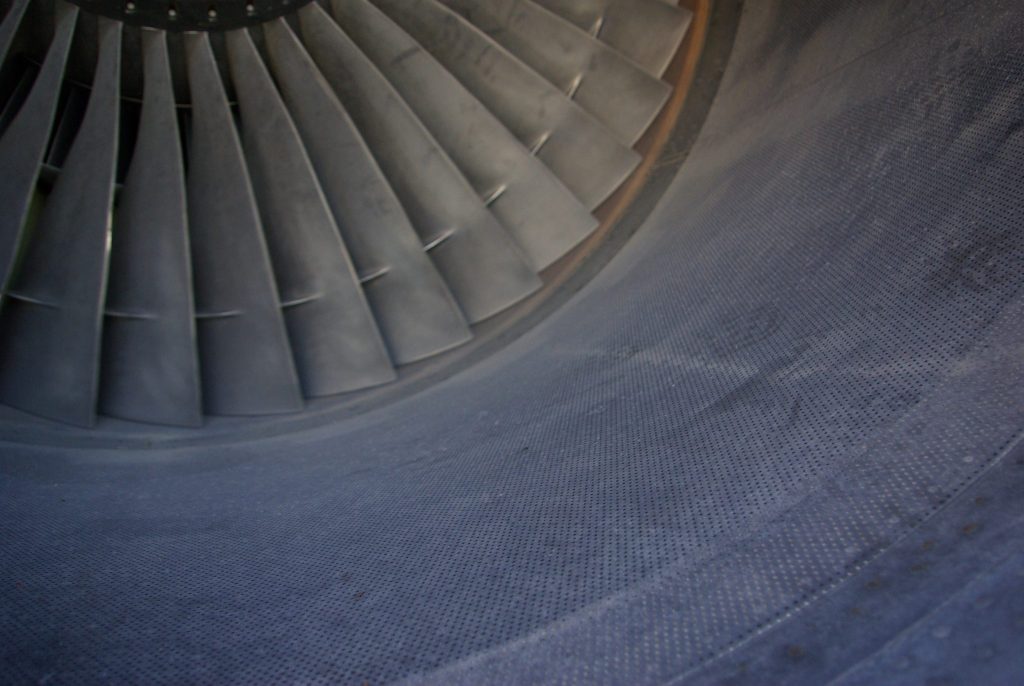
Fan et nacelle d’un moteur General Electric CF-6 d’Airbus A300. L’intérieur de la nacelle est microperforée pour réduire l’intensité du bruit.
Electroacoustic Resonator photo (a) and sketch of the nacelle inlet without front wiremesh and perforated plate (b).
What we are working on
Besides room acoustics and aircraft engine noise reduction applications, the Electroacoustic Resonator concept’s unique performance is a perfect fit for noise reduction and sound control in the low- to middle-frequency range. Examples of applications we are investigating are ventilation and HVAC systems, in-ear hearing devices (hearing aids among others), improvement of partitions and screens in open space offices, etc.
We have likewise moved to applying the same control strategy to a new kind of electroacoustic transducer, the Corona Discharge Transducer, which extends the performance in terms of frequency bandwidth.
List of projects associated with this topic
Funding body
Project
Period
SNSF
Smart Panels with Variable Acoustic Properties (SPA)
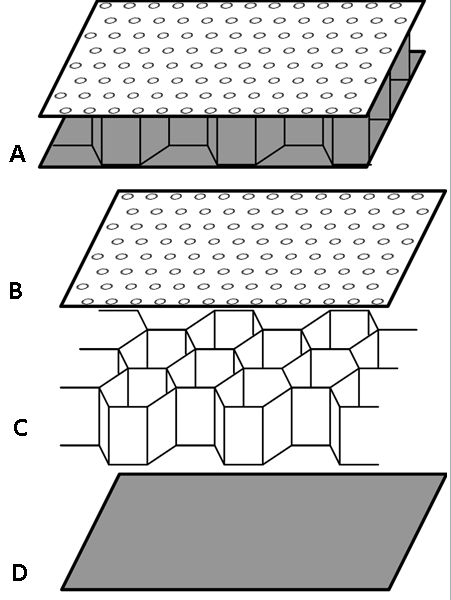
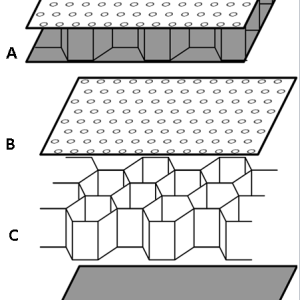
By George William Herbert, modified by Diego Copiello – https://en.wikipedia.org/wiki/Honeycomb_structure#mediaviewer/File:CompositeSandwich.png, CC BY-SA 2.5, https://commons.wikimedia.org/w/index.php?curid=38545220
Fan et nacelle d’un moteur General Electric CF-6 d’Airbus A300. L’intérieur de la nacelle est microperforée pour réduire l’intensité du bruit.
Electroacoustic absorbers are used to damp room modes at low frequencies. Here the laboratory prototype of the Acoustic Group, side by side with the AVAA C20 model of PSI Audio.
By George William Herbert, modified by Diego Copiello – https://en.wikipedia.org/wiki/Honeycomb_structure#mediaviewer/File:CompositeSandwich.png, CC BY-SA 2.5, https://commons.wikimedia.org/w/index.php?curid=38545220Fan et nacelle d’un moteur General Electric CF-6 d’Airbus A300. L’intérieur de la nacelle est microperforée pour réduire l’intensité du bruit.Electroacoustic absorbers are used to damp room modes at low frequencies. Here the laboratory prototype of the Acoustic Group, side by side with the AVAA C20 model of PSI Audio.
2025
The Advection Boundary Law in presence of mean flow and plane wave excitation: Passivity, nonreciprocity and enhanced noise transmission attenuation