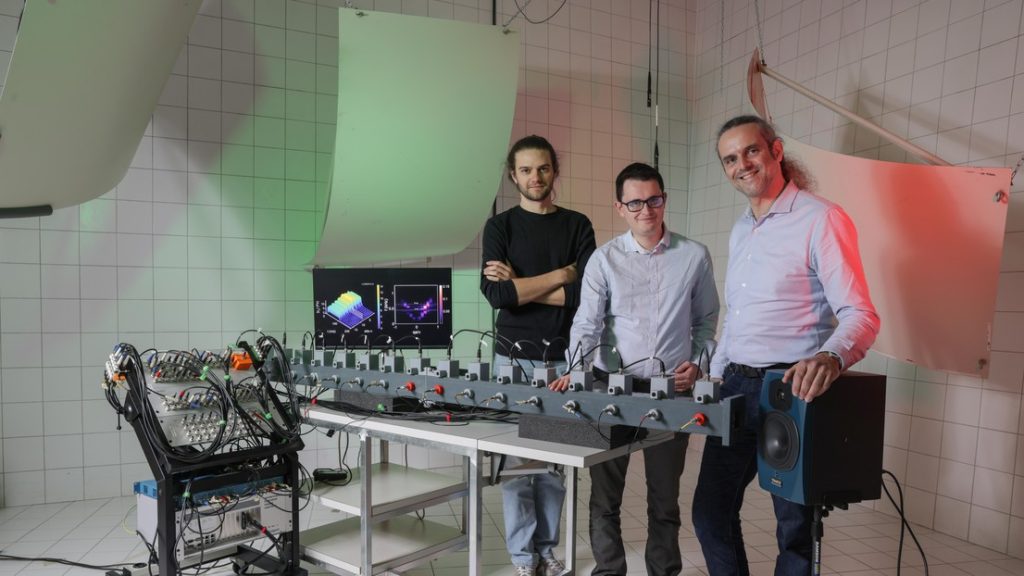
Picture of the Active Metacrystal platform developped by Mathieu Padlewski. Credit: Alain Herzog@EPFL
Introduction
From the Greek μετά – meta, meaning “beyond”, acoustic metamaterials are artificially structured materials designed to exhibit extraordinary acoustic properties not typically found in nature – such as negative bulk modulus (K), negative mass density (ρ), and even negative refractive index (n). These remarkable properties allow sound to be controlled in ways that conventional materials cannot achieve.
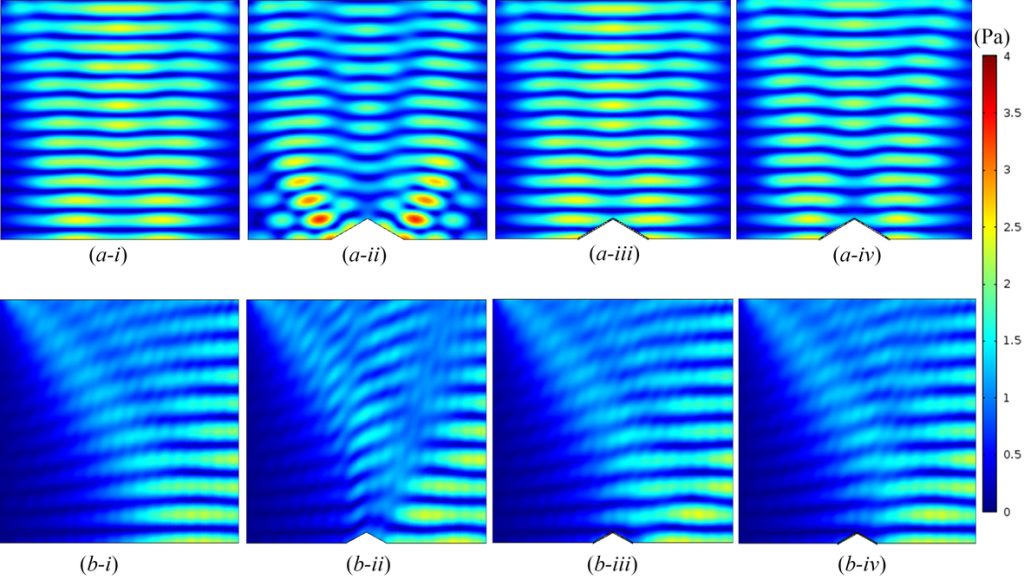
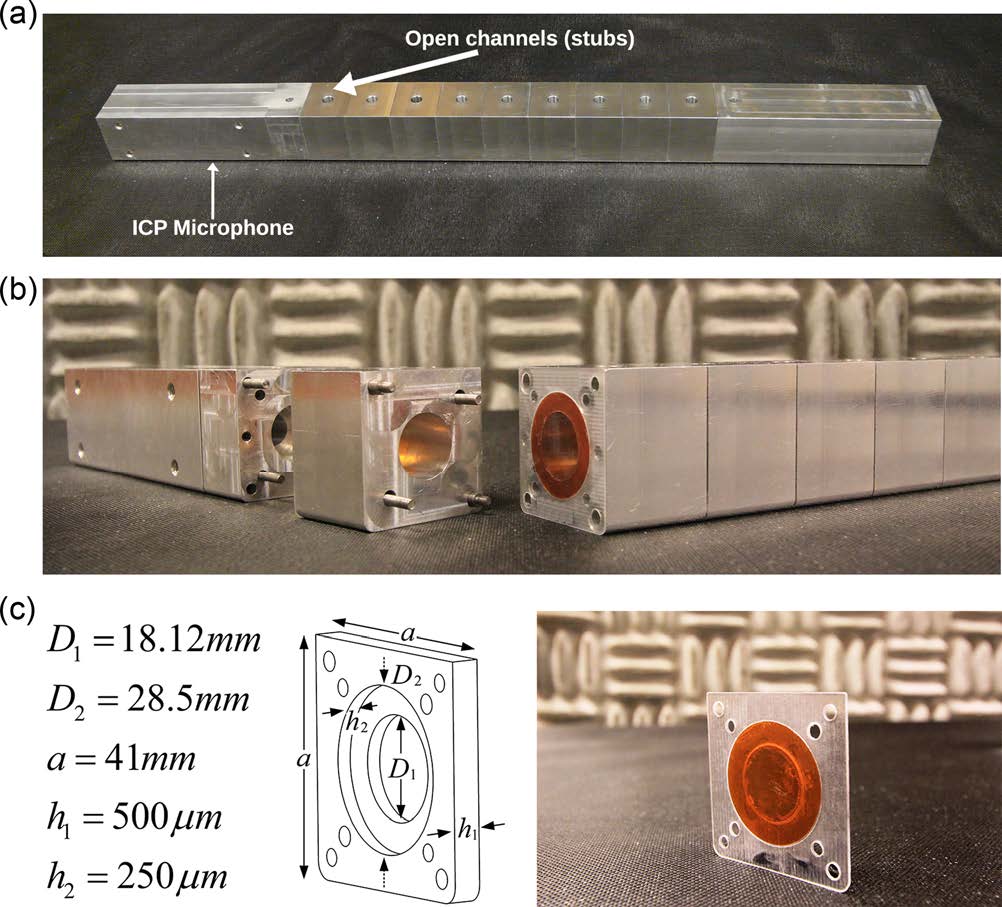
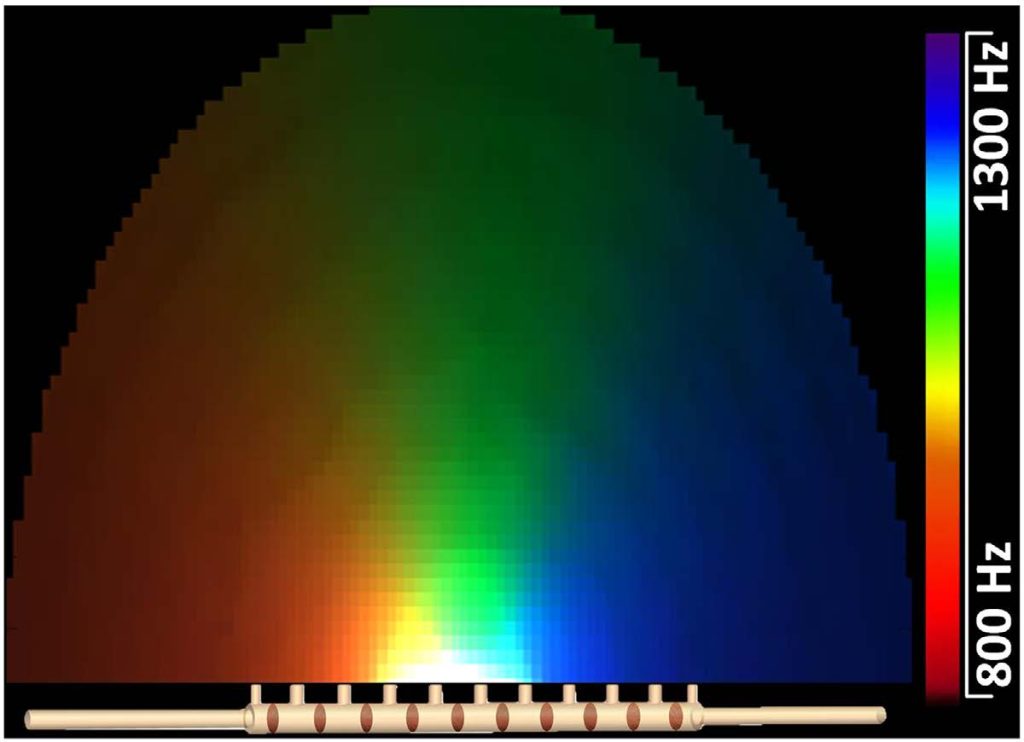
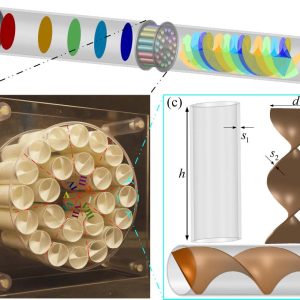
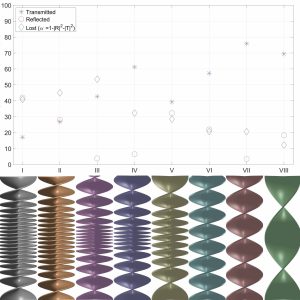
However, traditional (passive) acoustic metamaterials are inherently limited: their behaviour is decided and fixed during the design and fabrication, they often operate only over narrow frequency bands, and they experience significant losses due to resonator-based mechanisms. Because of this, their use is restricted in practical applications like acoustic prisms, carpet cloaks and leaky-wave antenna (see photo gallery below).
Active electroacoustic metamaterials overcome these limitations. By combining acoustic elements with electronic control they can manipulate sound waves in real time. Unlike passive systems, which rely solely on geometry and material properties, active metamaterials integrate sensors, actuators, and digital controllers to dynamically tune their response (similarly to the Active Electroacoustic Resonator concept). This enables advanced wave phenomena such as nonreciprocity, topological insulation, and amplitude-driven confinement, offering promise for a new generation of adaptive and high-performance acoustic devices.
How it works
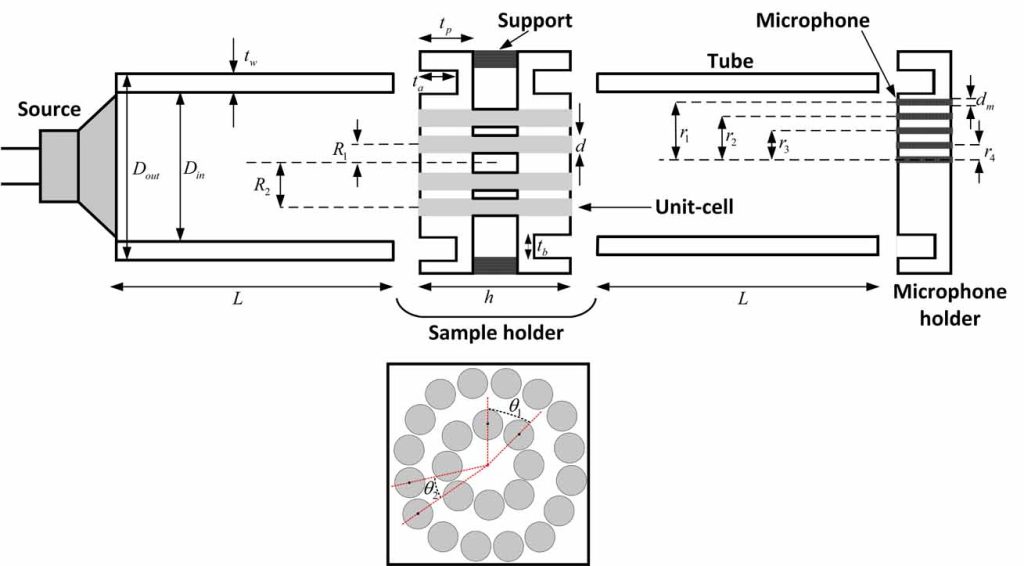
Based on the Active Electroacoustic Resonator concept, each unit cell typically includes a microphone to sense incoming pressure waves, a controller (DSP or FPGA) to compute the desired response, and loudspeaker diaphragm to exert a controlled force. The microphone picks up local sound pressure, the controller calculates the required diaphragm force to shape the local acoustic impedance, and the amplifier drives the diaphragm to absorb, reflect or reroute sound waves as needed.
When arrayed, these components form a feedback loop that allows the metamaterial to behave as a programmable medium. By adjusting parameters like impedance, coupling strength, and nonlinearity, researchers can simulate complex physical models that go beyond the natural realm.
What are the applications
Active electroacoustic metamaterials have broad and impactful applications, especially in room acoustics and noise control engineering. These include noise control through adaptive cancellation and absorption in changing environments; architectural acoustics with real-time tuning of reverberation and reflections; acoustic imaging via beam steering and resolution enhancement; topological acoustics enabling robust sound transport immune to defects; nonreciprocal devices that allow one-way sound transmission for communication and sensing; and energy localisation through amplitude-driven confinement for energy harvesting and wave trapping.
What we are working on
Our recent research focuses on nonlocal and nonlinear coupling between resonators, enabling the study of exotic forms of matter. This includes amplitude-driven topological transitions, demonstrating that increasing the driving amplitude can switch the system between different topological regimes (learn more about amplitude-driven topological confinement of sound, active acoustic Su-Schrieffer-Heeger-Like metamaterials and chiral linearity for topological protection). We also explore non-Hermitian and nonlinear wave manipulation, investigating the interplay of nonlocality, nonlinearity, and non-Hermiticity in classical wave systems (learn more about amplitude-driven nonreciprocity for energy guiding). Additionally, we study cochlear mechanisms, as the cochlea is composed of an array of active hair cells which can be modelled by our system (learn more here).
These innovations are validated through a fully programmable experimental platform capable of dynamically reconfiguring the acoustic response of the system.
List of projects associated with this topic
Funding body
Project
Period
SNSF
Active Nonlinear AcousticMETAsurfaces
2021-2025
Metasurface prototype achieving Orbital Angular Momentum. Illustration on how the metasurface allows spinning acoustic wavefronts.
Setup to assess the Acoustic Metasurface achieving Orbital Angular Momentum (OAM).
Space-coiling labyrinthine acoustic channel used for designing an Acoustic Metasurface with graded transmission phase.
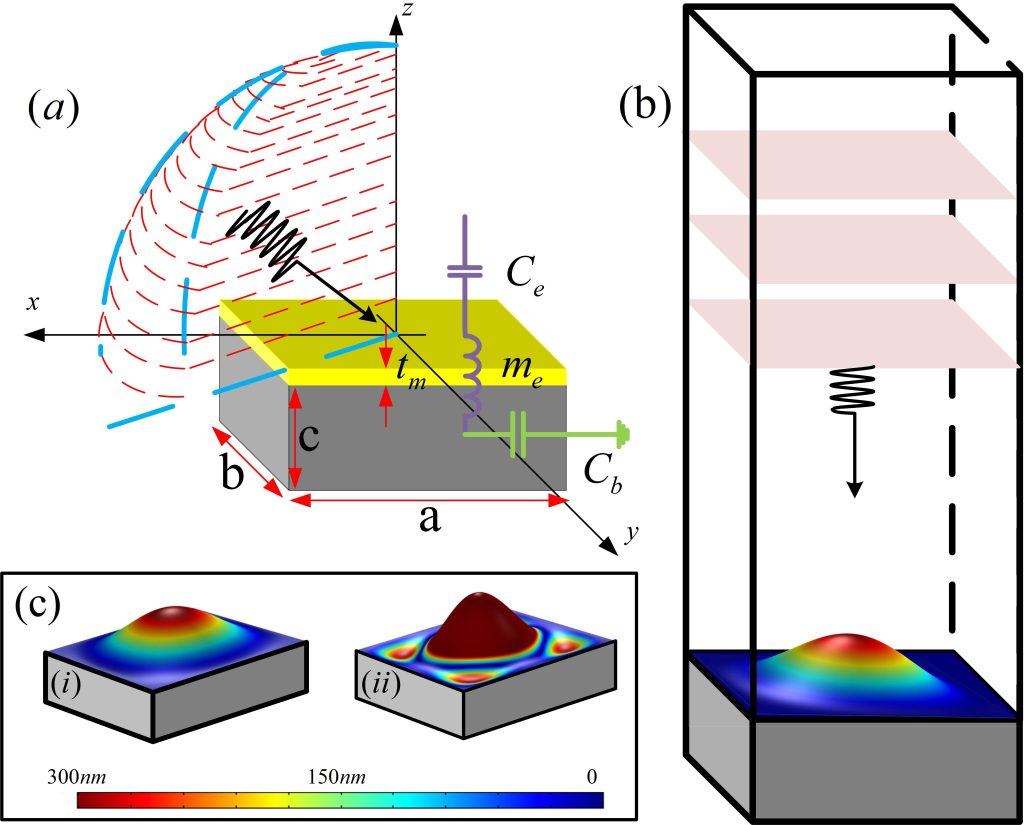
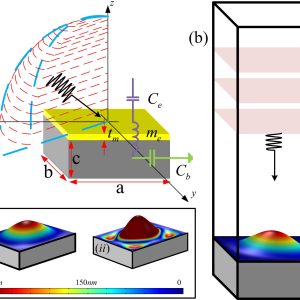
Principle of a metasurface unit-cell composed of membrane-capped small cavities. The membrane thickness allows adjusting the reflection coefficient phases of each unit, to obtain a prescribed grating over the metasurface, eventually breaking the Snell-Descartes law of reflection.
Illustration of the acoustic carpet-cloak, achieved with an ultra-thin metasurface made of an arrangement of membrane-capped small cavities.
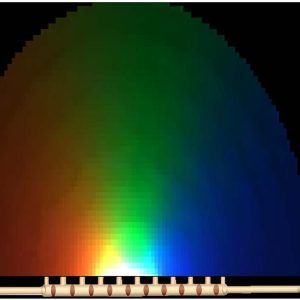
Prototype of an artificial acoustic prism, consisting of a 1D acoustic waveguide loaded by a periodic arrangement of thin plates, and side channels allowing sound to leak out.
Illustration of the acoustic prism effect. A sound source placed at the left extremity of the host waveguide leaks out towards the surrounding medium along frequency-dependent directions.
Artistic illustration of sound waves passing through series of scattering objects, yet being unaffected in amplitude thanks to active elements.
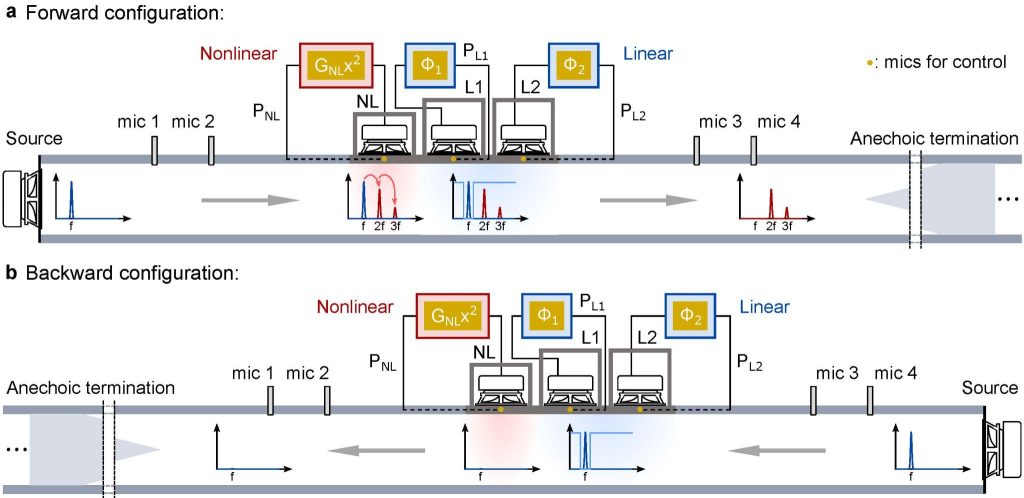
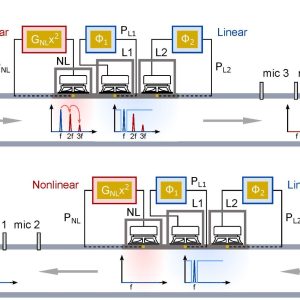
Principle of an acoustic metamaterial achieving non-reciprocal harmonic conversion in real sounds
Metasurface prototype achieving Orbital Angular Momentum. Illustration on how the metasurface allows spinning acoustic wavefronts.Setup to assess the Acoustic Metasurface achieving Orbital Angular Momentum (OAM).Space-coiling labyrinthine acoustic channel used for designing an Acoustic Metasurface with graded transmission phase.Principle of a metasurface unit-cell composed of membrane-capped small cavities. The membrane thickness allows adjusting the reflection coefficient phases of each unit, to obtain a prescribed grating over the metasurface, eventually breaking the Snell-Descartes law of reflection.Illustration of the acoustic carpet-cloak, achieved with an ultra-thin metasurface made of an arrangement of membrane-capped small cavities.Prototype of an artificial acoustic prism, consisting of a 1D acoustic waveguide loaded by a periodic arrangement of thin plates, and side channels allowing sound to leak out.Illustration of the acoustic prism effect. A sound source placed at the left extremity of the host waveguide leaks out towards the surrounding medium along frequency-dependent directions.Artistic illustration of sound waves passing through series of scattering objects, yet being unaffected in amplitude thanks to active elements.Principle of an acoustic metamaterial achieving non-reciprocal harmonic conversion in real sounds
To learn more
2026
Achieving Broadband Directivity Control with Dual Corona Discharge Transducers