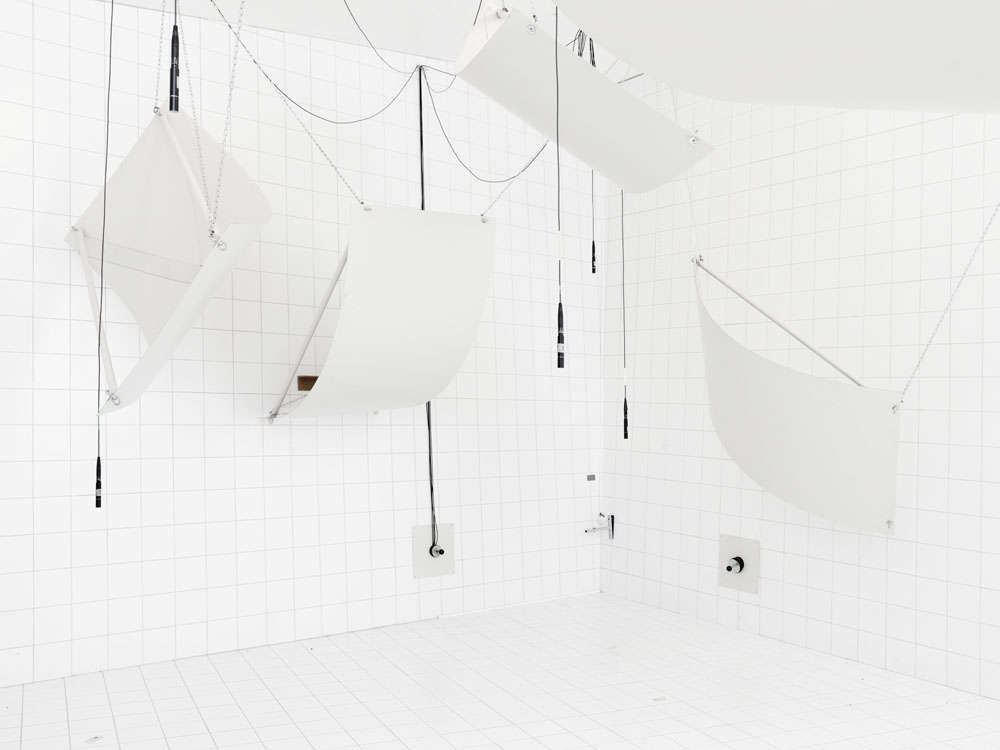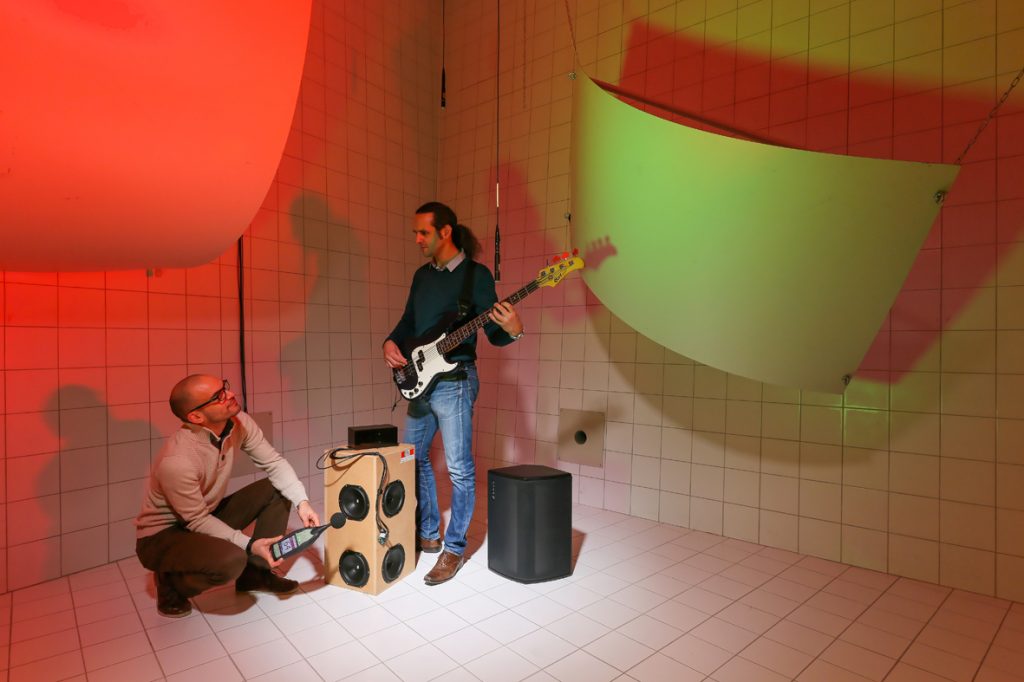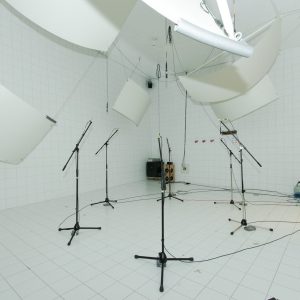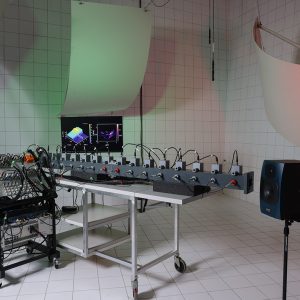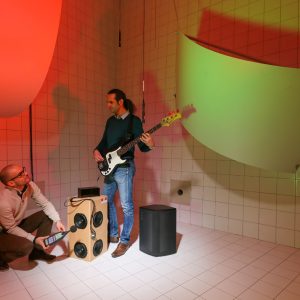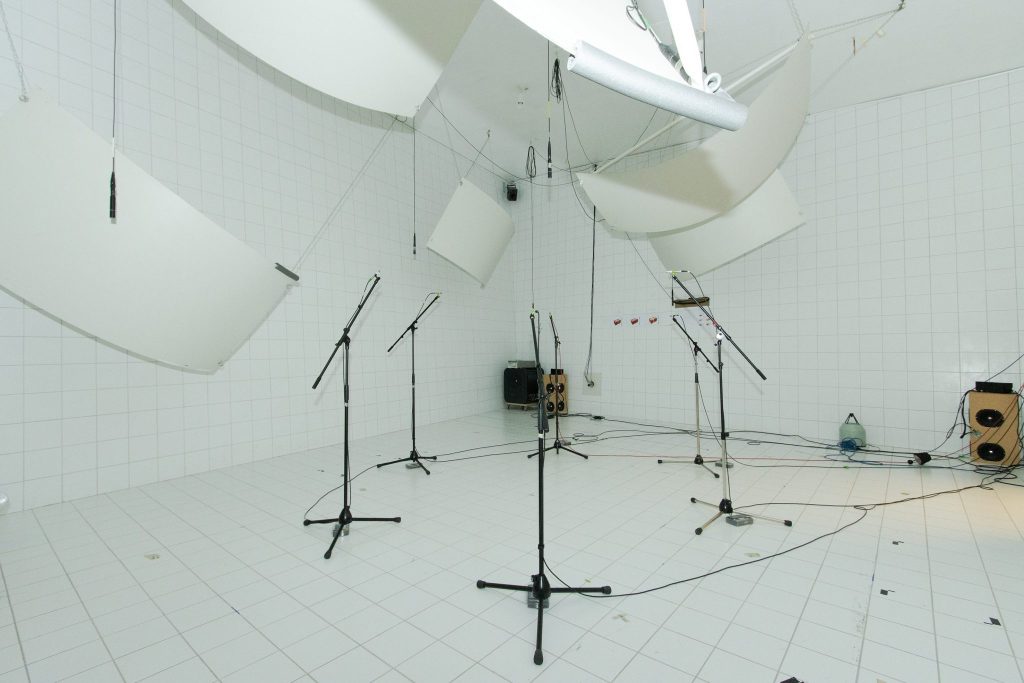
A reverberant room is devoted to the manifestation of “reverberation”. As the room walls are made of perfectly reflecting materials (eg. ceramic tiles here), the sounds emitted inside the room do not encounter any damping (except if some absorbing material is deployed inside the room). If you clap your hands inside this room, this short impulsive sound experiences multiple reflections on walls without decreasing much, thus mixing at any position of the room after consecutive delays (namely the time for the sound event and its multiple reflections to travel in space at the speed of sound to a listener or microphone position). As the time differences are too short, they are not heard as “echoes” but rather merged by the auditory system, as a single, long-lasting, sound event. This sustain of sound is known as “reverberation”.
We also qualify the reverberated sound in such a room as “diffuse”, as it is theoretically identical at any position of the room (statistically, the resulting sound pressure should be exactly the same at any position). This is even exacerbated by the presence of “diffusers”, large reflective panels that are suspended at different positions, in a view to increase the diffusion of sound inside the room.
“Reverberation” is often misnamed “resonance“, but the two phenomena coexist and are somehow distinct. Indeed, resonance is also a physical manifestation of sound in the room, the result of standing waves “captured” between two opposite walls at specific frequencies called “resonance frequencies”. This results in a geometrical distribution of sound pressure inside the room, that clearly opposes to the spatial diffuseness of the reverberation. Moreover, they manifest a certain sustain (similarly to reverberation, but at given resonance frequencies). This effect of resonances in rooms, also referred to as “room modes”, affects sound diffusion at low frequencies, as the long sustain of resonances at those specific resonance frequencies masks the other frequencies. Since no “conventional” material of reasonable size is capable to absorb those low-frequency sounds (owing to the quarter-wavelength rule), we developed the Electroacoustic Resonator concept, unique solution for low-frequency sound absorption in a much compact form factor.