
Numerical simulations of solids undergoing dynamic fragmentation, impact, or complex multibody interactions are characterized by dense, high-speed contacts. Accurately capturing the physics of these systems—such as the transition from an intact solid continuum to a violently interacting debris cloud—poses a severe numerical challenge.
Capturing the true nature of these interactions is notoriously difficult. Traditional penalty-based contact models treat collisions using artificial, compliant springs. In highly dynamic scenarios, this compliance introduces non-physical wave reflections, high-frequency oscillations, and inaccurate energy variation, masking the true physical behavior of the colliding bodies. To accurately study the physical consequences of impact, friction, and multi-body collisions, a stricter enforcement of contact conditions is required.
Our Approach: Rigorous Nonsmooth Contact Dynamics
Rather than approximating contact with artificial stiffness, our research utilizes the rigorous framework of Nonsmooth Contact Dynamics (NSCD). We model impacts and permanent contacts as strict mathematical inequalities (unilateral contact), ensuring bodies do not interpenetrate and that contact forces are physically consistent.
To achieve this in large-scale explicit-dynamics simulations, we use the semi-explicit Nonsmooth Newmark (NSN) time integrator. This hybrid numerical approach enables us to:
-
Resolve Strict Unilateral Contact: Contact constraints and velocity jumps are solved implicitly and exactly upon impact, eliminating numerical chatter introduced by artificial contact springs.
-
Capture Accurate Energy Dissipation: By introducing a contact restitution coefficient, we can control and measure how kinetic energy is dissipated through contact.
-
Maintain Efficiency: The bulk material behavior and wave propagation remain explicit, keeping the computational cost highly competitive for complex multi-body simulations.
Applications and Physical Insights
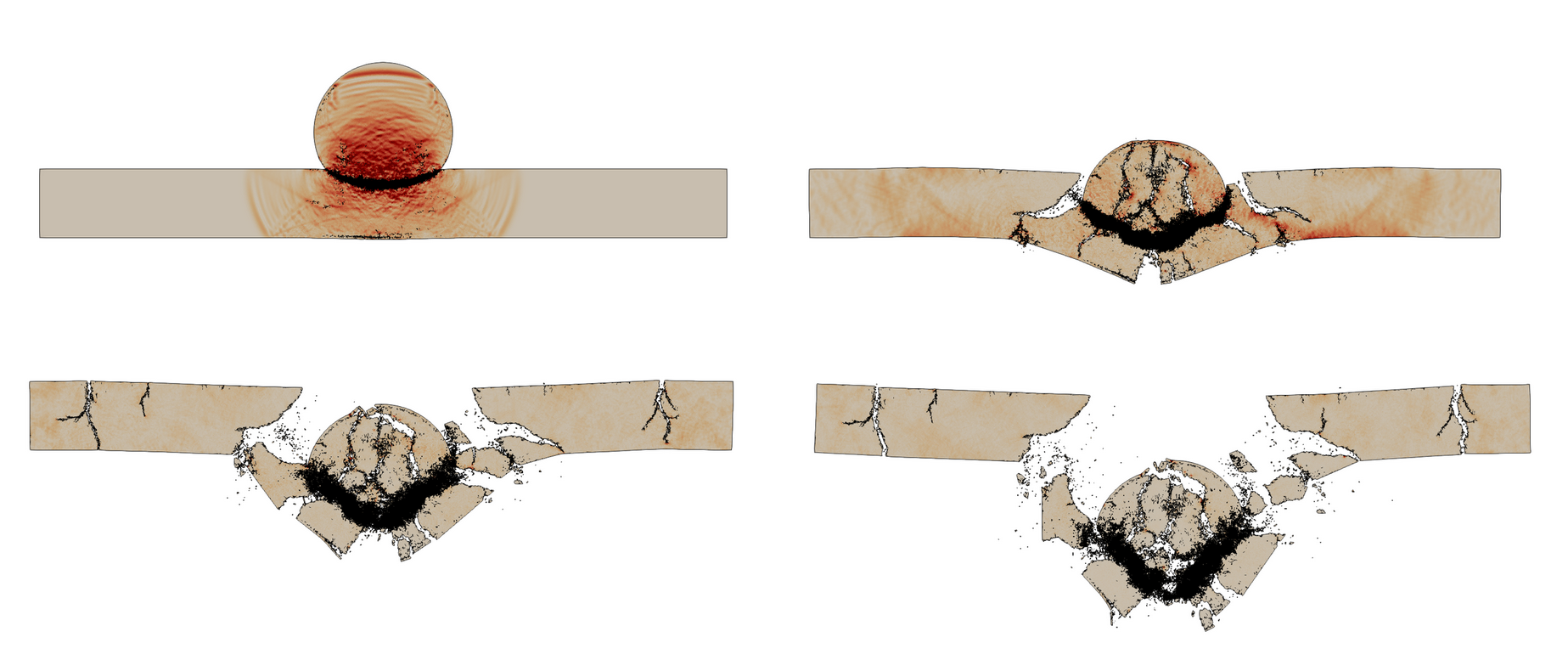
The strict enforcement of contact physics provides a highly stable computational foundation for exploring extreme, collision-rich environments. By eliminating the numerical artifacts and artificial energy fluctuations typical of traditional penalty methods, this framework is fundamentally versatile and easily generalized:
-
Methodological Adaptability: While highly effective when coupled with explicit Finite Element Methods (FEM) and Cohesive Zone Models (CZM), the underlying semi-explicit integrator can be readily applied to Discrete Element Methods (DEM) or other particle-based schemes to eliminate the severe time-step restrictions and instabilities associated with penalty-based contact.
-
Broad Material Scope: The formulation includes a tunable contact energy dissipation and accurately resolves dynamic contact forces across different material behaviors. It handles the transition from an intact solid continuum undergoing brittle and potentially ductile failure to the discrete interactions of a granular medium.
Rather than being limited to a single physical problem, this algorithmic stability unlocks high-fidelity simulations for any explicit-dynamics scenario governed by dense contact networks. Primary applications include high-velocity impact mechanics (tracking ejecta and fragment distributions), the fundamental study of contact dissipation during dynamic fracture, modeling rapid granular flows (such as rockfalls or avalanches), or analyzing complex self-contact in structural crashworthiness.
For additional information, please contact Thibault Ghesquière.