
Granular matter is ubiquitous in nature and industry, accounting for approximately 70% of the materials handled and processed. Its behavior can vary dramatically—acting like a solid, liquid, or gas depending on the circumstances. Therefore, a comprehensive understanding requires insights both at the single particle level (involving tribology and solid mechanics) and at the system level (involving rheology and fluid mechanics).
In collaboration with Bühler AG, this research aims to develop a deeper understanding of the physical mechanisms governing granular matter, moving beyond the empirical approaches that have been used to design food processing machines over the past few decades.
By utilizing parallel DEM (Discrete Element Method) simulations, we can generate data at both the particle and flow scales, providing insights that are difficult to achieve through experiments alone. These simulations also enable rapid exploration of the design parameter space, allowing us to assess how factors like geometry and material properties influence system behavior.
Additionally, we will exploit dimensional analysis and scaling laws to predict average flow behavior, stress intensities, and their fluctuations. These predictive tools could help optimize the design and efficiency of machinery, reducing energy consumption and improving process control in the handling of granular materials.
Shape-Dependent Rheology
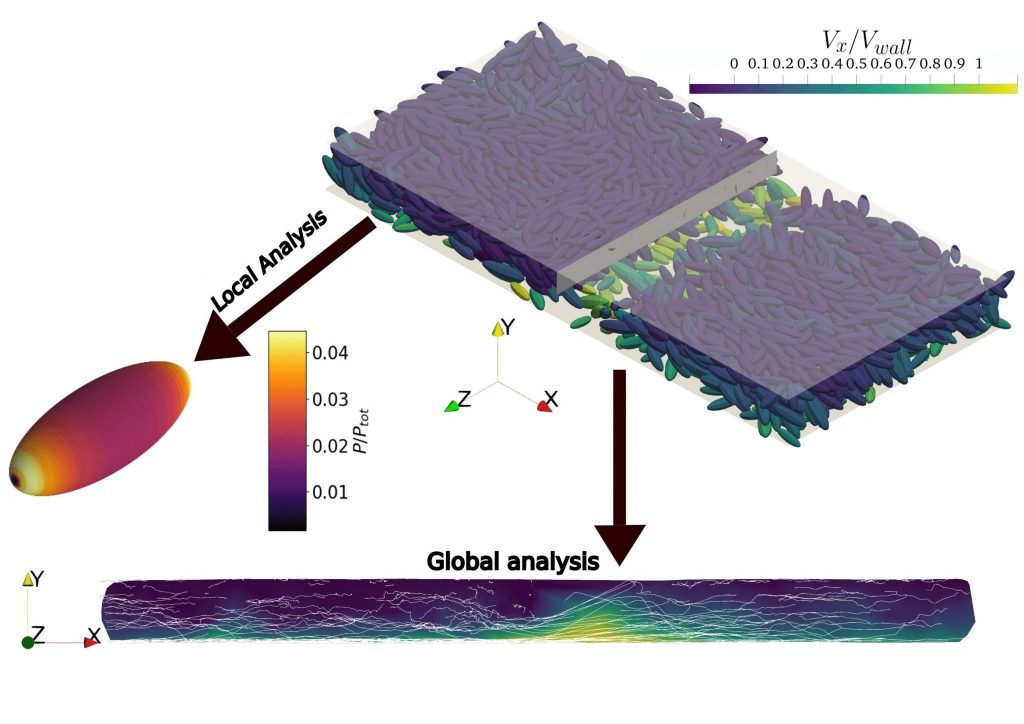
From breakfast cereals to landslides, the flow of granular materials is critical in both daily life and nature. While friction is a well-known factor, our research reveals the profound impact of particle shape, specifically elongation and flattening.
Using computer simulations of 2,000-particle systems, we discovered a key difference between flat, “lentil-like” grains and elongated, “rice-like” ones. Flat particles form larger, more coordinated flowing groups. Lentil-like grains build stronger internal force networks that enhance collective, synchronized movement.
This happens because non-spherical grains tend to align their longest axis with the flow direction. That alignment allows them to slide past each other more efficiently while limiting their individual rotation.
Our simulations also showed that energy loss from friction concentrates in “hot spots” along the aligned particle sides.
This deeper understanding has direct implications: from designing better industrial processes for handling powders and pills to improving geophysical models of soil and debris flows.
Thermodynamic Analogies in Driven Matter
We demonstrated that sheared, low-friction granular rods reach a quasi-equilibrium state quantitatively described by classical liquid crystal theory.
This steric screening state breaks down at high inter-particle friction, which drives a transition to a far-from-equilibrium frictional gearing state where contacts actively promote particle rotation.
We mapped this boundary using a phenomenological effective Ericksen number to define the limits of thermal thermodynamic analogies in driven athermal matter.