
T. Schertenleib, M. Asgari, B. Mouriño, V. V. Karve, T. M. O. Felder, D. Stoian, V. Bon, J. Hao, A. Ortega-Guerrero, E. Oveisi, K. V. Agrawal, B. Smit, S. Kaskel, S. J. L. Billinge, and W. L. Queen, Anisotropic node distortions in amorphous MOFs: Low-valent Zr sites as catalytic hotspots Chem, 102619 (2025) doi: 10.1016/j.chempr.2025.102619
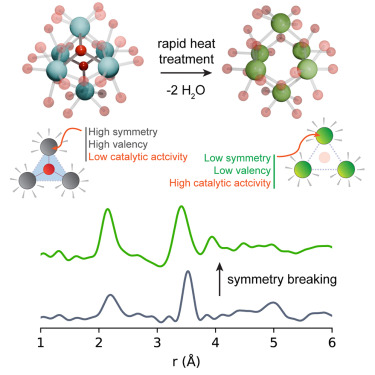
Abstract: We introduce a new approach to defect engineering in Zr-based metal-organic frameworks (Zr-MOFs), aiming to reduce Zr site valency while preserving high node connectivity. Using a rapid heat treatment (RHT) in humid air, oxygen vacancies (O-vacancies) were created in Dresden University of Technology (DUT)-67 through cluster dehydration. Unlike conventional defect engineering, aimed at creating missing-linker defects, this method breaks intra-cluster Zr-μ3O–Zr bonds, generating coordinatively unsaturated Zr (Zrcus) sites. Pair distribution function (PDF) analysis, X-ray absorption spectroscopy (XAS), and density functional theory (DFT) calculations reveal that the O-vacancies lead to symmetry breaking, irreversible node distortions, and framework amorphization. This treatment converts 50% of metal sites to Zrcus sites, nearly doubling the catalytic activity of DUT-67 in glyoxal conversion to glycolic acid. DFT modeling and in situ PDF analysis highlight the dynamic behavior of Zr clusters under reaction conditions, suggesting a new avenue for defect engineering in Zr-MOFs to enhance catalytic performance.