Research Projects
Our research focuses on the understanding of fundamentals of emergent quantum many-body physics. Strong correlations in solid-state systems often make the regular electrons behave differently, and sometimes the resultant quantum states host quasi-particles that are rather immune to local environmental disturbance. These quasi-particles are fundamentally different from electrons or any other fundamental particles. Being fragile, they are elusive and experiments to detect them are much more challenging; yet their understanding may change the way we presently look at advanced technology.
Quantum Hall interferometers as a tool to investigate edge states coupling
(Dr. Ning Ma)
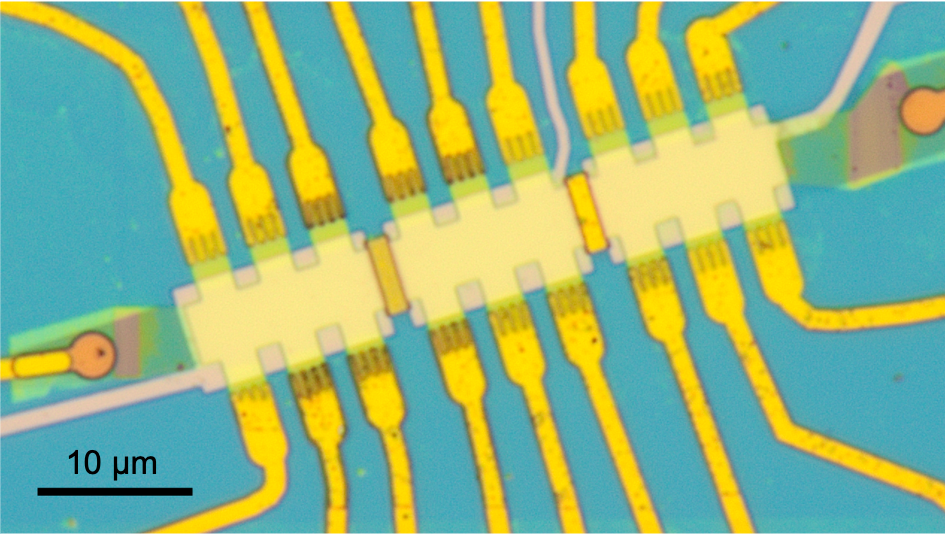
Interferometers based on the one-dimensional quantum Hall edge states have been proved to exhibit fundamental phenomena, i.e., when multiple edges are involved, unusual electron pairing or tripling are characterized by anomalous Aharonov-Bohm interference frequency doubling or tripling. These phenomena are usually related to a combination of edge-edge coupling and edge-bulk coupling. We fabricate highly tunable quantum Hall interferometers in bilayer graphene and study the evolution of the electron pairing by tuning magnetic field and carrier density to control the interaction strength among different edge channels.
Interlayer correlated states in graphene
(Dr. Ning Ma)
Bilayer quantum Hall system is believed as an ideal platform for the investigation of exotic phenomena which are attributed to the interlayer Coulomb interaction and tunneling effect. In terms of graphene systems, two single carbon layers are usually spaced by an atomically thin insulating material, i.e., hBN, which together with the external magnetic field, decide the strength of the inter- and intra-layer coulomb interaction, respectively. Recently, large angle twisted bilayer (or double bilayer) graphene offers a new pathway to study the interlayer correlation physics. The large relative angle results in a mismatch of the Dirac cones in two layers, which suppresses the interlayer tunneling and hybridization. Besides, the ratio of interlayer and intralayer Coulomb interaction can be larger by over one order of magnitude because of the absence of the insulating spacer, which makes interlayer Coulomb interaction dominant. By fabricating high quality large angle twisted double bilayer graphene (TDBG) devices, we are planning to investigate the correlated states induced the strong interlayer Coulomb interaction, i.e., interlayer excitons, and fractional quantum Hall states.
Exotic states in rhombohedral graphene
(Kilian Krötzsch)
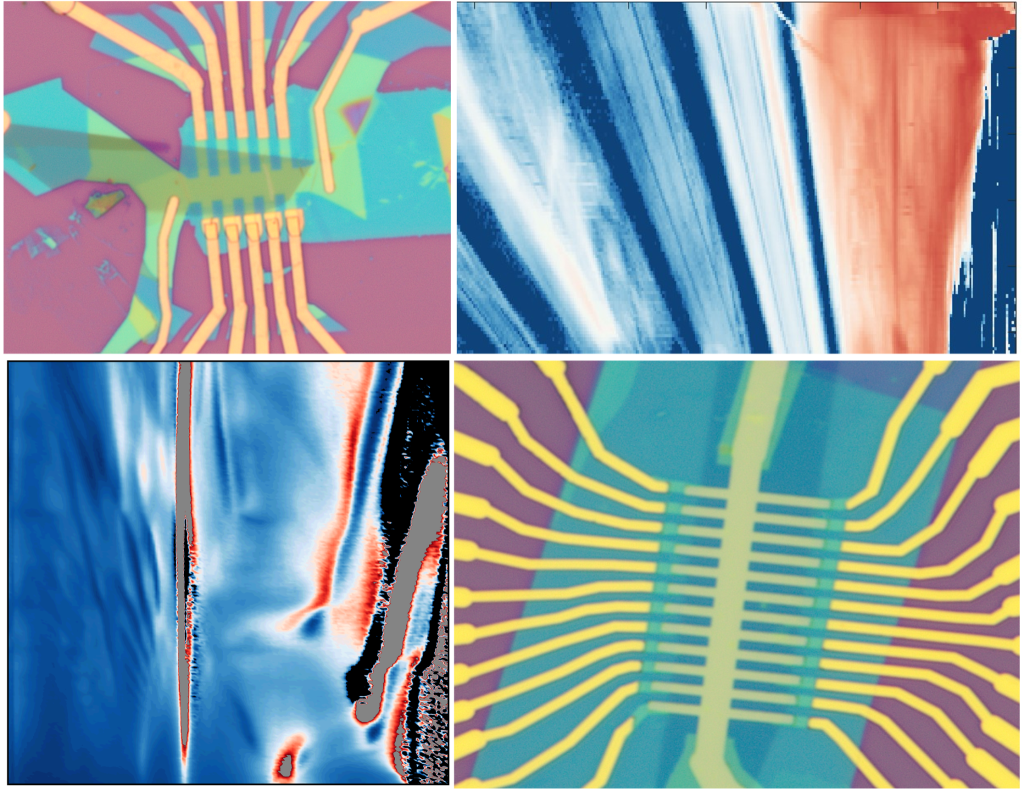
The fabrication of graphene-based 2D material heterostructures can lead to the formation of flat bands in the electronic band structure of graphene, significantly enhancing electron-electron correlations that are normally neglected in the single-particle picture used in condensed matter physics. We perform (magneto-)transport measurements on these systems to study a variety of quantum mechanical phenomena: Phases that belong to the large family of quantum Hall effects, which can arise even in the absence of an external magnetic field. This is exemplified by the quantum anomalous Hall effect and in fractional Chern insulators, which result from spontaneous time reversal symmetry breaking. Furthermore, magnetic ordering, spin-valley polarized phases, and superconductivity have been observed in these systems. The stacking order of few-layer graphene plays a crucial role in the formation of these phases, and its properties can be tuned even further. For example by introducing an additional moiré potential or by adding spin-orbit coupling and superconductivity by proximity effects. Consequently, it is a versatile platform for gaining deeper insight into the physics governing strongly correlated systems at cryogenic temperatures.
Superconductivity in twisted graphene systems
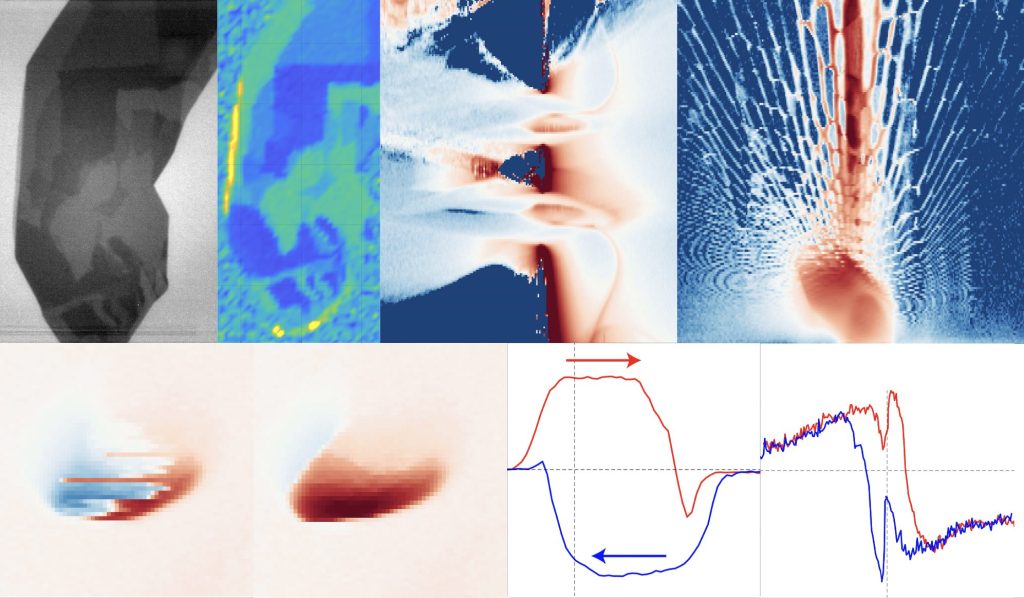
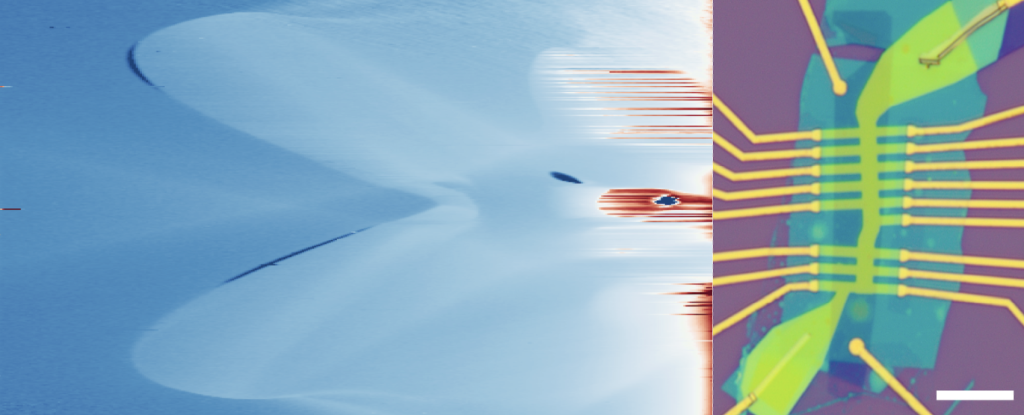
(Dr. Zekang Zhou, Nanyu Yao)

Antidot charge spectroscopy in the fractional quantum Hall effect
(Emily Hajigeorgiou, Mario Di Luca)
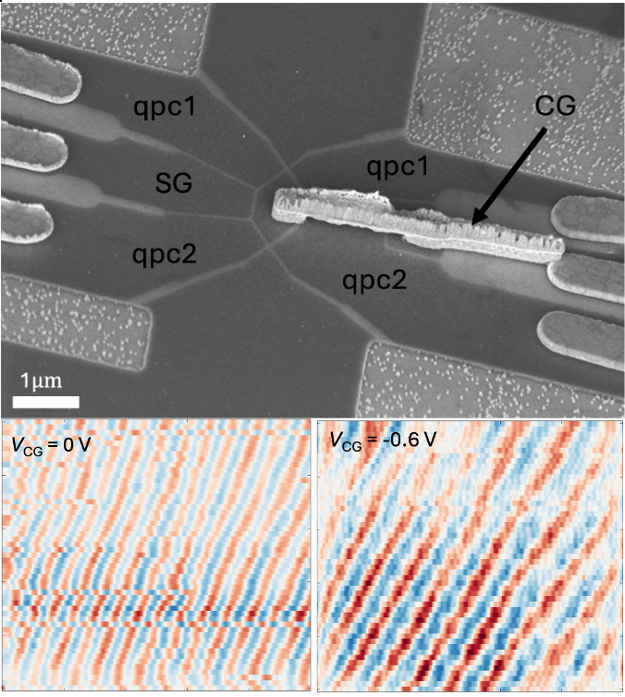
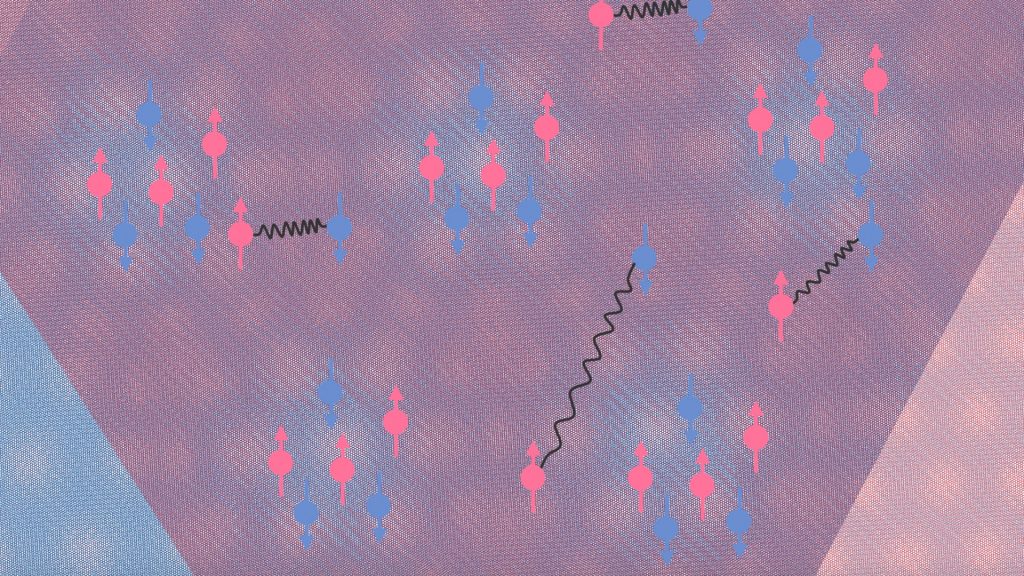
Anyons are fractionally charged quasiparticles that emerge in the fractional quantum Hall effect and are predicted to exhibit exchange statistics fundamentally different from those of ordinary particles. Their ability to be braided around one another makes certain non-Abelian anyons promising building blocks for topological quantum computation, where information could be intrinsically protected against local sources of decoherence. A major experimental challenge, however, is to controllably localize individual anyons and measure their properties. In this project, we use gate-defined quantum Hall antidots in bilayer graphene to trap quasiparticles and determine their fractional charge. The antidot geometry provides a controlled way to localize individual excitations, an essential prerequisite for future braiding experiments, while allowing their charge to be extracted directly from the periodicity of conductance oscillations. This provides an alternative to conventional shot-noise measurements and avoids their stringent requirements on contact quality and device transmission.
Inducing magnetic interaction in graphene via substrate proximity
(Punam Barman)
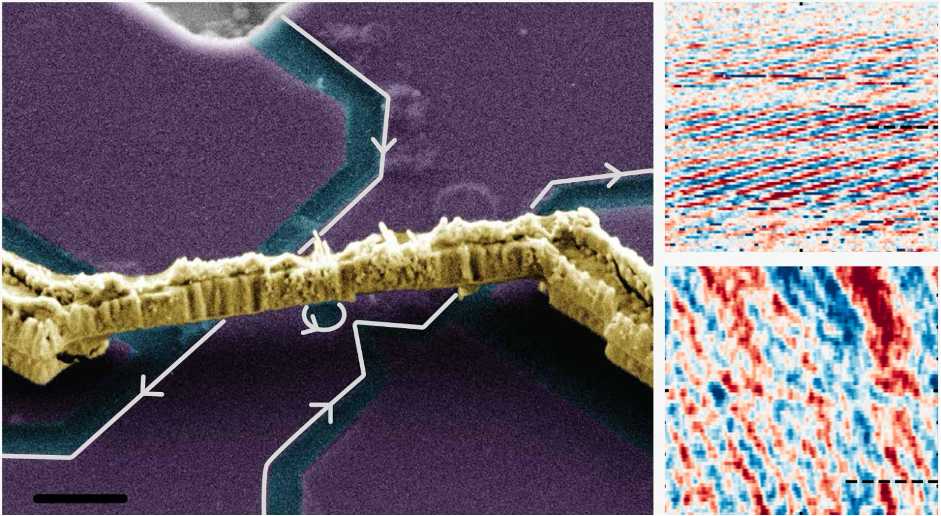
Graphene is prized for its high electronic mobility and tunable electronic structure, but on its own it is neither magnetic nor strongly spin-orbit coupled, two ingredients essential for many topological and spintronic phenomena. Our research explores how these properties can be introduced into graphene from the outside, by placing it in close contact with a magnetic substrate.When graphene is stacked on a magnetic van der Waals material, the substrate’s magnetism and spin-orbit coupling can leak into graphene through proximity effects, without altering graphene’s own atomic structure. This coupling can open a topological gap in graphene’s electronic bands, giving rise to the anomalous Hall effect and, in select systems, topologically protected helical edge states associated with the quantum spin Hall effect. We investigate this approach using the antiferromagnetic van der Waals material CrPS4, which imprints magnetic exchange interaction and spin-orbit coupling onto graphene while largely avoiding the interfacial charge transfer.We are also extending this approach beyond monolayer graphene to multilayer graphene, where the number of layers, stacking order, and interlayer coupling offer further ways to tailor the resulting electronic and magnetic properties. Rhombohedral (ABC-stacked) graphene, in particular, already hosts rich correlated and topological physics on its own, including intrinsic superconductivity and quantum anomalous Hall states. Combining CrPS4-induced magnetism with these correlated multilayer systems is a promising direction for discovering new magnetic and topological phases in graphene-based devices.
Probing fractional quantum Hall states through entropy measurements
(Emily Hajigeorgiou)
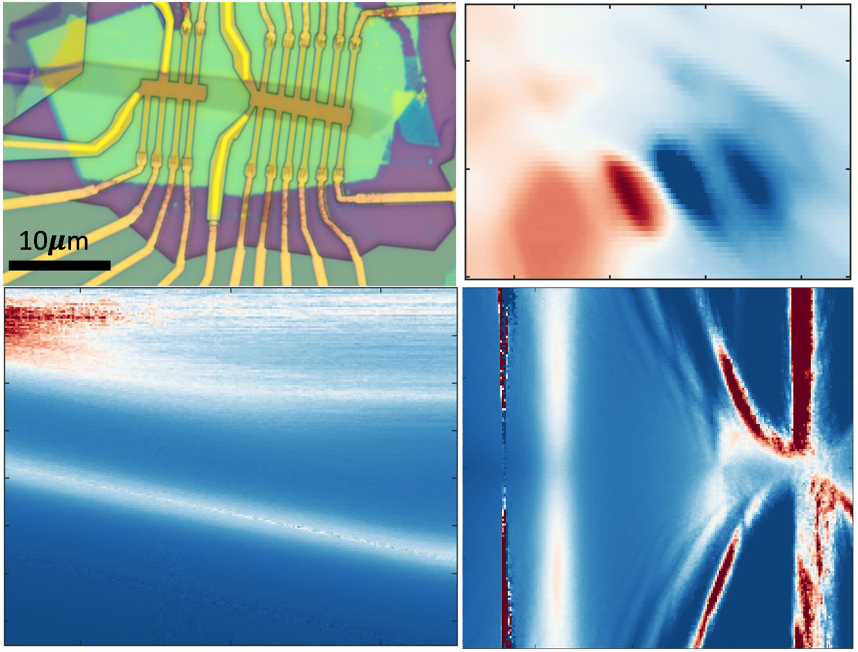
The Fractional Quantum Hall effect provides a powerful platform for studying quasiparticles with fractional charge and exotic exchange statistics, including non-Abelian anyons. Conventional approaches to probing these excitations rely on transport measurements such as electronic interferometry, anyonic colliders, and shot-noise spectroscopy, which provide access to quasiparticle charge and statistical properties. In this project, we combine these transport techniques with a complementary thermodynamic approach based on GaAs quantum dots, focusing on measurements of the entropy associated with localized quasiparticles. Non-Abelian quasiparticles possess additional topological degrees of freedom characterized by a quantum dimension, which gives rise to a characteristic entropy contribution. Measuring this entropy, together with the quasiparticle charge extracted from shot noise, can provide complementary information about the underlying topological order and help distinguish between competing candidate fractional quantum Hall states. By using controlled quasiparticle localization to enable sensitive entropy and charge measurements at cryogenic temperatures, we aim to develop a broader experimental framework for probing Majorana zero modes and more exotic non-Abelian excitations.
Thermal transport in graphene-based devices
(Nanyu Yao)
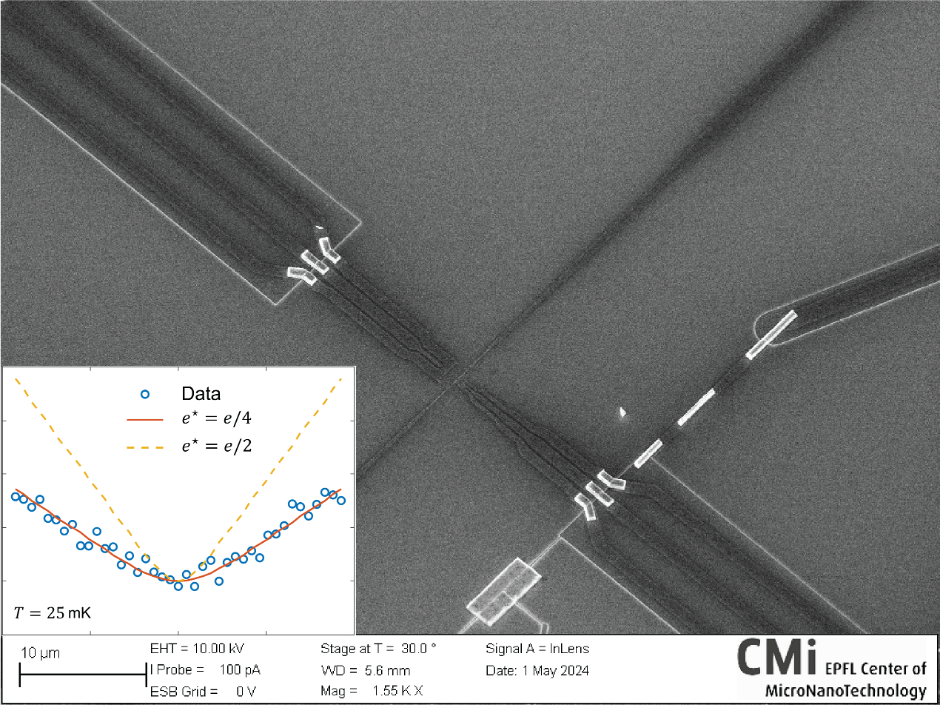
Even-denominator fractional quantum Hall states, most notably the ν=5/2 state, have attracted significant attention because they may host non-Abelian anyons, which can be useful for topological quantum computing. While electrical transport measurements fail to reveal if these states are non-Abelian and the underlying topological order, thermal conductance can resolve this question, as both charged and neutral edge modes carry energy, and each of them contributes one (half, for Majorana modes) thermal conductance quantum. Despite the state-of-the-art thermal conductance measurement techniques developed in GaAs in recent years, all experiments in this system suggest particle-hole Pfaffian, a topological order different from theoretical prediction. Disorder in GaAs devices is believed to account for this discrepancy; therefore bilayer graphene stands out as an ideal platform, not only because mechanically exfoliated graphene flakes encapsulated in hBN are ultra clean, but also because the N=0 and 1 orbital degeneracy in its lowest Landau level allows access to various even-denominator states by tuning carrier density and displacement field.